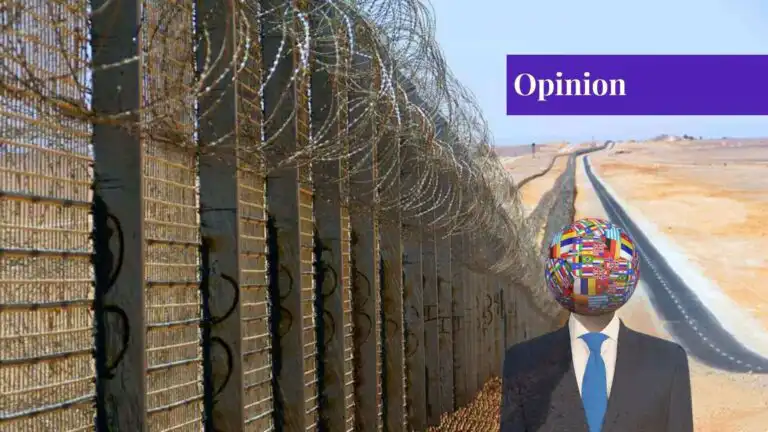
In modern discussions, borders are frequently villainized. They are portrayed as perpetrators of division, violence, inequality, and the displacement of millions. The discourse around borders largely implies that without them, we would not view this world as broken; free movement and access, with no restrictions, could tackle an array of modern world crises. Yet, this reasoning ignores an important, usually neglected reality: the real crisis is not borders, but the loss of political memory. This forgetting alters our understanding of the past and vilifies borders while hiding the more nuanced and complicated manifestations of inequality, conflict, and migration. Moreover, borders may not be the cause, but rather the lesser evil, in a world without a collective memory of political struggles.
The Blame Game: Borders as Scapegoats
In a globalized world, where the fantasy of a borderless utopia can be attractive, borders are easy scapegoats. They are often framed like this: if there were no borders, humanity could rise above its divisions. If we were free to move anywhere, every person could potentially prosper, all people could share equally, and cultural exchange would be plentiful. In this framework, borders are just arbitrary human creations, random lines on a map that separate us with no useful justification.
However, this perspective diminishes and misconstrues the historical and political significance of borders. Borders are not incidental; they have resulted from long histories of wars, treaties, and political decisions. To characterize borders merely as barriers to the free movement of people erases the complicated, often tragic, histories that put them in place. Often, borders are products of colonialism, imperialism, and geopolitics. But to pin modern ills on borders, as primary drivers of the global ills, is to misunderstand their purposes in the maintenance of political order.
Borders are not the cause of the problem; they are an indicator of the political issues that have lingered over many years. By focusing on borders, we distract ourselves from the real cause of today’s political dilemmas: the loss of memory.
Political Amnesia: The Real Crisis
Political memory, the joint remembering of past struggles, treaties, actions, and identities, is the foundation of any political order. It links individual identities, shared histories, and institutions. When political memory fails or is abandoned, we cease to understand our present, and we lose our ability to plan and decide about the future.
It is not the borders themselves that divide people, but rather the collective forgetting of histories that made those borders. Political amnesia is the inability to recall the whole range of histories, power dynamics, and moral trade-offs that gave rise to nations and territories. It is selective amnesia, typically perpetrated by people in power who would prefer to mask inconvenient truths to keep the status quo.
Think about the colonial past of borders in Africa and the Middle East. Many of these borders were established by a European power at a time of colonial expansion, when Europe was “scrambling” for Africa, or when the Ottoman Empire, which was located in the Middle East, collapsed. These regions were defined by hastily drawn boundaries, with no regard for local ethnic, cultural, and historical realities. The consequences of this political amnesia, this denial of colonial history, still shape lives today, often in the form of violence, instability, and mass migration.
Instead of challenging that historical amnesia, however, the focus shifted to the borders themselves. The migration debate often centers on the moral question of keeping people out or letting them in, with little attention placed on the aspects of historical forces that have put in place facets of global inequality and displacement over the course of hundreds of years. In effect, the debate over borders is dissimilitude, a way to avoid having to deal with global dynamics that have been producing conditions of detachment within broader structural dynamics for centuries.
Why Borders Are Necessary
Borders are not necessarily exclusionary or oppressive. In a world where political memory has been erased or cast aside, borders are a mechanism whereby order, identity, and society can be sustained. Borders reflect the political possibilities of the society that inhabits them. They are historical legacies of treaties, conquests, and compromises that seam the modern world together, through time.
To appreciate what borders do, we need to consider the historical trajectory of the modern state. The idea of the nation that is inextricably linked to borders was borne out of the Treaty of Westphalia (1648). The Treaty of Westphalia generated principles that underwrite the modern international order in terms of international relations of territoriality and sovereignty. If we take borders away, there is no political liability, no collective rights, and no way to capture the interests of citizens.
In an era of fractured memory, borders offer a degree of stability. They are the points by which nations and societies identify and define themselves. Without borders, there is no way to sustain the identity of the nation-state, and no clear way to distinguish between competing historical claims or conflicting political interests.
Take, for example, the issue of migration. Helping those fleeing war and persecution is an undeniable moral imperative, but we don’t move forward with the idea of open borders. Borders provide an essential service in maintaining national identity and political stability, which is ultimately vital to maintaining some sort of order and responsibility in the migration process. Without borders, migration becomes chaotic, uncontrollable, and impossible to manage through the complexities of economic, social, and political forces that push people in search of refuge in other states.
The Path Forward: Rebuilding Political Memory
The answer to our current crises is not to get rid of borders but to reconstruct political memory. By recognizing the erased histories that make up our present, we can start to comprehend the actual instances of inequality, migration, and conflict. Reconstructing political memory calls for uncovering the trauma of colonialism, imperialism, and exploitation.
Rebuilding memory also means challenging the selective nature of the historical narratives we remember. Political memory is constructed by those in power who seek to. There are as many histories as there are groups. By engaging with histories, we are able to interrogate the narratives we are told and work towards a more authentic account. Once we can record our histories, we will be able to deal with borders not as an abstract moral issue, but as a political issue that we have to work on with informed, specific solutions.
In this sense, borders are not our enemy: they are a signifier of a political order that, even if not a perfect one, has allowed the development of stable, functioning societies. They do not signify division, but rather, a product of shape-shifting political negotiations and historical processes. In a society where political memory is fragmented, borders serve as an important construct that provides definition and order. In order to move forward past the divisions, we need to first rebuild our collective memory, understand the fields of historical forces that built them, and use that knowledge to influence a more just world, one of interconnectedness.
If you want to submit your articles and/or research papers, please visit the Submissions page.
To stay updated with the latest jobs, CSS news, internships, scholarships, and current affairs articles, join our Community Forum!
The views and opinions expressed in this article/paper are the author’s own and do not necessarily reflect the editorial position of Paradigm Shift.

Momina Areej is currently pursuing an MPhil in Clinical Pharmacy Practice. With a passion for writing, she covers diverse topics including world issues, literature reviews, and poetry, bringing insightful perspectives to each subject. Her writing blends critical analysis with creative expression, reflecting her broad interests and academic background.