

Introduction
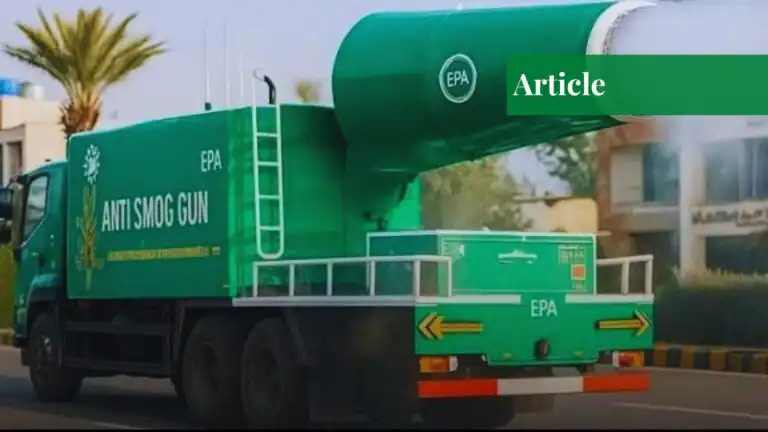
The horrors of last year’s air quality still haunt the citizens of Lahore. The air quality reached 1000+ AQI in November 2024, so even masks were somewhat ineffective. Where the memories of the so-called “green lockdown” were a delight for educational institutions, it was a nightmare for people running to their daily tasks and jobs. However, since the smog season is on its way, the government of Punjab has rolled out the fleets of cannons of mist: anti-smog guns. These locally operationalized water spraying guns have effectively reduced the air pollution by 70% in Kahna, Lahore. But the real question is: are these spraying cannons of hope or just an illusion of relief?
The Dilemma of Hope vs. Illusion
The dichotomy exists where the media is chanting praises for the government of Punjab for launching anti-smog guns in various areas of Lahore, a prodigious response to last year’s trauma. Yet, on Tuesday, 21st October 2025, Lahore was declared the second most polluted city in the world. The problem is not just the hazardous air quality levels, but also our negligence and rhetorical action towards the fight against air pollution.
The Science Behind Anti-smog Guns
Anti-smog guns are designed on the principle of wet scavenging (also known as precipitation scavenging) of airborne particles. Each water gun is attached to a water tank using 16,000 liters of water and is carried around on a vehicle. Water droplets with a diameter of 5-10 µm are sprayed into the air using high-pressure fans or pumps up to 100m in height, colliding with particulate matter (PM2.5 and PM10) in the air, making them heavier and settling onto the ground, reducing the concentration of suspended particles.
Manufacturers, like Cloud Tech, claim high removal efficiencies; some of them even assert claims of removing up to 95% of airborne pollutants by their machines. The system mimics artificial rain and consists of not only mechanical settling but also chemical/interfacial phenomena.
However, there are some key aspects affecting the performance of these mist cannons, including droplet size, coverage and reach, ambient conditions, and chemical interactions. While the mechanism can reduce coarse dust in certain settings, such as construction sites and mining areas, the real-world performance for fine particulate matter (PM 2.5) in open urban atmospheres is less certain and subject to many variables.
The Reality Check: What Studies and Experiments Showed
Drawing lessons from our neighboring states, China and India, it is evident that anti-smog guns are effective only for a short period of time, only where they are sprayed, and in a very specific type of environment. In Delhi, despite hours of spraying, the levels of PM 2.5 had no significant decrease in Anand Vihar (2017) or in New Delhi (2024). Authorities also clearly mentioned that anti-smog guns are only effective in construction sites, not in big urban cities.
Moreover, Chinese studies indicate that PM2.5 actually increased by up to ~13% after deployment of these mist-spraying guns. The study also highlighted water-soluble organic carbon (WSOC) rising 62–70% due to aqueous-phase reactions. This undeniable data proves the fact that anti-smog guns are more “optical” measures rather than effective interventions.
The Underlying Problems and Policy Recommendation
Here is a list of problems linked with these anti-smog guns:
Spraying liters of water droplets in the air does not eliminate the sources of air pollution (coal- and gas-dependent industries, burning of crops, millions of vehicles on the road). The Punjab government should instead focus on controlling emissions and afforestation initiatives. The so-called responsive policy-making in Pakistan needs to be addressed. A more proactive and preemptive approach is necessary to address the challenges of air pollution.
Smog isn’t local; it’s atmospheric. One gun covers merely around 50–70 meters, and the effect lasts barely a few hours. This short-term effect of these spraying mists highlights the habit of prioritizing quick and short-term relief by the policymakers of Pakistan. The people do not need a one- or two-hour relief. The people need a fundamental action towards long-term stability and clean air to breathe, not one detrimental to vital organs.
Another main concern is water wastage. Pakistan is a water-stressed country with the per capita water availability below 1000 cubic meters. However, these mist cannons use 16,000 liters of water every hour, which makes no economic sense in a water-scarce and economically challenged country like Pakistan. A country under 80.5 trillion of debt (as per the State Bank of Pakistan’s 2025 update) cannot afford such luxuries as mist sprays.
Last but not least, Lahore is home to 14.8 million people, and every hour is a rush hour or peak hour in Lahore with millions of vehicles on the road ALL THE TIME. The last thing Lahore needs is more vehicles wandering around in the city. In contrast, these guns could be deployed at specific areas where the air quality index is higher.
However, to address these issues, Shivam Kumar Sah’s (2024) paper proposes an actually good idea of integrating anti-smog guns with cyber-physical systems. This is a data-driven model using IoT sensors and AI to spray water only where PM levels are high. The sensors will send data to the system, and the algorithm determines which fixed anti-smog guns to activate. It could minimize water waste and target pollution sources more efficiently. This system could address inefficiency and resource waste.
Conclusion
Thus, the fight against smog will not be won by spraying water into the sky but by cleaning the ground: industries, fuels, and habits. The coal-dependent industries should reduce emissions, public transport or cleaner fuels should be prioritized, and every citizen should be an environmentalist. Where anti-smog guns can only buy us a few cleaner hours, the fate of cleaner futures is in the hands of every citizen of Pakistan. For that, cities need not just mist but vision, a vision of fighting for the climate cause towards sustainability, not short-term relief. Anti-smog guns are effective, but should not be the only source of addressing smog.
If you want to submit your articles and/or research papers, please visit the Submissions page.
To stay updated with the latest jobs, CSS news, internships, scholarships, and current affairs articles, join our Community Forum!
The views and opinions expressed in this article/paper are the author’s own and do not necessarily reflect the editorial position of Paradigm Shift.

Maheen Nadeem is an international relations graduate who's passionate about human development, policy making, governance, and global politics. She sees it as her duty to advocate for the issue of climate change and spread awareness through her research and analytical skills.