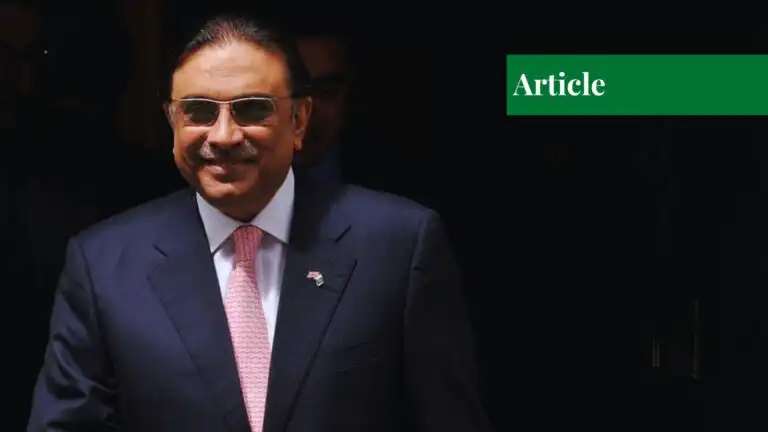

Asif Ali Zardari, an influential, popular, and strict political visionary, is a son of the land of Sindh province. Famous for his political association with the Pakistan People’s Party (PPP), he has been leading the party as its co-chairman since 2007 after his wife Benazir Bhutto’s assassination. Originally belonging to a business background, Zardari held significant economic influence in Sindh even before joining politics. Through his diplomatic insight and business/deal-making style, Zardari has demonstrated his political excellence by adapting to various situational crises with sharp political moves. No matter who his supporters are or not, every friend and foe considered him to be the most senior and experienced politician in Pakistan to date. Let’s delve into his life experiences, from his childhood to becoming the President of Pakistan again in 2024.
History of President Asif Ali Zardari
He was born in 1955 in the Zardari tribe of Nawabshah, Sindh. His father, Hakim Ali, was a landlord and small businessman in Karachi. Agriculture, landowning, and cinema practices were their main businesses. He went to school at St. Patrick’s High School and later studied at a college in Karachi. Due to their close relationships with the Bhutto family, especially between Zardari’s mother and Nusrat Bhutto, it resulted in their political tilt towards the Pakistan People’s Party. His family residence, Zardari House, is situated in Nawabshah, and their ancestral graveyard, Baloo Ja Quba, is where his father and mother are laid to rest. Before his marriage to Benazir Bhutto, the Muslim world’s first female prime minister, he was involved in cinema practices in Karachi, a business owned by his father. He had also pursued polo and boxing during his youth.
Upbringing and Education of Children
Zardari has three children, namely Bakhtawar, Asifa, and Bilawal Bhutto Zardari. As a powerful Sindhi with a cultural and traditional heritage, Zardari offered his children an elite Western education. Oxford, Edinburgh, and University College London are the institutions where Bilawal, Bakhtawar, and Asifa graduated, respectively. Bilawal also served as the chairman of PPP and as the 37th foreign minister of Pakistan. His daughters are also politically active. Therefore, Zardari is an integral part of the politics of Pakistan, with his family having a strong representation in governance.
Entry into Politics – Pakistan Peoples Party (PPP)
In 1987, Zardari got married to the daughter of a former Prime Minister, Zulfiqar Ali Bhutto. This game lured him into the Bhutto family trap that overtook Pakistani politics. The former was a quiet businessman who became the husband of an opposition leader who was serving a jail term. Benazir was sent into exile, and his return to the country transformed him. Zardari had played small tasks behind the scenes when she became the Prime Minister in 1988.
He was in charge of party logistics, and he developed networks in the countryside. It was his introduction to the world of publicity, but he was low-profile. Their relationship was tested immediately. Zardari helped Benazir in her struggles against the regime. This marriage not only elevated him; it plunged him into a dynasty where being loyal was a matter of life and death. By 1990, when her governing administration collapsed, he had mastered the game of politics.
Imprisonment
Following the removal of the first term of Benazir Bhutto in August 1990, the Sharif government ordered his arrest on allegations of corruption, kidnappings, and extortion. Until the second term of Benazir Bhutto, he spent three years in jail. Thereafter, Zardari was once again confronted with great challenges owing to his estranged relationship with his brother-in-law, Murtaza Bhutto. The controversial killing of Murtaza took place in the year 1996, leading to the detention of Asif Ali Zardari. He remained in jail till 2004.
After his release, he went into self-exile in Dubai, distancing himself from Pakistani politics for several years. After the assassination of Benazir, Zardari returned to Pakistan. This time, he became the leader of PPP and started contesting for the national election. His party won the 2008 elections and he became the President of Pakistan. The imprisonment, exile, and political hurdles make him even tougher and stronger. He has often stated in various interviews that while in jail, he used to study and read books and was self-educating and preparing himself for future endeavors.
Political and Tribal Leadership
On 30th December, 2014, as a descendant of his father, he was raised to the status of leader of the Zardari tribe, entitled “Raees Asif Ali Zardari.” The most notable difficulty as a tribal leader was to bring his people together and preserve their customs. His greatest challenge in the post-9/11 era was balancing the civil-military relations regarding his political career. He pursued moderation, supporting the U.S. affiliation but protecting the civil government. The drone operations were quietly conducted in Afghanistan by Zardari, and this met with social criticism.
Osama bin Laden was also arrested during his tenure in 2011. He also seized opportunities despite all these. In 2008, he revived the chief justice, loosening the army’s control. The balance between the civil and military made him a wise choice for a battle. In 2013, Zardari retired, leaving Nawaz Sharif in charge. He remained the chief of PPP and led behind the scenes. Setbacks of the party ensued, but he quietly rebuilt.
14th President of Pakistan
After undergoing a historic comeback of being re-elected as the 14th President of Pakistan on 10 March 2024 through a coalition agreement, after the 2024 general elections, Asif Ali Zardari came back to the history books. He had made an important political progression in returning to the presidency, as his leadership skills and capacity to win allies could be seen. The win made him one of the few leaders in the history of Pakistan to be elected for two non-consecutive terms as president and cemented his role in Pakistani politics.
Trump and Zardari – A Common Comparison
American President Donald Trump and Pakistani President Asif Ali Zardari have many things in common. President Zardari can be considered the “South Asian Trump” if not exaggerated. Following is the list of key convergences between Trump and Zardari:
- Both leaders entered politics as unconventional personalities, with little or no political association. Both, by profession, are businessmen.
- They are controversial personalities with corruption and legal charges. Various scandals and media battles have surrounded their political career.
- Trump and Zardari are known for their political rhetoric against the deep state, judiciary, and mafia, making them ‘political dons’ of their countries.
- They are both known to prioritize deal-making over ideology. As businessmen, both have their own art of deal-making. Bargaining and backroom dealing are key to their political operations.
- Both are pragmatic leaders. They don’t follow rigid doctrines or frameworks. Both are unpredictable, maneuvering, and adapting to the evolving political civil-military environment.
- Their respective parties are historically critical of the deep state. But, through their decision-making, they have always chosen a path of reconciliation with their establishments and bureaucracy.
- Both men are polarizing in nature. They attract strong supporters and strong critics. Despite political attacks and underestimated reputations, both have shown remarkable survival skills. Their political careers reflect resilience under pressure.
Conclusion
Zardari, no doubt, has been defamed by opposition parties and public opponents, but his extraordinary political skills and experience, vision, and cleverness with calmness can’t be ignored. Considered to be the most senior in political circles, President Zardari, in spite of all hurdles, is firmly standing, not only leading his party but also our country. Thus, to entitle him as “South Asian Trump” would not be wrong, as he has that ability and courage not only to lead Pakistan but also a superpower.
If you want to submit your articles and/or research papers, please visit the Submissions page.
To stay updated with the latest jobs, CSS news, internships, scholarships, and current affairs articles, join our Community Forum!
The views and opinions expressed in this article/paper are the author’s own and do not necessarily reflect the editorial position of Paradigm Shift.

He is pursuing a BS in International Relations programme from International Islamic University, Islamabad and has a keen interest in research works, policy analysis, defence and strategic studies and conflict resolution.