
The world of terrorism in the twenty-first century is changing its face fundamentally, not only because of the change of ideologies but because of a radical change in generation and cultural restructuring. Far-right extremism that at some time was linked to strict hierarchies, more mature activists, and well-defined political agendas, has over time been directly adopted as a youth-based one and is now entrenched in online subcultures. Atomwaffen Division and Atomwaffen Division No Lives Matter are examples of such groups that are horrifyingly clear in their development. These movements, developed out of forums, gaming platforms, meme cultures, and encrypted messaging apps, exemplify how digital space has taken over the common meeting grounds, enabling extremist ideas to propagate at high speeds, anonymously, and across nations.
To most teenagers struggling to find their identity in the face of political polarisation, social alienation, and economic uncertainty, these online biospheres provide a seductive feeling of belonging, rebellion, and meaning. The fact that such radicals are young is not the only difference between this new generation of extremists, but the aestheticisation and gamification of ideology.
Violence has ceased to be an instrument of strategic politics; it has been made into content -memes, videotapes, manifestos, acts of symbolism to be passed among online users, which are ironised and stylised. The meaning of accelerationist storytelling is destroyed, and the culture of saints mythologises the perpetrators and transforms mass violence into a kind of cultural capital among extremist groups. Consequently, terrorism is becoming closer to a subculture act, but not a traditional insurgency.
To comprehend Atomwaffen and No Lives Matter, then, it is essential to go beyond established security paradigms and consider the intersection of youth culture, digital media, and identity crises to create a unique and contemporary manifestation of neo-Nazi terrorism and the rise of a new generation of terrorism.
The Rise of Atomwaffen and No Lives Matter
Understanding the Rise of Youth Centre Neo-Nazi Terror
The 2010s saw a global resurgence of far-right extremist movements, which have moved from fringe cells to more prominent, networked societies. While loosely organised neo-Nazi groups and accelerating factions embraced decentralised, “leaderless resistance” tactics, social discontent, economic insecurity, and nationalist-populist political surges all contributed to this comeback. These organisations used symbolic acts, particularly those sparked by events such as the riots at the U.S. Capitol and other mass-casualty attacks, to foster mobilisation and mythologise former assailants as “saints.” For example, FBI data reveals a dramatic increase in domestic-terrorism-related cases in nations like the United States of America, from approximately 1,890 by 2017, to more than 9,000 in 2021. The following are also some major factors.

Influence of Political Polarisation and Digital Communication on Youth Identity
Over the course of the decade, political polarisation grew more intense, resulting in binary ideological zones where extremism was largely reinforced by internet media. Extremist content was boosted by social media algorithms, particularly on sites like TikTok and Telegram. Over time, these ideological echo chambers normalised extreme discourse. The “alt-right pipeline,” in which young brains are gradually exposed to extreme content from jokes to harsh rhetoric, leads them to dehumanise out-groups, proving especially dangerous for young people who were already navigating identity formation.
Extremist Groups Increasingly Target Disaffected, Alienated Youth
Extremist groups deliberately target young people who lack purpose or feel socially isolated. According to psychological studies, a number of criteria make young people more vulnerable, including a search for purpose, a propensity for excitement, a lack of social obligations, and an openness to radical preaching. Moreover, recruiters take advantage of weaknesses such as identity confusion, familial pain, or community alienation using commitment and identification to entice people further into extremist power.
Digital Culture as an Incubator of Radicalisation
The role of online spaces like 4chan, Discord, Telegram, Omegle, and TikTok 4chan is known for its nasty content and lack of moderation. It was a major factor in the radicalization of young people, as tragically demonstrated by the radicalization of Buffalo shooter Payton Gendron, who frequently visited boards. Discord, which was initially created for gamers, has been used by extremist organisations for ideology sharing, plotting, and radicalization. In one instance, a private server fostered accelerationist language and visions of actual violence, while in another, Charlottesville organisers utilised Discord to plan their event. Telegram is popular among far-right organisations and Neo-Nazis due to its encrypted discussions, making it a preferred site for extremist recruitment, propaganda, plotting, and exchange of radical manifestos.
TikTok’s “For You Page” algorithm can expose users to more extreme information more quickly. This has been used by extremist groups to avoid moderation by enclosing films with memes. In other platforms like Omegle and Roblox, etc, users may be exposed to more extremist information more quickly because of their “For You Page” technology. Extremist organisations have utilised this to evade moderation by encapsulating films with memes. Although not extensively researched, sites such as Roblox and random webcam chat services have been used on occasion to expose or groom young people to extremist views.
The following are the tactics gaining popularity.
Memes as Recruiting Tools
Extremist organisations use meme culture to disseminate their beliefs under the pretence of humour. Memes such as Pepe the Frog are used as insider signals and ideological shorthand in alt-right communities.
Disguising extremist messages as jokes, sarcasm, and edgy humour makes intent unclear and makes it simpler for regulating bodies to ignore them. Recruiting Via “trolling raids,” memesharing, and enhanced content that normalises hate, platforms like Discord, Telegram, and even gaming forums that were initially designed for play are being used for extremist indoctrination. Extremist content is quickly adopted and disseminated across platforms by fringe communities, which have a significant impact on mainstream meme culture.
Emergence of Terrorgram
A dispersed collection of neo-fascist telegram groups associated with organisations such as Atomwaffen Brigade and The Base that advocate the ideology of accelerationism and brutality. Terrorgram creates “terrorwave” art using a unique visual aesthetic that includes Vapor wave, trendy neon graphics, skull skulls, occult symbols, and esoteric images. It uses stylised propaganda to exalt violence and martyrdom. These websites frequently distribute assault instructions, manuals, guides, target lists, and the idea of “Saints culture,” which portrays terrorists as heroes or martyrs. Terrorgram now publishes periodicals and online materials, such as current tactical manuals, that provide information on how to make explosives and conduct assaults.
Appealing to Youth
Teenagers are drawn to thrills, humour, and identity. Terrorgram channels produce in-groups united by similar aesthetics and ideologies. This gives young people who are feeling alone or alienated a sense of exclusivity and purpose. Particularly among thrill-seeking teenagers, the thematic framing of abuse as heroic and the flamboyant, stylised aesthetic arouses interest and excitement. Extremist content is gamified by using memes, self-serving codes, and “saintly” glorifying, which parodies conventions while luring participation. Irony and dark humour mask seriousness, allowing young users to minimize or justify extremist information as rebellious or edgy entertainment.
The Case of Attomwaffen Division’s Rise
Cultivating Violence Through Subculture Identity
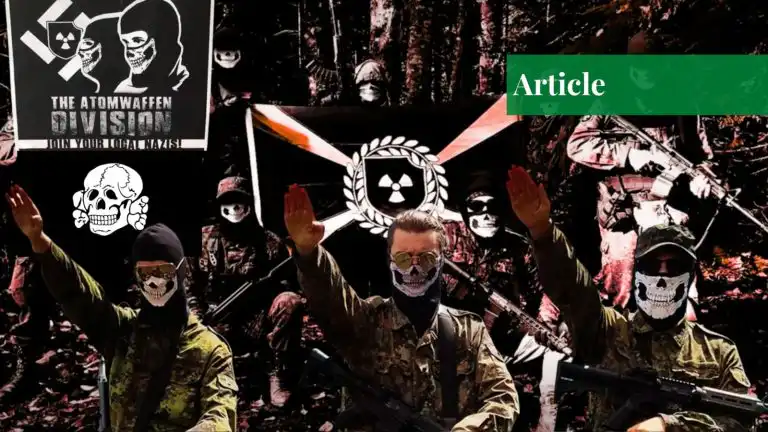
Brandon Clint Russell established the Atomwaffen Division (AWD), commonly referred to as the National Socialist Resistance Front, in 2015. On the Neo-Nazi online community Iron March, he declared its foundation. AWD’s ideology is heavily influenced by accelerationist and Neo-Nazi ideas. Charles Manson, Joseph Tommasi, William Luther Pierce (The Turner Diaries), and James Mason (author of Siege) are important ideological influencers. To create a white ethnostate, the group supports violent disruption. One influential ideological mentor was James Mason, whose Siege Culture became a focal point of propaganda. John Cameron Denton oversaw operations after Brandon Russell commanded until his detention and incarceration.
Recruitment Strategies
With a strong focus on weapons instruction and paramilitary identity, AWD specifically trained young, white, male recruits, frequently through gaming groups, internet forums, and college campuses. The group extolled the virtues of military activity and discipline. To establish a macho, action-oriented character, they exploited images of weapons and violence and set up “hate camps” for training exercises. AWD adopted an accelerationist viewpoint, holding that the only way to bring about their ideal ethnostate would be through violent social breakdown. Disillusioned young people who are looking for meaning via destruction are drawn to this ideology.
Digital Propaganda
Digital propaganda includes visual terror campaigns, manifestos, and video montages. Visual Propaganda, usually accompanied by techno and dramatic music, AWD created and distributed videos that showed burning flags or constitutions, members in masks marching and firing in forests, and weapons training. The organisation kept up a covert online presence, with websites, dark web portals, or channels displaying their propaganda, which included Hitler’s Mein Kampf, Siege Culture, and other movies and articles. In keeping with their signature approach, AWD disseminated scary, staged messages, such as their “Fission” film, which showed young people in armed wilderness scenes wearing camouflage and masks.
Subcultural Rituals and Shared Codes
Youth Members’ shared codes and subcultures rituals shared an esoteric identity. Their veneration for radical leaders is the source of rituals, common codes, and “saint” martyr cults. Community ties were formed through reading Siege, embracing its and donning group-specific insignia. To maintain unity, AWD used anti-establishment practices (such as training camps and coordinated internet pledges) and common symbols in their decentralized but enclosed “cells.” Through inside messaging (“rats and traitors receive the rope first”), lingo, and ritualistic pledging or mocking, encrypted chatrooms din Discord or other platforms reinforced belonging.
The Case of No Lives Matter Division
Another Terror Group on the Rise
The Com/764 network, a decentralized, radical area that was formerly associated with these organizations similar to Atomwaffen, gave rise to No Lives Matter (NLM). It shifted from engaging in child sex exploitation to encouraging violence and terror in the real world. Operating mostly via encrypted platforms like Discord and Telegram, NLM blurs the boundaries between networks like Atomwaffen, along with The Base, and distributes content with other extremist organizations like the Terrorgram Collective.
Recruitment Strategies
NLM uses “clout chasing” to recruit young misanthropes, who are frequently attracted to it by status in chaotic subcultures, dark humor, and blackpill memes. Brutal activities such as physical attacks, animal cruelty, or self-harm are part of membership rites and are meant to demonstrate dedication. Members sought “deep bloody cuts” instead of “simple cut-signs” for entry in one message.
Visual Sensationalism
To desensitize and draw in people drawn to taboo or gore, NLM and its affiliates use shock value, which involves disseminating violent movies, stabbing footage, and kill guides with icy detachment. Violent information is repackaged as entertainment and personal branding by using flashy colour schemes, memes, and other internet aesthetic themes. NLM sees violence as a performance and an aim in itself rather than a political act. Beyond the excitement of fame and devastation, there is no ideological strategy. The thought of being the cause of humanity’s demise appeals to participants; violent acts are presented as inevitable, exalted, and personally significant to those who are nihilistically disillusioned.
Between Memes and Mass Violence: Escalation, New Threats, and the Rise of a Digital Terrorist Generation
The current increase in terrorist activity not only demonstrates that incidents of terrorism have grown, but also shows that there is a structural change in the manner terrorism is manufactured, transmitted, and reinforce,d particularly among digitally native youth who are radicalised by online ecosystems as opposed to traditional hierarchical organisations. Modern extremist violence is becoming more of an actor who is initially exposed to radical ideas through an algorithm and meme culture and subcultural identity formation than through physical recruitment. Examples of this new threat environment include groups like the Atomwaffen Division, or No Lives Matter; these groups do not function as a traditional terrorist organisation, but as an ideological ecosystem that cultivates violence by reinforcing the idea that chaos is glorious, that notoriety is rewarded, and that violence is a means of making a cultural statement instead of being a strategy. This change is evidenced in recent months with the government reporting a rise in extremist actions and arrests of affiliations to far-right organizations.
In coordinated raids carried out in Spain and the EU in December 2025, European police disrupted the activity of the neo-Nazi organization The Base, confiscating weapons and extremist materials, which demonstrates the ongoing transnational nature of the threat of decentralised accelerationist cells, as per Europol.
In Australia, at the end of December 2025, an 18-year-old was prosecuted after demonstrating Nazi salutes and spreading extremist propaganda in the streets, which illustrates the concept of digital radicalisation transferred into the real-life hate crimes that, in turn, precondition the occurrence of more serious offenses.
These trends highlight how the increased amount of youth-related plots, copycat attacks, and web networks glorifying the perpetrators prove that terrorism has been accelerated, decentralised, and made difficult to stop as inspiration is spread through memes and not orders. Compared to previous terrorism waves, which were based on discipline, hierarchy, and long-term political goals, this one lives on nihilism, irony, and spectacle, in which violence is an initiation and a performance, and attention is the key currency itself. This change is a decisive intensification. It is not only that terrorism is organised in cells, but it has become an aspect of youth digital culture, which creates a new generation of threats that are unpredictable, hugely networked, and culturally normalised before any display of actual violence in the real world.
Conclusion
The emergence of the Atomwaffen Division and the No Lives Matter is an indication of a new generation and a new wave of terrorism, where extremist violence is entrenched in digital culture, youth subcultures, and online networks. Gamified ideology, memes, and performative actions will convert chaos and notoriety into cultural capital, which would make terrorism more speedy, unpredictable, as well as more difficult to stop. The recent arrests in Europe and Australia demonstrate that online radicalisation quickly becomes real-life attacks, which proves the fact that radicalisation is not a single movement in a vacuum but a part of the global and interconnected threat level.
Nihilism, spectacle, and amplification with the digital aspect have resulted in the creation of a generation of extremists in which identity and notoriety cannot be considered without violence. It is important that, in addressing this new wave, it is not only surveillance and law enforcement that are needed, but also the use of culturally sensitive interventions, the involvement of the youth, and the provision of digital literacy to cut the online pipelines of radicalisation. Until the underlying problems of alienation, identity crisis, and social isolation are addressed, this new generation of terrorists will keep using the same digital platforms that characterize the modern youth culture and reduce online spaces to incubators of mass violence.
In the end, the Atomwaffen and No Lives Matter story is a chilling revelation that, in the 21st century, terrorism is not a matter of ideology, but a matter of creating a new, more digitally-native form of violence.
Recommendations for Future
- Addressing fundamental problems with alienation, identity, and belonging by establishing constructive subcultures and chances for community involvement that offer different paths to resistance and purpose.
- To lessen vulnerability to radical internet content, teaching young people how to identify and assess extremist propaganda, memes, and coded language.
- Using accessible, youngster-friendly messaging that refutes hate narratives while honouring youth culture and language to counteract extreme iconography and aesthetics.
- Enhancing the monitoring and control of apps such as TikTok, Discord, and Telegram to identify and stop propaganda, recruitment, and symbolic acts prior to get out of hand.
- Encouraging young people’s artistic, athletic, and activist endeavours that satisfy their need for acceptance and meaning, which lessens the allure of threatening, extremist subcultures.
If you want to submit your articles and/or research papers, please visit the Submissions page.
To stay updated with the latest jobs, CSS news, internships, scholarships, and current affairs articles, join our Community Forum!
The views and opinions expressed in this article/paper are the author’s own and do not necessarily reflect the editorial position of Paradigm Shift.

Ms. Zainab Anwar is an MPhil student of International Relations at Kinnaird College for Women, Lahore. Her research interests include global security threats, climate security, and peace studies.