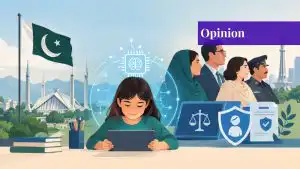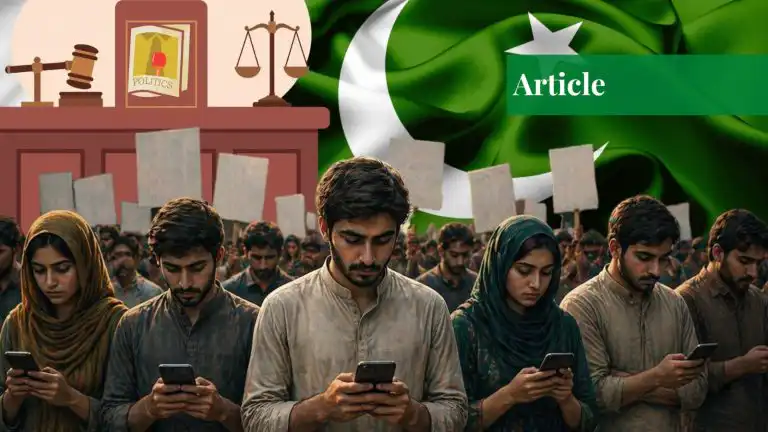
“Democracy is not a spectator sport,” was once said by Marian Wright Edelman. A country cannot be prosperous when its people are silent observers of their own democracy.” The quote defines the situation of an increasing crisis of civic culture in Pakistan, where democratic institutions have been established, but citizens have not yet participated in the process. Democracy hinges on civic responsibility, which means involvement in the governing, respect for the law, upholding of taxes, and engagement in the community. However, in Pakistan, the governance and social cohesion are being compromised by poor civic culture, low turnout and decreasing trust in institutions.
Electoral disengagement is one of the most evident indicators of this crisis. Voting turnout scale compared to 55% in 2013 dropped to 52% in 2018 and 50% in 2024. This is challenging because 55 million registered voters in Pakistan are between the ages of 18 and 35, and more than 60 per cent of Pakistanis are under 30, while almost 48% of young people may vote in 2024, most of them are not involved in local government or community activities.
The crisis is not limited to elections. Another big problem is low tax compliance; fewer than six million of the population of 240 million Pakistanis filed income tax returns in 2025 (STI). This poor involvement in fiscal affairs restricts the state from offering basic services such as education, healthcare, and infrastructure, which contributes to the suspicion of the general population.
The civic norms are further eroded by everyday habits of the citizens, such as neglecting traffic regulations, being careless with the environment, and abusing state property. The failure of citizens to assume these roles makes governance more challenging.
One of the biggest reasons for this fall is the deficit of civic education. Research indicates that approximately 75 per cent of Pakistanis never attended civic education classes, and 90 per cent never participated in civic or human rights groups. Without understanding their rights and responsibilities, citizens often consider governance as the only domain of politicians. As noted by George Jean Nathan, “Bad officials are elected by good citizens who do not vote,” which resonates with troubling accuracy in the case of Pakistan.
Various groups are trying to encourage civic engagement in Pakistan. PILDAT studies governance and elections, whereas FAFEN monitors elections and trains observers. Transparency International Pakistan fights corruption and enhances accountability.
The Pakistan Youth Commission Association is an organization in Pakistan established in 2013 that works on youth empowerment in the country through initiatives in their education, social cohesion, and citizen journalism to inspire youth involvement, and the Aurat Foundation works on mobilizing the communities and empowering women in their local politics. These campaigns focus on the importance of civil society in strengthening democracy.
The legal system in Pakistan also encourages civic participation. Articles 17, 19, and 32 of the 1973 Constitution assure the freedom of association, expression, and role in local governance. The Elections Act of 2017 fosters transparency, and the Right of Access to Information Act of 2017 allows citizens to hold officials accountable. Provincial Local Government Acts are also meant to institutionalise participation at the grassroots level, but in practice, inconsistent implementation has been a challenge.
Civic responsibility is further enhanced by religious and philosophical traditions. Individual accountability is emphasised by the Prophet Muhammad: “Each of you is a shepherd and responsible for his flock”, a principle that resonates with democratic participation. Allama Iqbal also highlighted citizen responsibility, stating, “Nations are born in the hearts of poets; they prosper and die in the hands of politicians.” Islamic scholars such as Ibn Khaldun and Shah Waliullah emphasised justice, social responsibility, and civic participation as the foundation of good societies.
Civic responsibility is also important during times of war. The conflicts with India and Afghanistan and recent events of Iran vs Israel/USA reveal that Pakistan has managed to strengthen its national resilience not only through military power but primarily through civic unity. In the Afghan war, there were millions of refugees in Pakistan, which is a clear indicator of societal resilience. On the other hand, history proves that the rivalry with India has contributed to national unity.
Geopolitical struggles in the Middle East have resulted in numerous demonstrations and forms of civil action, such as demonstrating that civic activism can unify individuals and change political results when there is tension. These cases demonstrate the fact that civic involvement is extremely vital to the nation’s well-being in times of crisis.
Global case studies have definite solutions. Participatory budgeting in Brazil gives people power to determine how the government will spend the public funds, which enhances services. Online services and voting were made possible in Estonia, and increased transparency through e-governance. South Korea has also adopted online measures to track projects and report corruption; these examples show that being actively involved in civic life enhances democracy and governance.
In the end, it is necessary to restore civic responsibility in Pakistan. Democracy is not only in institutions but also in knowledgeable and engaged citizens. It is important to enhance civic education programmes, empower the local governments, and motivate the youth and women to engage in civic education and the development of civil society. The future of Pakistan lies in changing its people into active citizens who will practice democratic values and make Pakistan a strong participatory state.
If you want to submit your articles and/or research papers, please visit the Submissions page.
To stay updated with the latest jobs, CSS news, internships, scholarships, and current affairs articles, join our Community Forum!
The views and opinions expressed in this article/paper are the author’s own and do not necessarily reflect the editorial position of Paradigm Shift.

Arslan Mehndi Nekokara is a lecturer at GCUF Chiniot Campus. He has an MPhil in political science from Punjab University Lahore, and his expertise lies in global politics, comparative governments, world constitutions, political thoughts, and theories. He can be reached at mehndiarslan@gmail.com.