Who could have imagined that during the 1970s and 1980s, a single bank would shake the financial centres of the world, from Wall Street in the United States to the City of London? Like the Roman Empire, BCCI was not built in a day. It took years of rapid expansion, ambitious leadership, and growing international influence to become one of the world’s largest private banks having an impressive $23 billion in assets worldwide and 380 offices in 72 countries, and a covert presence in others. Yet, when it finally collapsed, its downfall was swift and sent shockwaves throughout the global financial system.

The Bank of Credit and Commerce International (BCCI) was founded in 1972 by Pakistani banker Agha Hasan Abedi. Abedi began his career as an ordinary banker in India before migrating to Pakistan after Partition, but his vision extended far beyond that of any of his peers. He aspired to build an international financial institution that would serve developing countries overlooked by Western banks, bridging the gap that they could not fulfil. What started as an ambitious dream soon grew into a banking empire that operated across more than 70 countries. However, behind its remarkable success lay a complex web of fraud, weak regulation, and poor corporate governance that would ultimately lead to one of the greatest banking scandals in modern history.
Agha Hasan Abedi, commonly referred to as Agha Sahab by his friends and family, was born into an educated family in Lucknow on 14 May 1922. Growing up in an environment rich in literature and culture, he received a strong education and studied law at Lucknow University, eventually completing a Master’s degree in English Literature. Fate, however, had something else planned for him. Having developed an interest in finance during his college days, he began his career as a trainee officer at Habib Bank in 1946, eventually showing unprecedented growth in a short span of time. By 1959, he had built an impeccable reputation in the field of banking and then tried his own luck at founding his own bank. Through his connection with the Saigol family, he founded what is today known as United Bank Limited.
Abedi founded the bank in Luxembourg, a confidentiality haven. The initial funding consisted of $2.5 million obtained through a joint consortium led by the Bank of America and a further $500,000 provided by Shaykh Zayed Al Nahyan. Abedi successfully capitalised on the oil boom before many of his competitors. Abu Dhabi’s oil revenues, over which Shaykh Zayed Al Nahyan presided, totalled around $750 million annually during the early 1970s, a figure that surged to $10 billion by the end of the decade. BCCI proved to be the bridge between Abu Dhabi’s oil revenues and the financial world beyond it.
BCCI’s assets rose from $200 million in 1973 to over $2.2 billion in 1977. In just those four years, BCCI’s network of branches increased from nineteen offices in five countries to 146 offices in thirty-two countries. BCCI’s network continued to expand rapidly through the following decade, growing faster than even Abedi had imagined, and this was all part of Abedi’s ambition for it to become the largest bank in the world. He had revolutionised banking through his hospitality and care for his customers.
The bank went through rapid expansion by tapping into the neglected ethnic minorities from South Asian backgrounds, primarily in the UK. Bradford, Manchester, Birmingham, Leeds, and East London were densely populated immigrant communities. All of these communities needed a reliable and trustworthy bank to transfer their savings from the UK to their home countries. A similar strategy was used in the Middle East, where labourers from the subcontinent preferred BCCI as their bank of choice due to its widespread branches across their countries of origin. BCCI had amassed a solid standing in the world of banking and finance. In addition, the British Asian community had a strong business presence that depended on the bank because of its lending policies, which had eased access to finance and credit markets.
By 1983, BCCI was the second-fastest-growing bank in the world, according to Euromoney and the financial press. However, beneath its success lay a much darker reality. BCCI was one of those international banks that collected money from corrupt politicians and dictators, including Ferdinand Marcos of the Philippines, Saddam Hussein of Iraq, and a vast number of Persian Gulf oil sheikhs. BCCI also stood out because of its extensive network of influential connections. In some cases, BCCI helped officials accumulate wealth through bribery and fraudulent practices. Similarly, when global economies experienced periods of crisis, the bank continued to thrive on the oil boom enjoyed by its clients in the Middle East, which provided it with a steady stream of income. Abedi’s bank also laundered money from the drug trade, particularly during the Afghan War, making substantial profits while serving as a channel for trades involving opium.
BCCI’s occasional loans to developing countries were financed by the deposits the bank received from Third World central banks and governments. Central banks, in particular, usually deposited their countries’ foreign exchange reserves in international banks with the highest credit ratings. BCCI was exactly the sort of bank that a prudent depositor should have avoided. It was not properly monitored, nor was it subject to the scrutiny of regulatory authorities. Its main holding company was incorporated in Luxembourg, a country without a central bank; therefore, it had no “lender of last resort” to assist it in the event of liquidity problems. Since BCCI was privately held, it was not scrutinised by stock market analysts either. Finally, credit rating agencies such as Moody’s and Standard & Poor’s did not analyse the bank’s creditworthiness or solvency, which would later prove to be disastrous.
Despite all this, BCCI attracted deposits from the governments of Barbados, Belize, Cameroon, Guatemala, Jamaica, Nigeria, Paraguay, Peru, and Zimbabwe. Even after BCCI ran into deep trouble with US law enforcement in the late 1980s, many developing countries continued to do business with it. It was alleged that BCCI also paid bribes to obtain deposits and evade regulations, with veteran officials reporting that bags of cash were handed out to government officials during meetings. US law enforcement authorities stated that they had evidence that BCCI paid bribes to central bankers or finance ministry officials in about a dozen developing countries, including Argentina, Nigeria, Peru, Senegal, and Sudan.
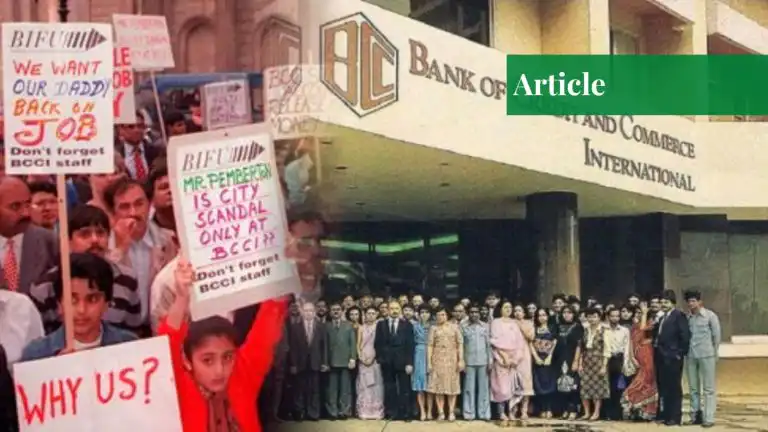
The bank was officially put to rest at 1:00 p.m. on Friday, 5 July 1991. Employees were asked to gather their belongings and leave, and similar scenes occurred at numerous branches across the European continent. Immediately, notices were posted on the glass doors of every BCCI branch informing customers that the bank had been closed by order of the Bank of England. The shutdown of BCCI touched off angry protests by depositors across the globe, sometimes erupting into violence. The timing could not have been more impeccable—midday on a Friday. Consequently, the protests were unable to build momentum until Monday, when depositors and employees carried placards demanding that their money be returned. Credit lines for several small businesses began to dry up, resulting in a severe credit crunch. Thousands lost their jobs and were affected by the collapse of the bank. The Federal Reserve would later impose a penalty of $200 million for violations of US banking laws.
Agha Hasan Abedi suffered a severe heart attack in 1988 and formally resigned as president in 1990, retreating into a secluded life before eventually passing away in 1995. His right-hand man, Swaleh Naqvi, was appointed as his successor and would later be indicted on charges of fraud and sentenced to eight years in prison. Thus, the bank that began from a two-room head office in London had closed its doors for the final time.
Although BCCI’s reputation was permanently overshadowed by its collapse, under Agha Hasan Abedi’s leadership, BCCI engaged in notable charitable initiatives which even today continue to impact the world we live in. Abedi believed in giving back to the community and to Pakistan. He supported institutions including the Foundation for the Advancement of Science and Technology (FAST). He founded the Infaq Foundation, whose major beneficiaries have been SIUT, National Institute of Cardiovascular Diseases, Sir Syed University of Science and Technology, and GIKI.
The closure of BCCI wasn’t the fall of any ordinary bank; it set a new precedent by proving that even a bank considered too big to fail could indeed fail. But one may ask the question: was BCCI the only bank involved in such practices? Why weren’t other banks pursued in the same way BCCI was? Was the closure of the bank a foreign conspiracy?
All of these questions remain unanswered to this day.
The story of BCCI demonstrates how weak oversight, a lack of corporate governance, and financial secrecy can break even the strongest of institutions. It led to stronger laws promoting greater accountability and tighter regulatory oversight. In the wake of the BCCI failure, the Federal Reserve proposed legislation to increase supervision, including new powers to bar the entry of foreign banks into the United States and to inspect any bank suspected of violating the nation’s laws. The episode showed that geography is no longer a barrier in the financial world, and that laws and regulations must adapt accordingly. In the end, the single most valuable asset any financial institution can hold isn’t what it can show on its balance sheet, but rather the trust of its customers.
If you want to submit your articles and/or research papers, please visit the Submissions page.
To stay updated with the latest jobs, CSS news, internships, scholarships, and current affairs articles, join our Community Forum!
The views and opinions expressed in this article/paper are the author’s own and do not necessarily reflect the editorial position of Paradigm Shift.

Tayyab is an undergraduate student pursuing a BS in Accounting and Finance at the Institute of Business Administration (IBA), Karachi. His interests include banking, financial history, corporate governance, and public policy. He enjoys researching historical financial events and writing analytical articles that make complex economic topics accessible to a wider audience.