
A High-Stakes Economic Gamble
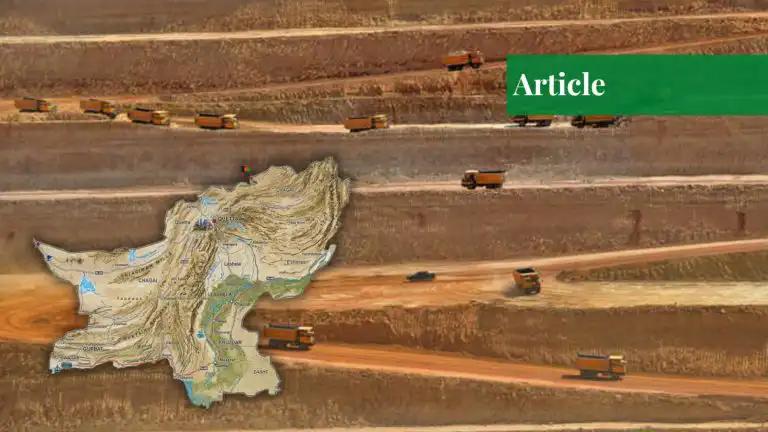
Beneath the dry hills of Pakistan’s Chagai district lies the highest-stakes gamble for Pakistan’s economic future. The Reko Diq copper-gold mining operation, with an estimated 5.9 billion tons of minerals, has received financial backing from the International Finance Corporation and the Asian Development Bank, as well as an increasing amount of attention from Washington, which views critical minerals in Pakistan as part of an effort to diversify its supply chains from China.
At full-scale operation, the mine is expected to produce almost $2 billion per year of free cash flow, half of which will be divided between the government of Balochistan and Pakistan’s federal state-owned entities. According to officials in Islamabad, the mining project will be the backbone of the country’s mining industry and one of its core economic sectors over the next two decades, and Washington has already said it is ready to finance more such mining operations in Pakistan.
A History of Exclusion
The numbers make sense of why Reko Diq plays such a prominent role in the Pakistani efforts to reach out to both Washington and Beijing. They say little, however, regarding the implications of the mineral bonanza for the province whose soil it enriches.
Balochistan is not only the largest but also the poorest Pakistani province by any developmental criteria. It has been supplying a disproportionate share of natural resources to the country for three-quarters of a century. The natural gas found in Sui in 1952 warmed up houses and fueled factories across Pakistan for decades; the province it originated from has yet to become fully integrated into the country’s gas network.
Environmental and Security Concerns
History influences how several Baloch communities perceive Pakistan’s ongoing mineral boom in the region. There have been at least five separate instances of Baloch nationalists revolting against the Pakistani government due to their perception that resources within the province are being exploited for the benefit of the central government and external investors rather than local communities residing above those resources. An outbreak of cholera in the district of Dera Bugti in 2022, due to a drought that made people drink contaminated water, can be cited as an example of that discrepancy.
Beyond the issue of receiving resource royalties, there are other worries. Reko Diq is situated in one of the most water-stressed regions of an already dry province. Even the project investors admit that there is a risk to the groundwater on which local pastoralists and farmers depend. The land needed for the development of mineral deposits will interfere with the grazing trails and seasonal routes which nomadic families have traditionally used.
A statement from the U.S. International Development Finance Corporation, which is mulling backing for the project, meanwhile, notes road safety and security concerns stemming from the private guards hired to secure the site, an especially important consideration in a province in which the behavior of security forces is a matter of intense public suspicion.
Lessons from Gwadar
Some two hundred miles to the south, in Gwadar, the port on the China-Pakistan Economic Corridor, the same pattern has been followed in miniature, but over a significantly longer time. Despite more than a decade of spending by Chinese and Pakistanis, residents of Gwadar have held multiple protests, one drawing several thousand women and children, over a shortage of municipal water that has never been properly addressed.
An investigation by the public accounts committee of the Balochistan Assembly revealed financial mismanagement in the provincial department responsible for supplying the town’s water. Studies of the region indicate that Gwadar illustrates how climate pressure – along with irregular rainfall – increased drought periods, and poor governance combine to cause unrest. The same combination of factors is occurring quietly in the surrounding districts of Chagai.
That is the dilemma that cannot be indefinitely deferred by policymakers in Pakistan, nor by Reko Diq’s foreign stakeholders. What geology makes Balochistan important to Washington and Beijing is the geology of the extraction, which has made Balochistan more aware of its sense of exclusion. A strategy focusing on exports and competition between major powers will result in the reproduction of Gwadar’s tensions on an industrial scale, that too in an area with fewer means to cope with that kind of situation.
A Path Forward: Local Legitimacy and Shared Wealth
There are useful examples in other parts of the world. Mineral-rich but underdeveloped regions have taken advantage of ring-fenced, independently audited funds designated for local development, based on a share of mining income, to turn mineral wealth into visible local infrastructure as opposed to difficult-to-trace fiscal transfers far removed from the region in question.
Pakistan’s National Finance Commission Award is an established mechanism of revenue distribution between the federal government and the provinces; applying something like that, adapted to mineral royalties and independently verifiable, would address the credibility issue that purely verbal assurances from the federation have failed to solve in the past seven decades.
Decoupling of vital infrastructures, especially water and power, from the whims of mining companies and federal development plans is equally critical. Given Gwadar’s decade-long inability to get necessities, while hundreds of millions of dollars’ worth of Belt and Road investment poured into the city, the Baloch people have been given a good demonstration of the type of development possible without an accompanying right to consultation on the use of the land and water resources near them.
Chagai district, and mining towns like it, do not have to learn this lesson again in relation to a copper mining project worth several billion dollars. Imposing a provision that guarantees a certain amount of water and power facilities will go toward serving the local communities and not just the mining project alone will make no material impact on the project’s finances, but it will affect its local image.
The mineral deposits in Pakistan have become real levers in the increasingly competitive international economy, sought after by US and Chinese investors in a way that very few export-oriented industries in the country can emulate. However, having leverage internationally does not equate to having legitimacy locally. Whether Reko Diq will become the bedrock of a sustainable indigenous industry or just the next addition to the country’s history of resource extraction without permission will be determined by how the province beneath it is treated.
If you want to submit your articles and/or research papers, please visit the Submissions page.
To stay updated with the latest jobs, CSS news, internships, scholarships, and current affairs articles, join our Community Forum!
Find our FREE quizzes and MCQs here!
The views and opinions expressed in this article/paper are the author’s own and do not necessarily reflect the editorial position of Paradigm Shift.

Nisar Kakar is a writer and poet and a BS English student at Quaid-i-Azam University, Islamabad, Pakistan, hailing from District Killa Saifullah, Balochistan. He serves as Assistant Coordinator for Literary Prose at the Quaidian Debating and Literary Society (QDLS).