In August 2025, a single hour of extreme rainfall killed hundreds of people in Buner district and reshaped Pakistan’s conversation about climate disasters. A year later, with fresh floods striking the same province and NDMA once again naming Buner among the districts most at risk, the record shows what the government promised, what it delivered, and what still hasn’t been fixed.
What Is a Cloudburst?
Cloudburst means a sudden, heavy localized rain with very heavy rain in a very short time, generally less than an hour. Cloudbursts occur when moist air is pushed up very quickly in the mountains, causing towering clouds to develop and carry a huge amount of water vapour until the cloud eventually has so much water that it releases it all at once, meteorologists said. The danger is heightened in steep mountain valleys as there is little flat land to catch or slow the water, allowing a cloudburst to quickly become a wall of water and debris, with little time for residents to respond. Cloudbursts are extremely difficult to predict precisely as they are localized and develop very rapidly. Weather departments can alert the public to large-scale weather patterns conducive to heavy rainfall (humidity, wind direction, monsoon activity), but currently no forecasting system anywhere in the world can predict exactly which valley or village will receive the rain, and when. This discrepancy between wide-area notifications and localized life-saving advice is at the heart of what occurred in Buner.
August 15, 2025: The Night Buner Changed
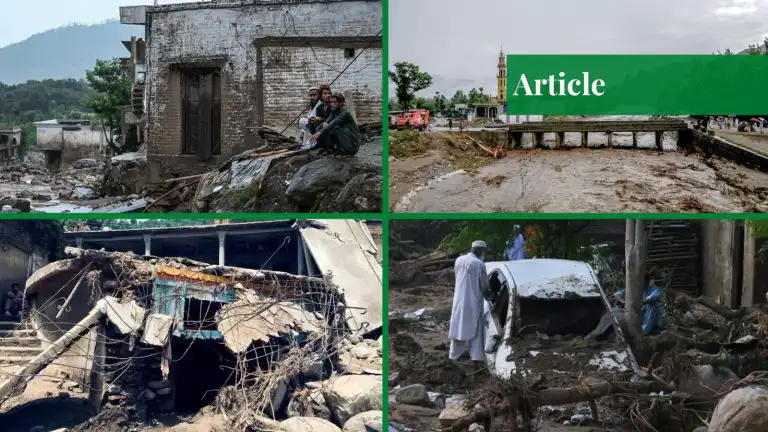
Buner is a mountainous District in Khyber Pakhtunkhwa (KP), approximately 100 kilometres due north-west of Islamabad, and is characterized by narrow valleys, steep slopes and streams which flow rapidly during monsoons. This torrential rain fell on the district for approximately an hour, with some estimates putting the amount over 150 millimetres per hour on the evening of August 15, 2025. Having no place to disperse, the water rushed down the hillsides as a force of destruction, sweeping through the villages along the riverbanks, and washing into villages with mud, rocks, and fallen trees.
The flooding occurred in a few villages, such as Pir Baba, Qadar Nagar, Beshonai and Malik Pura, where the village of Beshonai (with over 80 households) was left in ruins, having had its houses swept away by flash floods in a matter of moments. One instance was reported in which a family had just celebrated a wedding in Qadar Nagar when the floods struck, killing 24 people. There was no warning before the water came, according to survivors and elders there, but via the usual means: through the mosque speakers. Later, the government officials stated this was a sudden and intense rainfall, so intense that they could not give warnings, but that it had been the Buner district (not any particular village) that had been marked as vulnerable in advance.
Rescue and recovery efforts continued for days. About 2,000 rescuers, army troops and sniffer dogs were sifting through the rubble for the victims and bodies, while landslides and damaged roads and phone lines hindered the efforts. Another provincial government helicopter was also operated in the relief effort and crashed, killing all on board during the crisis.
The Human Toll
In the first two weeks, casualty figures fluctuated daily (this is to be expected in such a disaster), but every count referred to Buner as the worst-hit district by a factor of tens. Provincial Disaster Management Authority (PDMA) situation reports put Buner’s death toll at 208 within the first 48 hours, rising past 220 by August 18 as more bodies were pulled from the wreckage. Shangla, Mansehra, Swat, Bajaur, Battagram and Lower Dir were other badly affected districts. Towards the end of the year, the National Disaster Management Authority (NDMA) reported a total of several hundred fatalities province-wide due to the floods in KP, with Buner having the highest number of deaths compared to any other district. NDMA reported at least a thousand casualties in KP, Punjab, Sindh, Balochistan, and Azad Kashmir as a result of the deadly flood rains during the monsoons this year in Pakistan, which is one of the worst monsoon seasons in the country in years. During the next few months, Rescue 1122 emergency teams saved thousands of people and recovered hundreds of corpses in KP.
Why Was Buner So Vulnerable?
Geography and a changing climate were two factors that made this disaster as deadly as it was. Buner is located in the foothills of the Himalaya-Karakoram range, where water flows through narrow valleys from steep slopes, prone to erosion. Hillsides in some areas of the district have been eroded over the last 20 years, allowing the sides to become more vulnerable to landslides when saturated. When there is a lot of rain to drain in such a landscape, there is nowhere else for the rain to fall other than downhill, at speed, through settlements located on the valley floor. This topography is then overlaid by a warming atmosphere. Researchers have long known that the atmosphere is able to hold about seven percent more water for every one degree Celsius of warming, which is equivalent to more water being available for storms to dump in a shorter time. This dynamic and the shift of the monsoon towards the west to KP was cited as a factor that contributed to the intensity of the August 2025 rains by Pakistani officials and meteorologists. The disparity between Pakistan’s contribution to greenhouse gas emissions GHGs and its susceptibility to disasters driven by climate change is very prominent and has become a recurring issue for Pakistan’s disaster response debates, as less than one per cent of the world’s GHGs are being generated by Pakistan.
How Did the Government Respond?
With the magnitude of the tragedy realized, the provincial and Federal governments acted to mobilise emergency resources. KP Chief Minister Ali Amin Gandapur went to Buner within 48 hours and promised to restore the damaged infrastructure, offer compensation to families of victims, and relocate people residing in high-risk zones to safer places. The provincial government declared a state of emergency in nine of the worst-hit districts, including Buner, till the end of August, which gave the local governments access to all the machinery and funds they had available in the area to deal with relief work. The KP government handed over Rs 800 million for relief to all affected districts, while Rs 500 million was allocated for Buner as it has suffered disproportionately.
The families of the deceased were given Rs 2 million apiece as compensation. The prime minister has directed his ministers and cabinet members to personally monitor the relief activities in KP and also directed them to donate their salaries for the relief, whereas NDMA has deployed tents, blankets, water pumps and medical supplies to the affected districts. Separately, more than a billion rupees were allocated to the KP Communication and Works Department for washed-out roads and bridges repair. Affected families have received compensation from PDMA in the months since, and by December 2025, PDMA has also rolled out a digital claims platform that aims to streamline and increase transparency in the payments of disaster compensation, in lieu of the slower paper-based process. In addition, the province started to develop a long-term Provincial Disaster Management Plan for 2025-2030, which aims at enhancing the hazard mapping and preparedness efforts in anticipation of future monsoons.
What Was Promised and What Wasn’t Delivered
The biggest gap was still early warning. Despite the scope of the Buner tragedy being revealed, district-level disaster alert messages were still being issued instead of village/stream level warnings, which would allow residents to move to safety. The lack was clearly seen when the government’s warning system warned of a threat in Buner district but not the specific village or an evacuation pathway, and the warning was not received by the households that most needed it.
Despite all the spending and promises made to the public, the evidence and events since then indicate that the actual impact of the emergency spending and public pledges is mixed, and that there are real differences between what was said and what has been accomplished — although not so stark as to qualify for an all-fails rating by early 2026. Measurable, though not complete, progress could be seen on hard infrastructure, according to PDMA’s own statistics. As of mid-January 2026, the authority reported that 65 of 77 damaged bridges in the flood-affected districts had been rebuilt, 234 of 386 disrupted water supply schemes had been restored, and electricity had been reconnected to all 99 affected feeders. By that time, the province had already distributed over Rs 4 billion in relief and reconstruction funds, it said, and a total of Rs 5 billion is expected to be released — far more than what was done in the first week of the crisis, which was Rs 800 million.
There is also a second gap with regard to infrastructure accountability. To date, there has been no public result from a programme established in 2026, with financial backing from the Prime Minister’s Office, to review and certify that embankments and flood barriers in flood-prone districts have been repaired to the correct standard to resist the next cloudburst – meaning it is difficult to tell whether the work has been completed to the right specification.
The housing issue proved to be the biggest and slowest to shift. Roads and bridges were reported to be repaired, and the same is true of water schemes, but with PDMA’s own reporting by January 2026, the number of rebuilt houses was far behind. Pir Baba was among the most devastated areas, where families were still sheltering in makeshift homes and tents made from stolen stone, mud, and wood, only to await the housing assistance that had been pledged in the days following the disaster – despite officials citing the same figures about infrastructure as indicators of progress.
Many residents reportedly continue to live in makeshift shelters through the following winter, and relocation of residents from high-risk riverside areas – one of the earliest and most specific promises made by the KP chief minister – doesn’t seem to have been fully implemented at scale: a year on, many residents still reportedly live in high-risk riverside areas, and reports from aid groups indicate that many high-risk households have not been moved from their precarious locations.
The Monsoon Returns: 2026
The subsequent monsoon season provided the best proof of unfilled lacunae. In late July 2026, NDMA said fresh monsoon rains have already claimed dozens of lives and wrecked hundreds of houses across the country, with KP accounting for the highest loss of life compared to other provinces. The Pakistan Meteorological Department has predicted further rainfall, wind and thunderstorms in Buner and its adjacent areas till the end of July and the first week of August, while on August 1, 2026, NDMA gave a new National Flood Alert naming Buner, along with Mohmand, Bajaur, Mardan, Kurram, South Waziristan, Shangla and Peshawar, as flood prone districts due to streams and hill torrents. Buner was once again a repeat visitor to the list of areas where authorities were aware of problems a year to the week later.
With the renewed heavy rainfall in August 2026, flash floods occurred again in some parts of KP, killing more people and adding to the ongoing flash flood alerts issued by NDMA for the hill torrents in KP and Dera Ghazi Khan. This year’s levy also serves as a reminder of a structural deficit that can’t be corrected with finances. A cloudburst, like Buner’s, killed a large proportion of the dead this year nationally, not from the floodwater itself but from the resulting failure of poorly built houses – a vulnerability that is similar to that of Buner’s house.
The number of households in kacha (mud-built or otherwise informal) houses, which cannot withstand this kind of rainfall, is about one in five houses nationally, and the numbers have been identified by the latest census, and there has been no reconstruction or building-standards programme announced since Buner’s that has been able to take care of this stock at scale. There are some positive developments: agencies are now issuing monsoon advisories more regularly than previously, with greater specificity, and observers note an element of institutional learning. But the consistent list of districts like Buner in the at-risk category for broadly similar reasons over the past few years has prompted local commentators to question the effectiveness of the institutions that are tasked with mitigating risk even when it is so clear: along river banks, construction is taking place without regulation; flood defences are not being repaired; a house stock that makes the monsoon rains fatal.
The Bottom Line
One year later, Buner’s cloudburst isn’t all good or all bad. On emergency relief, as well as some hard infrastructure, the government acted swiftly and was able to cite some real figures – money released, the vast majority of bridges and water schemes rebuilt or restored, compensation paid to many families, and a digital claims system launched.
What has been lacking is just the segment that would save lives in Buner, and would save lives in the next cloudburst: hyper-local early warning systems that reach a village or stream, but don’t reach an entire district; independently verified, rather than merely announced repairs to flood defence; and a serious reckoning with the kacha housing stock that continues to turn ordinary monsoon rain into a body count. The province’s improvement in responding to disaster after the event has occurred is evidenced by the return of deadly flooding in 2026; Buner was still identified as one of the most vulnerable districts, and the dead in this year’s disaster were more likely to be in a building than in the water.
If you want to submit your articles and/or research papers, please visit the Submissions page.
To stay updated with the latest jobs, CSS news, internships, scholarships, and current affairs articles, join our Community Forum!
The views and opinions expressed in this article/paper are the author’s own and do not necessarily reflect the editorial position of Paradigm Shift.
Zohra Iqbal is an Electrical & Instrumentation Engineer with interests in renewable energy, solar power, and sustainable technologies.