

Introduction
WAPDA (Water and Power Development Authority) is primarily responsible for maintaining the electricity supply system in Pakistan. The water and power resources of the country are also managed by this organization. WAPDA records the amount of electricity and water utilized by a consumer. This recorded data is then used to further calculate the total amount for the service provided during the whole month. Every citizen has to pay his electricity bill at the end of each month based on his energy usage. Therefore, it’s mandatory for a citizen to comprehend the WAPDA bill in order to properly manage his electricity expenditures.
If you want to plan your budget rationally and use energy wisely, then you should develop an understanding of the costs that are linked to your electricity usage (taxes, units, and other fees, etc.). This would ultimately prove that you’re making an effort to support sustainable energy practices and effectively use resources. This article highlights the important components of which the electricity bill is composed. It also sheds light on the massive corruption in WAPDA. It further elaborates on the methods to understand your bill, which would ultimately help in reducing corruption and using electricity wisely. Lastly, it gives some recommendations that would help you save electricity and reduce your bill costs.
Navigating Your WAPDA Electricity Bill
In order to comprehend the WAPDA bill, a person should be familiar with its important elements. Some of the important charges highlighted on the WAPDA bill are units, taxes, surcharges, and rates. Now, let us look into their details.
WAPDA Bill Unit Rates and Their Usage
The first and foremost step to understanding consumer electricity bills is to find out how much electricity you’ve utilized, expressed in kilowatt-hours (kWh). By using the calculation of this result, you can find out your electricity expenses. You can multiply the unit rate by the amount of electricity you have used in kilowatt-hours. This amount is the cost tag of your energy consumption, and it could be different depending on the electricity distribution company you’re linked with.
In Pakistan, electricity is distributed through different companies in different regions. For instance, the electricity distribution services in Multan are provided by the Multan Electric Power Corporation (MEPCO) and in Lahore by Lahore Electric Supply Company (LESCO). Companies of other regions are HESCO, GEPCO, IESCO, SEPCO, FESCO, etc. These companies are responsible for supervising the distribution of power, maintaining vital infrastructure, and processing customer bills.
Therefore, by understanding the system behind the charges on your WAPDA bill, you become capable of either adjusting or eliminating various charges. This would ultimately help you determine your electricity usage and expenses.
Supplementary Fees and Taxation: Further insights
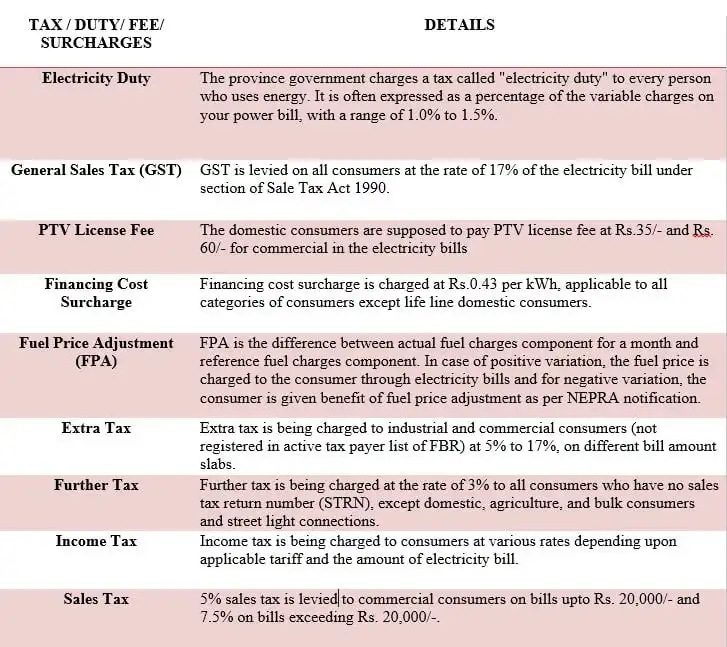
A significant portion of the WAPDA bill consists of charges that are determined by the government. You have to pay according to the amount of electricity you’ve consumed in an entire month. These charges include several elements; one of the most important is known as the general sales tax (GST). Its functions are equivalent to the additional tax on your electricity bill. In addition, you have to pay other taxes and surcharges, such as the basic income tax. It’s vital to understand these costs as they add up to the total amount you must spend on utilizing electricity. In essence, they are the major components of your power bill.
Let’s now look into the details of these taxes and surcharges.
Analyzing Electricity Tariffs and Fees
The electricity rates (commonly called tariffs), mostly determine the price of your energy usage. According to your consumer category and degree of usage, these tariffs are modified. The tariffs of every place (homes, factories, and companies) vary depending on their energy consumption. Due to the maximum use of energy, industrial tariffs (charges) are usually higher.
There may be exclusive policies and costs in some locations for specific clients. It is crucial to comprehend the tariff system because it will further determine how much you’ll have to pay for your electricity usage. However, differences may occur depending on your geographical location and type of usage.
Corruption in WAPDA
Corruption has become a prominent element in every sphere of Pakistan, be it social, political, or economic. The WAPDA (Water and Power Development Authority) has also faced massive charges of corruption. During the last three years, 448 WPADA employees from grade 2 to grade 20 were involved in corruption cases and stole millions of rupees.
Several were engaged in fraud, meter theft, fake meter readings, and taking bribes to install new meters. Most of them were involved in electricity theft cases. Those involved in identifying irregularities were eight 17-grade officers, eleven 18-grade officers, five 19-grade officers, and three 20-grade officers.
WAPDA meter readers are involved in corruption. These WAPDA meters are becoming notorious for fraud in even small and big cities. Despite holding power, they don’t fulfill their duties properly as they don’t visit the premises of hospitals, houses, factories, or other places. Due to their carelessness, stealing electricity has become really common in cities and villages.
Moreover, the prices of the projects increase tremendously due to corruption. These inflated prices are usually passed on to domestic consumers in the form of high electricity tariffs. As a result of this, consumers receive inflated bills. Recently, the former chairman of WAPDA, Lt Gen (retd) Muzammil Hussain, faced allegations of corruption worth 753 million rupees in the Tarbela hydropower project. WAPDA faced a loss of approximately 1,454 million rupees to the national exchequer, throughout his tenure as chairman.
WAPDA is also included in corruption worth Rs 400 million in the Munda Dam project, as stated by the Planning Commission. Senator Zahid Khan said that the investigation agencies (either NAB or FIA) should be given the responsibility to investigate the matter. He also highlighted that the government is not providing any subsidies to domestic consumers of electricity but rather, generating revenue by charging Rs18 per unit.
Furthermore, misallocation of funds meant for infrastructure maintenance and development could also lead to corruption. Due to this, proper investments couldn’t be made to improve distribution systems, power generation, and transmission, resulting in poor service efficiency and reliability. These inefficiencies then become the cause of higher bills.
Methods to Understand & Control Electricity Consumption & Eliminate Corruption
Carefully Read the Information Provided in the Bill
To better understand and manage power costs, customers may take a few actions. First of all, it’s really important for every citizen, to properly read the information given on the WAPDA bill, like consumption costs, the billing period, meter readings, and any other extra charges. It’s important to carefully review the bill for any errors, to avoid paying too much or too little.
Keep a Record of Your Previous Bills
Furthermore, it is essential that you keep a record of each time you pay your WAPDA bill. By doing this, you can track how much electricity you consume on a regular basis and estimate how much money you’ll need for future bills. Maintaining a record of your previous payments can help you better manage your finances and prevent unpleasant surprises when you get large bills from WAPDA.
Check Your Meter Reading Yourself
If you don’t have smart meters that can provide instant electricity usage, you need not worry. You can even calculate the electricity from the standard electricity meter that is commonly used in Pakistan. For this, you have to follow certain steps. The steps will be explained with an example for better understanding
Step 1:
The first step is to note down the numbers displayed on your electricity meter. You’re supposed to take the reading from left to right of the 5 black digits (ignoring the red digits). Let’s say the current reading on your meter is 1600kWh.
Step 2:
Secondly, note down the reading from your electricity bill for the previous month. Let’s say the previous reading on the last bill was 1400 kWh.
Step 3:
The third step is to subtract the previous meter reading from the current one.
Current reading – previous reading = 1600 – 1400 = 200 kWh
Step 4:
Then to find your billing rate per unit (kWh), contact your utility provider or check your bill yourself. Let’s assume the billing rate is PKR 16 per kWh.
Step 5:
Next, to find the cost of electricity used, multiply the difference in the readings (the previous and the current one) by the billing rate.
Cost = Difference in both readings x billing rate = 200 kWh x PKR 16 per kWh = PKR 3,200
Step 6:
Moreover, you could also take into consideration the additional charges that include surcharges, taxes, and other fees. For a more accurate estimation of your electricity bill, you can add these charges to the total cost (that has been calculated above).
Let’s suppose,
Fixed monthly fees: PKR 300
Sales tax (17% of the E/bill): 0.17 x PKR 3,200 = PKR 544
Step 7:
The total bill will be calculated as
Cost of electricity consumed + fixed monthly fee + sales tax = PKR 3,200 + PKR 300 + PKR 544 = 4,044
Therefore, Rs4,044 is your bill for the current month
Recommendations to Reduce Your Electricity Bill
Here are some recommendations that can prove helpful in reducing your electricity bills and using energy wisely.
- First of all, it requires a collective effort to reduce your electricity consumption. Therefore, you should teach your family members, friends, and colleagues the importance of saving electricity and encourage them to use it wisely. This would be the first step in electricity conservation.
- Next, it’s quite important to note how and where more electricity is being utilized. For this, you should conduct an energy efficiency evaluation of your workplace or home in order to check the areas where energy is wasted. You can check this by yourself, or you can even call a professional energy/electricity evaluator. To make improvements, air leaks, inefficient lighting, and outdated appliances should be checked thoroughly.
- Moreover, you should try not to use electricity during the peak hours. The time of the day when the demand for electricity is really high is referred to as “peak hours.” Consumers face the highest charges for every unit of electricity they use during these hours. On the back side of the WAPDA bill, the timing of the peak hours is mentioned, which is currently from 5 pm to 11 pm. So, during these hours, you need to be careful and try not to use appliances such as microwaves, irons, air conditioners, freezers, etc. as they consume heavier electricity. Therefore, in order to efficiently use electricity and reduce your electricity bills, try to use these appliances during off-peak hours.
- Another way to save electricity is to switch to LED bulbs, as they consume 75% less electricity and last longer, unlike traditional incandescent bulbs.
- Furthermore, turn off TVs, computers, chargers, and lights when they are not in use. This not only helps you conserve electricity but also helps increase the lifespan of these appliances.
- As the world gets more technologically advanced day by day, the electricity industry has also witnessed tremendous transformation, especially due to the invention of smart meters. Hence, instead of standard electricity meters, you should prefer smart meters in order to avoid errors. These meters help consumers get instant information about their energy use, which ultimately enables them to reduce unnecessary spending and make rational decisions about energy conservation.
- The government should also play a role in eliminating corruption from this institution by keeping a regular check, promoting transparency in pronouncement procedures, and imposing strict penalties for corrupt practices.
Conclusion
In Pakistan, it requires careful consideration and vigilant monitoring in order to comprehend and handle WAPDA bills. By maintaining awareness and discipline, consumers may efficiently manage their electricity bills and reduce corruption. Hence, by keeping updated on the latest advancements in WAPDA bills and corresponding issues, citizens could become responsible and efficient customers, as the country’s energy market flourishes.
If you want to submit your articles, research papers, and book reviews, please check the Submissions page.
The views and opinions expressed in this article/paper are the author’s own and do not necessarily reflect the editorial position of Paradigm Shift.