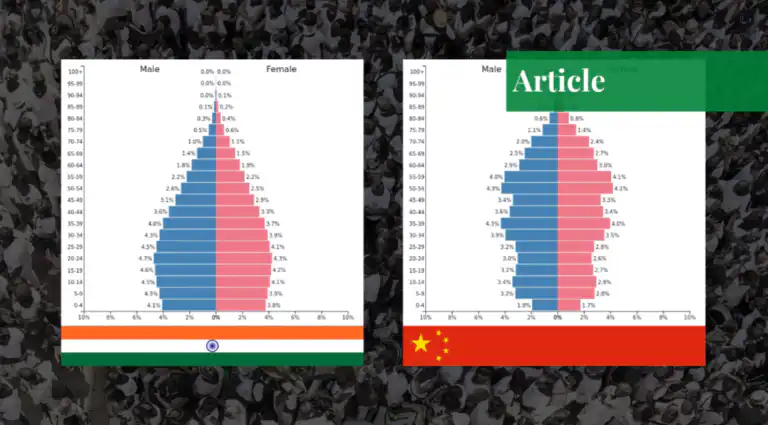
In 2023, India overtook China to become the most populous country in the world for the very first time. Without any formal ceremonies or crossing any borders, this achievement was reached at some point in the population data. However, its consequences for the distribution of power in Asia are significant.
Population has always served as one of the most crucial variables in establishing national power as a source of both labor force and military personnel, as well as consumer demand and, in certain circumstances, any invigorating economic processes. In 2026, the world’s two most populous countries are headed in opposite directions at the same time. China is becoming older and smaller, struggling with a demographic decline that its own scholars characterize as a structural crisis. India, for the first time, is youthful and expanding, with its working-age population being of tremendous size that no other country has ever possessed before, while experiencing all of the uncertainties in terms of whether the people will get proper education, skills, and jobs to turn quantity into wealth.
The gap between these two pathways is not just a fleeting statistical anomaly; it is one of the formative forces that could bring about the Asian century, impacting everything from levels of manufacturing efficiency to military prowess to the long-term viability of each country’s economic model.
What Demography Actually Means for a Nation
Demographic dividend signifies the potential growth that a nation can attain once its working-age population outnumbers the dependent group. The working-age population here refers to the group of people aged between 15 and 64 years. When a country has a greater number of people of working age compared to those in need of support, it will have positive economic consequences.
To receive demographic dividends, its conditions must be satisfied first. The working-age population must be well-educated, healthy, and paid work must be created in the economy to accommodate all existing workers. The countries that have successfully made use of their demographic dividends, such as South Korea or Taiwan, have made investments into education, infrastructure, and export-led production. Therefore, countries that did not make investments into the areas of education, infrastructure development, and export-oriented economies transformed their youth bulge into unemployment and instability.
It is important to note that the demographic dividend lasts only for a certain time period. As more people get older, the number of workers as compared to dependants may change in favor of dependants. This is true for the Chinese economy, which has already been seen by experts in demography.
China’s Population Cliff
When the National Bureau of Statistics of China issued its statistics in January 2026, it actually confirmed the predictions that had been made by analysts for years, even if it has happened sooner than what models have been anticipating. In 2025, China’s population shrank for the fourth consecutive year, dropping to 1.405 billion, 3.39 million less than in the previous year. The total number of births has fallen to 7.92 million, the lowest figure in decades. Consequently, the total number of deaths has gone up to 11.31 million. Thus, the difference between births and deaths is increasing instead of decreasing.
According to an analysis conducted by the Rhodium Group, drastic population decline in China is going to continue for another 10 years. The overall drop of nearly 60 million people in the course of a decade is expected to escalate to an annual decline of 7.6 million in 2035.
The chief reason is that the fertility rate fell to 1.01 births per woman in 2024, one of the lowest rates globally and about half the replacement rate of 2.1 needed for a steady population. While no single policy is solely responsible for this, the one-child policy introduced between 1980 and 2015 has instilled deep-rooted cultural and economic opposition to childbearing that has proved to be very resilient. The reality remains that urban women in China have around 1.11 children and that marriages fell by 20% in 2024, which constitutes the greatest yearly decline ever. The policies introduced by the state, including financial support, long maternity leave and easier marriage registration, have so far proved ineffective in changing the situation.
The impact on the labor market has already emerged and can be quantified. The cohort of the working-age population aged between 16 and 59, that is, the people who are essential for the working process in China, fell by 6.62 million in 2025. According to a RAND Corporation study, by 2050 the number of people actively involved in the labor process will decrease by 28 percent. In order to cope with the pensions challenge, the retirement age was raised in 2025 for the first time in years. The age will increase gradually from 60 to 63 years for men and from 55 to 58 years for women by 2040. Though this measure may postpone consequences, it does not solve the issue since there will be fewer young workers available to support a growing elderly population in the long run.
The strategic implications of China’s shrinking demographics go beyond economics, as a smaller working-age population leads to reduced military recruitment prospects and decreased taxation resources for defence. Furthermore, China’s leaders have invested heavily in achieving great-power status in advance of a more serious contraction of its population. According to many in the group of analysts known as Geopolitical Pragmatists, one of the most consequential structural tensions of today’s international system stems from the tension between China’s aspirations in international relations and its demographic realities.
India’s Youth Bulge
The demographic scenario of India will be very different from what it looks like in 2026. As the population of India is around 28 years of average median age, and the country has around 65% of its population below the 35-year age. It indicates that India is facing the biggest demographic opportunity in history. According to the country’s demographic history, in the year 2026, the workforce will account for 68% of the country’s population of around 1.4 billion people. In 2030, the country will have around 1.04 billion people between the ages of 15 and 64, which will make it the largest workforce country in the world in terms of population size. It is also predicted that the demographic window will be open till 2055, giving almost 30 years of demographic advantage.
Now, the economic indicators of 2026 allow us to maintain cautious optimism. As per the Economic Survey of India for the financial year 2025-26, there were 562 million employed people in the country during the second quarter of FY26. The unemployment rate fell to 4.8 percent in December 2025, while the LFPR reached 56.1 percent. India continues to be the fastest-growing economy of the world with an annual growth rate of over 6 percent.
The issues at hand are both systematic and urgent. According to the India Employment Report 2024, youngsters constitute 83% of the jobless workforce in India. This number is a clear reflection of the sluggishness in hiring new applicants in the job market. The India Graduate Skills Index 2025 pointed out that barely 42.6% of graduates were stated to be employable, falling from 44.3% in the previous year. From 40% to 50% of engineers remain unemployed owing to the mismatch between the education received and skills required in the market. The IMF estimates that reducing the gender employment gap in India alone can add up to 27% of GDP, proving that a great deal of human resources remain untapped.
India also faces a significant regional disparity that makes any national evaluation difficult. The southern states Tamil Nadu, Karnataka, Kerala, Telangana, and Andhra Pradesh are composed of an older and productive population. These southern states contribute a large share of national tax revenues and innovations. The northern states, on the other hand, have far more youth but are less educated, have fewer industries, and have higher unemployment rates. In the coming twenty years, the benefits of India’s demographic dividend will depend largely on how this regional disparity is tackled.
Where Demography Meets Power
The practical consequences of demographic change can be observed across multiple industries at the same time. In manufacturing, changes have already been noticed. As China has seen an increase in the cost of labor and a decrease in the working-age population, multinational companies have sped up their “China plus one” approach by diversifying their supply chains through cheaper alternatives. India, Vietnam, and Mexico have been the main countries that benefit from this move. The Production Linked Incentive system in India has led to investments in electronics, medications, and textiles, so the growing working-age population of the country means that production will continue to be developed for many years ahead.
The comparison when it comes to army strength is complicated. The People’s Liberation Army of China has been in a phase of modernization that emphasizes technology, accuracy, and cooperation rather than numerical superiority. China has a problem with recruitment indeed, but it has also been developing its military ideology away from the conventional approach for about two decades already. India does not have a recruitment problem because of the youth population that is constantly growing. The Hudson Institute stated that the problem for India does not lie in recruiting but in its establishment of armed forces that are competitive enough when compared to the opportunities offered by the private sector.
In terms of innovation and human capital, the situation is even more intricate. In response to the demographic problem it faces, China directs the majority of its resources into maximising the productivity of its economy through its investments in automation and technology. As reported by the National Bureau of Statistics in 2026, the average education level of Chinese citizens aged between 16 and 59 years has increased to 11.3 years, coupled with another piece of information, which is that the number of people engaged in research and development reaches 10.8 million. In this sense, China succeeds in changing the approach to its labour force from mere quantity to the adoption of more quality-oriented workers. In the case of India, its advantage is based on numbers; however, the success of its efforts in becoming innovative would depend on how educated its workforce is and how much money is allocated for research programs.
Conclusion
China’s problem with its demographics is deep-rooted, mostly unfixable in the short- to medium-term, and developing at speeds more rapid than expected even five years ago. Having gained immensely from its demographic dividend, China is now faced with the problems created by its disappearance against the background of geopolitical tension and economic changes. There hasn’t been a country that managed to get through a contraction of this kind without serious disruptions, and it is still unclear how China will cope with the situation.
India’s demographic opportunity is genuine, limited, and condition-related. The opportunity exists until 2055 at least, which is a good amount of time. However, demographic opportunities will not wait for politics or delayed investment. A large number of young people who are not employed and are not skilled enough constitutes a real danger due to the fact that it may lead to social instability should the labour market fail to absorb new workers sufficiently in the future.
What gives significance to this comparison affecting Asia’s power dynamics is that the comparison is still alive. China remains immensely powerful in terms of capital, infrastructure, technology, and institutional muscle. Its demographic crisis has yet to create any concrete challenges that it may bring in the future. India is large enough, but transforming its demographic strength into a real strength is still in progress.
If you want to submit your articles and/or research papers, please visit the Submissions page.
To stay updated with the latest jobs, CSS news, internships, scholarships, and current affairs articles, join our Community Forum!
The views and opinions expressed in this article/paper are the author’s own and do not necessarily reflect the editorial position of Paradigm Shift.

Kainat Farooq is a passionate International Relations student with a strong interest in diplomacy, policy, and global affairs. She is dedicated to contributing thoughtful analysis and research on international issues.