For years, the internet worked on a fairly simple exchange. Let’s suppose we use Google to search for something; it shows us various website links. Out of those links, we click one link to read the article or watch the video, or an advertisement to buy something. Through this, these websites get a visitor, and that visitor is worth something through advertising, subscriptions, sales, or future engagement.
Artificial intelligence is quietly changing that conventional arrangement. Several AI tools make searching convenient for us. We simply ask a question and receive the answer without visiting the website that generates the information in the first place. Google AI Mode gives us an AI-generated summary. ChatGPT can search the web and explain what it finds for us. Perplexity can gather information from several sources and present it as one answer.
It is convenient, but convenient for whom?
The Click Is Disappearing
The problem gets instantly solved with the help of AI tools. A 2025 Pew Research Centre analysis looked at 68,879 Google searches. It found that users clicked on a search result in only 8 per cent of visits when an AI summary appeared. When there was no AI summary, the click rate rose to 15 per cent. Clicks on sources cited inside the AI summary happened in just 1 per cent of visits.
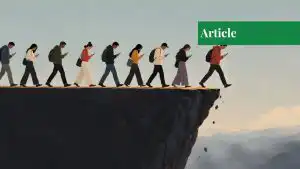
That is the basic idea behind the zero-click economy. The user gets the information, but the publisher does not necessarily get the visit. This matters because a website visitor is not just a number in Google Analytics. For many publishers, that visitor is how an article eventually pays for itself. It is an opportunity to build a relationship with visitors, with a high chance of subscription, more newsletter sign-ups, and more advertising impressions.

Remove enough of those visits and the economics of publishing start to change.
AI Did Not Create Zero-Click Search
It would be unfair to blame AI for everything. For years, search engines have been answering questions directly. Weather forecasts, sports scores, calculators, knowledge panels, and featured snippets have all reduced the need to click on a website.
AI simply takes the idea much further. Instead, AI not only searches for one fact, but an AI system takes information from several websites, combines it, rewrites it, and gives us a reasonably complete and polished answer.
That is much harder for publishers to compete with because the search engine is no longer simply sending the reader somewhere else. It is becoming the place where the reader finishes the journey.
The Platform Has a Different Incentive
This is where the issue becomes bigger than SEO.
Google says AI Overviews are sending billions of clicks to the web and argues that overall organic click volume has remained relatively stable. Google also says users are searching more and that clicks coming from AI experiences can be higher quality.
Publishers and independent researchers, however, are seeing a more complicated picture. A 2026 field experiment found that removing Google’s AI Overviews and AI Mode increased clicks to publishers. Another 2026 study found that AI-generated search experiences reduced publisher referrals without producing a corresponding improvement in user experience.
The disagreement matters because it shows this is not simply a question of whether AI is “good” or “bad”. It is a question of who captures the value created by information. A publisher spends money hiring journalists, researchers, writers, and editors. The article is published openly on the web. An AI system can then use that information to construct an answer that keeps the user inside its own interface.
The publisher may receive a citation. But a citation is not the same thing as a customer.
A Citation Does Not Pay the Bills
This is perhaps the strangest part of the new system. An AI answer can say, “According to [this publication]…” and even provide a link. That looks like a citation, and technically it is.
The publisher’s financial problem can be solved only through acknowledgement in AI searches when nobody clicks the link to their published content. Research published in 2026 found that more than half of the websites cited in Google AI Overviews have advertisements in their content; that means publishers are not getting the opportunity to monetise their content with a visit even when their content is being used as part of the answer.

That creates a difficult bargain. Publishers need their content to be visible so AI systems can discover and cite it. Yet the better those systems become at answering questions without requiring a visit, the less reason a user may have to visit the publisher.
The source becomes essential to the answer but less essential to the user’s journey.
What Happens When Publishers Stop Feeding the Machine?
This is where the long-term problem gets serious.
The open web depends on a cycle. Publishers produce useful information because producing it brings some economic return. Search engines send people to that information. Those visits help fund the next generation of content.
But what happens if AI systems increasingly extract value from that content while sending fewer people back?
A recent 2026 research paper described this as a potential form of “corpus erosion”. Its argument is straightforward: if publishers make their content freely available for users and do not receive much financial value, eventually, they will restrict access to crawlers, most probably start publishing less original content, or invest less in expensive journalism and research.
In other words, AI could become extremely good at answering questions while gradually weakening the ecosystem that supplies the answers. That would be a strange outcome. The machine would not destroy the web overnight. It could simply make the economics of producing the web harder and harder to sustain.
The Platforms Are Not Completely Ignoring Publishers
There is another side to the story.
Likewise, OpenAI already tells publishers that websites can appear in ChatGPT search and that publishers allowing its search crawler can track referral traffic. Google has also introduced features intended to make sources easier to discover inside AI Search.
These steps matter.
Moreover, AI companies clearly understand that they need a healthy supply of fresh, reliable information. The problem is whether linking to a source is enough when the user’s need has already been satisfied before the click. That is the part no interface redesign has completely solved.
Maybe the Real Currency Is No Longer the Click
For publishers, the answer may eventually involve changing what they consider valuable. Now, AI systems are the first place for people to find information; being cited might be important for reputation even if it doesn’t result in traffic right away. Stronger direct connections through newsletters, memberships, communities, subscriptions, and original content that is difficult to condense into a brief AI synopsis may be necessary for publishers.
But there is a limit to how much publishers can adapt individually. If the basic economics of the web shift from “create information and receive visitors” to “create information so someone else can answer with it”, the entire publishing model needs to be reconsidered.
The zero-click economy therefore raises a question much bigger than SEO. Who should benefit when an AI system turns thousands of hours of human-produced information into one convenient answer?
The user gets convenience. The AI company gets engagement. The publisher provides the raw material. The difficult question is whether the publisher gets enough in return to keep producing it. If the answer is no, the biggest risk of AI search may not be that people stop looking for information.
It may be that fewer people can afford to keep producing the information AI needs in the first place.
If you want to submit your articles and/or research papers, please visit the Submissions page.
To stay updated with the latest jobs, CSS news, internships, scholarships, and current affairs articles, join our Community Forum!
Find our FREE quizzes and MCQs here!
The views and opinions expressed in this article/paper are the author’s own and do not necessarily reflect the editorial position of Paradigm Shift.
Hooria Akbar is an independent researcher and content writer with a strong interest in contemporary issues across AI, technology, society, and emerging trends. She writes research-informed articles, thought pieces, and blogs on a wide range of topics, aiming to present complex ideas clearly and engagingly for diverse audiences.