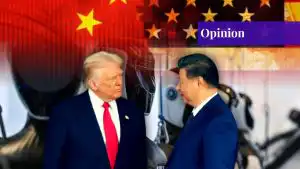
For years, we have seen a close friendship between the West and the East with Pakistan. Recently, we can see Pakistan being stuck between two economic rivals. But the main question is, can Pakistan actually afford to choose China over the West?
China can be seen expanding its influence across the world, especially in South Asia. China has been extending its influence across borders with trade and investments such as CPEC. This shows that China has increasingly become important as the global power balance has shifted away from the traditional Western-dominated system. China offers multiple benefits to Pakistan, such as strategic support, defense alliances, and investments, while, on the other hand, the United States and Europe remain important to Pakistan’s trade, diplomacy, and financial stability.
All of this creates a dilemma: even though China may appear to be a more organic partnership, Pakistan’s economic dependence on Western institutions and markets creates a completely different narrative. Therefore, the question is not simply whether Pakistan should decide between China and the West, but where they possess the economic and diplomatic autonomy to choose a side at all.
CPEC: Opportunity or Dependency?
While talking about Pakistan and China’s growing friendship, CPEC has become one of the clearest symbols of their relationship. Its massive investment in infrastructure, energy, and transportation has the potential to address some of Pakistan’s longstanding developmental issues. However, the relationship also raises an important concern about dependency.
If Pakistan keeps on depending on China’s investment without actually strengthening its domestic economy, there are risks of replacing one form of external dependence with another. This is why CPEC should not be seen as a success or a failure but as an opportunity that has long-term benefits depending heavily on Pakistan’s own economic plans.
Why Pakistan Still Needs the West
Regardless of Pakistan’s growing relationship with China, Pakistan cannot distance itself from the West. The United States and European countries still remain important destinations for Pakistan’s exports, while the Western states also have a significant role in remittance investments and Pakistan’s diverse integration into the global economy. Above all, Pakistan’s constant reliance on the IMF shows that its relationship with Western institutions remains significant. This essentially creates a contradiction: Pakistan may wish to increase and strengthen its strategic alignment with China, but its economic circumstances disrupt that.
The Cost of Choosing Sides
Currently, economists claim that Pakistan’s position economically is vulnerable. They have observed that during Pakistan’s periods of financial crisis, it has repeatedly asked for assistance from the IMF to stabilize its balance of payments and restore its international reputation. Even though the IMF is considered to be an international institution, it is still largely dominated by Western powers. This makes the West powerful in decision-making and influential within the global financial system.
This weakness or vulnerability has been observed by economists such as Atif Main, who argues that Pakistan’s economic issues are primarily structural and cannot be resolved through outside financial assistance only. Similarly, Adeel Malik also emphasized the need for profound reforms to cater to and target Pakistan’s long-term economic weaknesses.
Consequently, Pakistan cannot really pursue a foreign policy that caters to and treats China as a substitute for the entire Western economic system while also remaining dependent on internal financial support. Alternatively, its economic weaknesses suggest that Pakistan must maintain relationships that are diverse and preserve access to the Western-led financial institutions while also expanding investment, trade and economic cooperation with China.
The India Affect
Pakistan’s arrangement with China is also driven by the change in the balance of power in South Asia. India can be seen expanding its relationship with the United States, which caused Pakistan to deepen its partnership with China as a counterbalance. From Islamabad’s perspective, maintaining strategic relations with Beijing can be seen as advantageous. However, excessive involvement can pose threats to Pakistan, for example, geopolitical competition between India and China. This is why Pakistan must consider that creating a close alliance with China can bring benefits but can also create rivalry that cannot be controlled.
The Problem with Choosing Sides
The biggest flaw in the idea of choosing between two entities like China and the West is that there are assumptions being made, assumptions like global politics operating through division between two groups. Modern international affairs are far more complicated; Pakistan not only has close relations with China and the United States but also with the Gulf states, Central Asian countries, and the European Union. If Pakistan declares a serious arrangement with one major power, it can affect its diplomatic relations with others as well, hence creating limitations in building relations with others.
Sovereign Self-Reliance
Realistically choosing sides between the West and China can allow Pakistan to adapt or pursue something called sovereign self-reliance or strategic autonomy. This means maintaining strategic and close relations with the two competing powers while also avoiding complete dependency on them. This would allow Pakistan to be involved in Western affairs and markets as well as benefit from Chinese investments and other cooperation. On the contrary, this approach requires more than just diplomacy; it also requires a strong domestic economy. If Pakistan becomes more economically independent, then it will be able to pursue a broader and self-sufficient foreign policy.
Ideology vs National Interest
Ultimately, Pakistan’s foreign policy should be determined by national interests and not loyalty towards its allies. This is an approach that is advocated by economists such as Michele Ruta and Robert W. Stiger. These economists argue that geopolitical competition and rivalry should not affect the economic benefits of bilateral trade, and that governments can still pursue cooperation when it enhances national welfare.
For Pakistan, this suggests that China is definitely an alternative to the West, which can be as restrictive as making assumptions like Pakistan must maintain and remain in the Western sphere. China comes with opportunities for regional interconnectedness, investments, and infrastructure, while the Western institutions and markets remain crucial for economic integration. There is evidence, such as World Bank trade data, that demonstrates that both the Western and Chinese economies are vital for Pakistan.
Thus, rather than picking sides, Pakistan should focus on pursuing economic diversity, an independent economy, and diplomatic benefits from both while also maintaining autonomy over its own policymaking.
No choice for Pakistan, really?
Eventually, Pakistan cannot really afford to pick between China and the West due to factors like diplomatic and economic interests, which results in a connection between them. China may find it hard to resist Pakistan’s own strategic and infrastructural interests, while Western markets and global institutions also remain important to its economic stability. The real hurdle is not about choosing which power Pakistan should support, but it’s about developing enough economic independence to avoid depending on either. In the end, Pakistan should prioritize its own foreign policy and maintain a strategic diplomatic balance rather than complete dependence.
If you want to submit your articles and/or research papers, please visit the Submissions page.
To stay updated with the latest jobs, CSS news, internships, scholarships, and current affairs articles, join our Community Forum!
The views and opinions expressed in this article/paper are the author’s own and do not necessarily reflect the editorial position of Paradigm Shift.

Aima Hussain is currently a student at the Lahore School of Economics, with a keen interest in politics, international relations, and the forces shaping an increasingly interconnected world. Drawn to the intersection of power, history, and society, she enjoys questioning conventional narratives and examining the stories behind major
political developments. Her writing reflects a curiosity about the world beyond the headlines and the ideas that continue to shape it.