Why Cybersecurity Matters in Smart Cities
Pakistan is in a rush to develop smart cities. Urban life is getting rapidly connected with projects like Capital Smart City, Lahore Safe City, Islamabad Safe City, smart surveillance systems, digital governance platforms, and the overall Digital Pakistan Vision using IoT sensors, artificial intelligence, cloud computing, CCTV networks, smart traffic systems, intelligent electricity grids, and online public services. The technologies offer increased efficiency, good governance, and a higher quality of life.
Pakistan’s Rapid Digital Expansion
The digital infrastructure is growing at a much faster rate than Pakistan’s cybersecurity efforts to protect smart cities. Its consequences are exposing critical services and citizens’ data and national security. If cybersecurity is not considered as a key component of smart city planning, digital transformation can lead to more issues than solutions.
Growing Cybersecurity Challenges
The key to a smart city is the integration of various technologies that gather and analyze huge amounts of real-time data. They are used for monitoring traffic, water systems, and electricity consumption. Video cameras are used to stream into surveillance networks. Government services are used online by citizens. If security is not keeping up with connectivity, then each new device is a new pathway for attack.
Expanding Attack Surface in Smart Cities
Pakistan’s digital revolution is happening, and it’s there for all to see. The connectivity has expanded greatly in terms of bandwidth. As per the Pakistan Telecommunication Authority (PTA) and Pakistan Economic Survey 2025-26, the number of broadband subscribers had surpassed 150,000,000 and reached around 161,000,000 by March 2026. At the same time, the National CERT has recorded ransomware attacks against government agencies and has recommended that the institutions start monitoring them using Security Operations Centers (SOCs).
IoT Devices: The Weakest Link
There are a number of key findings that account for the increased risks. Cybersecurity is falling behind the curve in the digital revolution. Pakistan is focusing on the quickness of deployment of digital services; there are areas where security standards, investment, and good cyber governance are lagging behind. The outcome is planning that relies on technology, and systems are designed to be at risk.
The Internet of Things (IoT) devices are still one of the weakest links. A great many are still shipped with default passwords, do not use proper encryption, have infrequent updates, and have weak authentication. The inability to create secure IoT devices is one of the most common problems encountered by all smart cities globally, according to international cybersecurity experts.
Consequences of Cyberattacks on Smart Cities
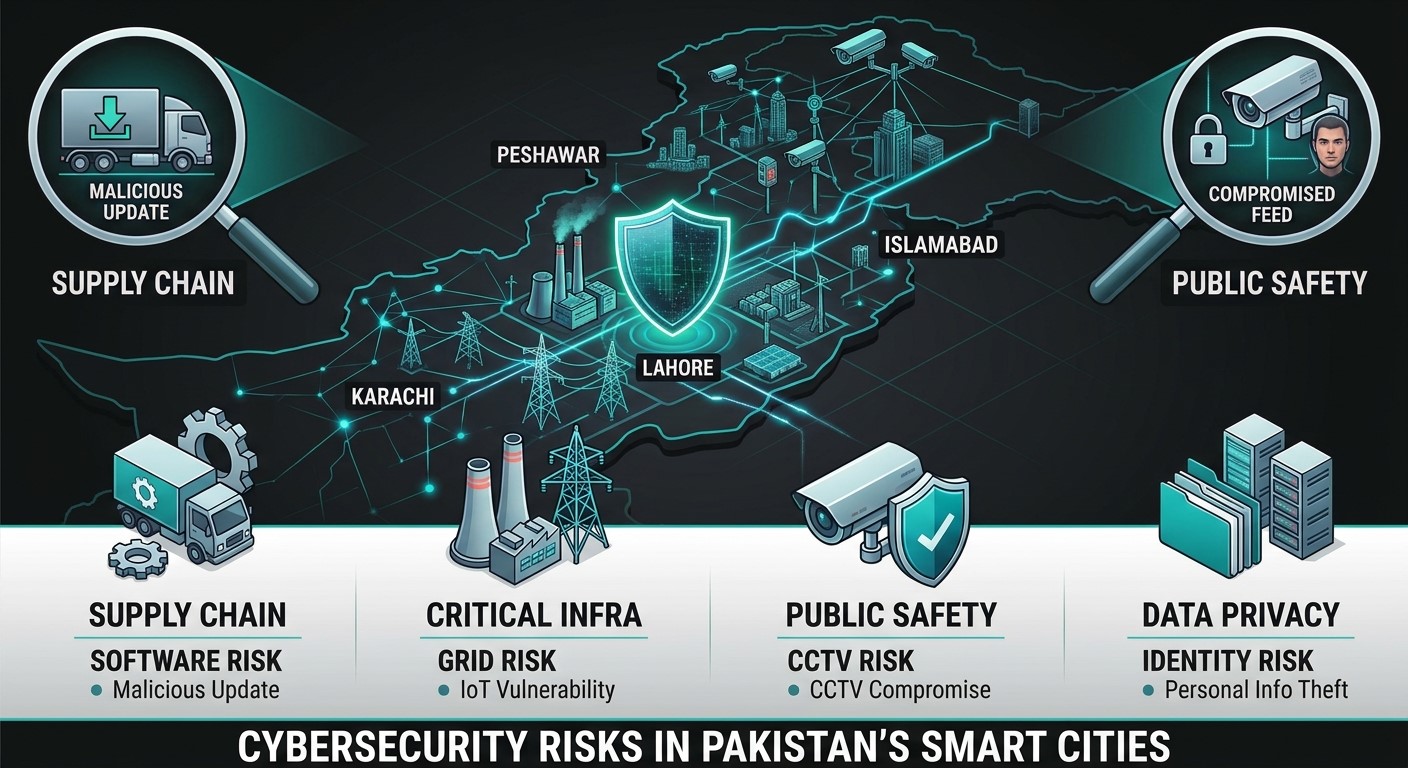
Smart cities increase the attack surface too. Each of the devices connected in the city—smart traffic lights, electricity meters, CCTV cameras, parking systems, public Wi-Fi, and water sensors—offers a new potential entry point. If an attacker manages to breach one poorly secured IoT device, he or she may be able to advance laterally through interconnected networks. One compromise can thus compromise many systems simultaneously.
Evidence of Cyber Threats in Pakistan
Data theft is not the only type of cyberattack that can occur in a smart city. They can cause power outages, delays on transportation networks, emergency response problems, disruption to healthcare services, water issues, and communications. The impacts are not just economic; they also have public safety and national security implications. Moreover, citizens’ privacy is also constantly being breached, with smart cities collecting the likes of location data, CCTV footage, biometric data, transport, and government service records.
Building Secure Smart Cities: The Way Forward
Even with the laws in place, there are still implementation gaps. In 2020, Muhammad Waqar Anwar and Umair Pervez Khan found that even though Pakistan had enacted laws like the Prevention of Electronic Crimes Act, the implementation of these laws is still facing problems due to institutional constraints, lack of technical capacity, and low cybersecurity awareness.
The hazards are clear cause and effect. As the number of digital systems increases, the number of connected devices increases. The more devices that are connected, the more entry points there are for an attack. The more attack points there are, the more likely it is to be compromised by a cyber threat, unless security is added throughout the system. A smart city is a network of networks; if one is compromised, it can open the door to several other parts of the network, and a single event can impact multiple public services at the same time.
This has been confirmed by the evidence from Pakistan and abroad. The National CERT Director General has stated that a government agency was hit by ransomware in 2026, leaving the institutions with a six-month deadline to set up a Security Operations Center. In June 2026, the Capital Development Authority’s online billing system was hit by a ransomware attack. Hackers breached sensitive billing data and demanded a Bitcoin ransom and threatened to leak it on the dark web. The National CERT warned 39 federal ministries in August 2025 of the threats posed by the ransomware attack known as BlueLocker.
Pakistan should now question not just the speed at which a smart city can be constructed but also how securely it can be constructed. A smart city is not truly smart when its digital underpinnings can be breached by weak passwords, unpatched Internet of Things devices, or outdated software and weak cybersecurity governance. Cybersecurity needs to be at the heart of a smart city’s design and development, not an afterthought.
Future development needs to have a security-by-design approach, meaning that the entire development process should be carried out with a security perspective. That means continued investment in technical capacity, better institutional coordination, frequent security testing, and timely patches for vulnerabilities and adequate enforcement of existing cyber regulations.
Cybersecurity is outpacing digital transformation, making smart cities in Pakistan more appealing targets for cyberattacks. Public services and personal data are in danger due to weak IoT security, highly interconnected critical infrastructure, implementation gaps, and limited cyber-resilience. Technological advancement will enhance public safety and national security only when security is considered fundamental and not an add-on. If this change does not occur, the concept of smart cities could lose much of its credibility as a result of the same connectivity that makes it so smart.
If you want to submit your articles and/or research papers, please visit the Submissions page.
To stay updated with the latest jobs, CSS news, internships, scholarships, and current affairs articles, join our Community Forum!
The views and opinions expressed in this article/paper are the author’s own and do not necessarily reflect the editorial position of Paradigm Shift.

Areesha Zainab is an undergraduate student of international relations with an academic interest in cybersecurity, emerging technologies, and national security. Her research focuses on the security challenges arising from digital transformation, particularly cybersecurity risks to smart cities and critical infrastructure.