
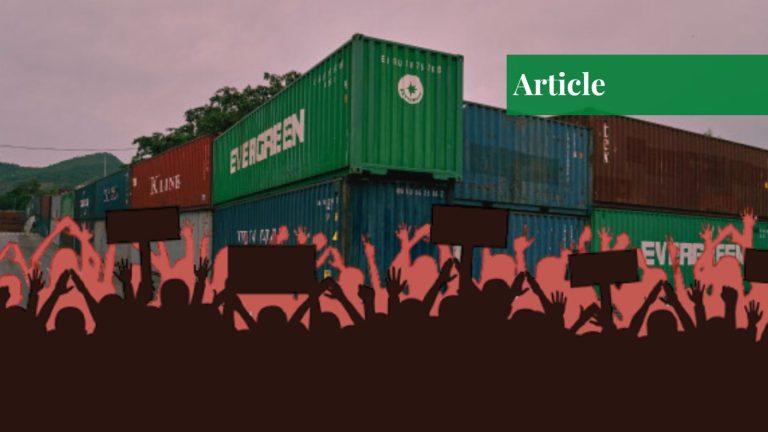
The sight of shipping containers on key roads has now become a routine feature of the streets of the federal capital of Islamabad, a warning sign of political confrontation. Major roads and entry points were once again shut down in September 2026, ahead of a planned march by Pakistan Tehreek-e-Insaf (PTI) for the release of former Prime Minister Imran Khan in the federal capital. Security forces were deployed in large numbers on the streets, and containers were set up around the important access points and in the Red Zone sectors of the city. The PTI later postponed its mobilization plan from September 27 to October 4, but many of the security arrangements were left unchanged.
For the common man, these containers are more than a traffic management solution. They have emerged as a tangible reflection of a recurring phenomenon of Pakistan’s political activity: the politicization and confrontation of political issues in the streets and the politics of Islamabad as the main arena of political mobilization and confrontation outside parliament.
There is a long history of protests, demonstrations, strikes, sit-ins, long marches, civil disobedience campaigns, and mass political movements in Pakistan. Some were successful in achieving their immediate goals, whereas others did not meet their main demands. Still others did not succeed in realizing their original purpose, but had political, constitutional, or institutional effects.
It is not possible to simply answer the question of whether a protest “won” or “lost” the history of protest in Pakistan. A movement can not only oust a government but also influence the public discussion. Another can force a government to comply with a certain demand, and at the same time yield broader institutional effects that were not intended.
This article analyzes the history of protest politics in Pakistan from early instances of collective resistance to the current days of long marches, political sit-ins, and street mobilization. It deals with what protesters demanded, how the governments and state institutions reacted, whether the protesters succeeded in fulfilling their immediate demands or not, and what kind of political, constitutional, or institutional change they created in Pakistan.
The First Time In History That People Protested
The urge to “take to the streets” against injustice is older than political parties and modern democracy. An early reported incident was in ancient Egypt in the 12th century BCE in the reign of Pharaoh Ramesses III, when labourers at the Deir el-Medina went on strike to protest the failure to pay their grain.
The workers joined forces to withhold their labour and to call for their wages, and it is generally thought to be the first recorded labour strike in human history. This is important because it marks an early instance of collective action being applied to try to make the authorities change their policies to respond to grievances, even though there were protests earlier than that, before written records were available.
The Evolution of Protest in Pakistan
Since 1947, street politics has played a role in Pakistan’s political past. Students have been involved in many protests and movements that have challenged governments and institutions, including student movements, religious campaigns, labour protests, constitutional struggles, political marches, and civil-disobedience movements.
In general, the history of protests in Pakistan can be categorized into four phases.
- The first was the early state-building phase (1947-1958), when religious, constitutional, student, and political campaigns arose in the wake of the creation of the new state and its direction.
- The second was the era of military rule and mass mobilization in politics from 1958 to 1988, which witnessed the anti-Ayub movement, agitation against Zulfikar Ali Bhutto, and the Movement for the Restoration of Democracy (MRD) against General Zia-ul-Haq.
- The third period (1988-2007) featured the alternation of civilian regimes, opposition marches, and frequent clashes between political parties, presidents, and other state institutions.
- Since, primarily from 2007 onwards, the fourth period witnessed the advent of long marches, political mobilizations over television, prolonged dharnas and the mushrooming of Islamabad as a key venue for political confrontation.
The Anti-Ahmadiyya Agitation
One of the earliest big mass upsets in Pakistan after Independence was the agitation against the Ahmadis (Qadiani) community in 1953. Religious-political organizations demanded, among other things, that Ahmadis (Qadiyanis) be declared non-Muslim and that prominent government officials like Foreign Minister Sir Zafarullah Khan be ousted. The violence erupted, especially in Punjab. In March 1953, martial law was declared in Lahore by the government.
None of the main demands of the agitation were immediately accepted. Instead, it gave rise to a significant political and institutional crisis.
A government commission, the Munir Inquiry Commission, was set up to investigate the causes of the disturbances. The episode also led to the dismissal of the Punjab government led by Mumtaz Daultana and the sacking of Prime Minister Khawaja Nazimuddin and his cabinet. The meaning of 1953 is far-reaching, with implications beyond the original demands.
It showed the political force and the dangers of political competition mixing with mass religious agitation that could have been mobilized. The next Munir Inquiry was a significant document in the constitutional and political history of Pakistan on the issue of religion, citizenship, and the state.
The immediate objective of the protest was not achieved through the agitation. However, there were more widespread consequences and a greater political/institutional impact.
Movement Against Ayub Khan
The ‘Movement against Ayub Khan’ of 1968-69 was one of the most impactful mass political actions in the history of Pakistan.
It started as a student movement, but quickly spread to workers, labour unions, professionals, and opposition political parties. The mobilization was brought about by a combination of economic grievances, political restrictions, and opposition to Ayub Khan’s political system. This movement continued to major cities and eventually even into smaller urban centres.
A key moment was when students were killed in the police rioting at the end of 1968. Student organizations stepped up their mobilization, and political parties and labour groups began to participate in the movement.
This student-led agitation had now turned into a much larger political problem. By early 1969, the opposition against Ayub Khan grew such that it started to cast doubt on his political stability. He resigned in March 1969 and handed over power to General Yahya Khan. So, the short-term goal of getting rid of Ayub Khan was accomplished.
But the far-reaching implications were far more nuanced. The introduction of political reforms was followed by the first general elections in Pakistan based on adult franchise in 1970 by the Yahya Khan regime. The political crisis that ensued was one of the reasons behind the events of 1971 and Pakistan’s disintegration.
So, the events of 1968-69 are a good example of why getting an immediate protest goal does not guarantee that all the ensuing effects will match the protesters’ expectations.
The immediate objective of the protest was achieved; Ayub Khan resigned. Long-term consequences took place in the country; a big political change ensued, culminating in the 1970 election and the 1971 crisis.
The Pakistan National Alliance (PNA) Movement
The next big national political agitation in the country was the PNA Movement in 1977. The PNA, which was a nine-party opposition alliance, refused to accept the outcome of the general election held in March 1977 and claimed that the elections were tampered with. This came to a head in a mass protest movement, strikes, demonstrations, and clashes.
The movement later took a religious tone, and the PNA also fought for a “Nizam-i-Mustafa” system. The Nizam-e-Mustafa movement was a major 1977 political and religious campaign in Pakistan aimed at replacing the government of Prime Minister Zulfikar Ali Bhutto with an Islamic system based on Sharia.
For many months, negotiations were ongoing between the government of Zulfikar Ali Bhutto and the PNA. History has it that the deal seemed to be closed in early July. On 5th July 1977, however, Ziaul Haq staged a military coup and ousted Bhutto from the government after imposing martial law. This makes it hard to classify this movement as a success or a failure in 1977.
If the primary goal is to oust Bhutto from power, then the movement ultimately helped bring about the one that did that. When the goal was one of a democratic political settlement via elections and negotiation, however, it was a completely different story: military intervention supplanted the civilian political process.
Thus, a military dictatorship was imposed on the movement, and the two were separated by a long period of military rule. In the short term, Bhutto lost her position. Broader repercussions: this led to military rule and martial law supplanting the civilian political system in the country.
The Shia Zakat Protest
In the 1980 protest against the Zakat and Ushr Ordinance by General Zia-ul-Haq in 1980, one of the most obvious examples of a protest on a specific policy that resulted in an immediate concession by the government is found.
In July 1980, Shia Muslims protested against the compulsory collection of Zakat under the new system being implemented by the state in Islamabad. Thousands of demonstrators converged around the area of the federal government, blocking the activity of the bureaucracy.
Eventually, the government was willing to allow Shias to provide Zakat voluntarily. This case is of special significance because it proves that a protest doesn’t need to bring down a government to accomplish its goal. An explicit policy requirement can be negotiated and accepted.
The immediate objective of the protest was achieved, and Shia obtained exemption from the Zakat.
The Movement for the Restoration of Democracy 1983
In 1983, the Movement for the Restoration of Democracy (MRD) came into existence as a wide coalition against General Zia-ul-Haq’s military regime.
The movement called for a restoration of democracy, the restoration of the Constitution of 1973, and an end to military rule. It gained added strength in Sindh, where demonstrations and civil disobedience were met with a high level of repression.
Although substantial mobilization took place, the movement failed to create enough political pressure throughout the country to oust Zia. The military government persisted, and even flourished, right up to the late 1980s.
The movement, however, played a significant role in Pakistan’s democratic struggle for freedom. It showed that a government can hold on to power, even in the event of a large protest movement, if the opposition is geographically localized, if the repression is widespread, and if mobilization is not widespread enough in the country.
The immediate objective of the protest was not achieved as General Zia continued to rule till his death. However, the broader impact was that the movement entered into the Pakistani democratic opposition’s legacy.
Long Marches Enter the Political Mainstream 1989-93
Following the return of party-based democratic politics in 1988, long marches were gradually adopted as a means of contestation between civilian political parties. During Mian Muhammad Nawaz Sharif’s first government (1990), opposition parties marched towards Islamabad. This march was peaceful.
Benazir Bhutto initiated another long march against Nawaz Sharif’s government in 1992, accusing him of rigging the last general election of 1990. The political face-off spurred a greater crisis, which was later resolved by the Supreme Court when President Ghulam Ishaq Khan dissolved the National Assembly.
Another skirmish erupted between Nawaz Sharif and President Ghulam Ishaq Khan and the military establishment in 1993. In the end, both the president and prime minister resigned due to the pressure of Army Chief General Waheed Kakar.
The episodes illustrate one of the key features of the Pakistani political system in the 1990s, that is, street mobilization often was intertwined with institutional disputes between the presidency, parliament, political parties and the military.
The immediate objective of the long marches was to be removing government was not achieved in 1992. In 1993: Although this was a major political shift, it was not brought about by street mobilization alone, but by a wider institutional crisis.
The Lawyers’ Movement 2007-09
The Lawyers’ Movement was another milestone in the history of protest in Pakistan. The movement started in March 2007 when President and Army Chief General Pervez Musharraf suspended the sitting Chief Justice of the Supreme Court, Mr. Iftikhar Muhammad Chaudhry. Lawyers staged demonstrations, boycotts, rallies, and finally long marches for the restoration of the judiciary. The movement quickly spread to the political parties, civil society, and parts of the media.
Following Musharraf’s imposition of emergency rule in November 2007, and the removal of judges once more, the movement gained momentum. A second large-scale march towards Islamabad was called in March 2009. The government finally announced the restoration of the deposed judges, and the march was halted.
The movement thus fulfilled its core institutional aim of securing. It also had a broader impact. It put judicial independence, constitutionalism, and the nature of civilian institutions and military power at the center of the national political discussion.
The immediate objective of the protest was achieved, and judges were restored. However, if we look at the wider consequences, it was a significant episode of public mobilization over judicial independence and constitutional governance.
The PTI–PAT Islamabad Dharna 2014
The Islamabad sit-in 2014 was a fresh episode in the protest politics of Pakistan. Both Pakistan Tehreek-e-Insaf (PTI) and Pakistan Awami Tehreek (PAT) made separate marches towards Islamabad. PTI called for the resignation of Prime Minister Mian Muhammad Nawaz Sharif, investigation into General Elections 2013 and electoral reforms.
The PTI sit-in lasted for almost 126 days, in which case it was the first time in Pakistani political mobilization history that a party made the capital its base for months.
The December 16, 2014, Army Public School (APS) attack in Peshawar became a turning point in the PTI’s four-month-long Islamabad sit-in. In the aftermath of the tragedy, Chairman PTI Imran Khan postponed the party’s planned nationwide protest and, on December 17, announced the end of the sit-in, calling for national unity against terrorism. The decision did not represent the fulfilment of the PTI’s original demands; rather, the changed national security environment following the APS attack led the party to suspend its street mobilization and return to negotiations with the government.
The immediate objective of the Dharna was not achieved; the Prime Minister Mian Muhammad Nawaz Sharif did not resign. The broader consequence was that institutional and political discussions of election-related questions grew widespread, and sit-ins in Islamabad became the norm of political pressure. In addition, it helped increase public awareness about elections, including greater familiarity with electoral result forms, election tribunals, and other related processes and terminology.
2017 Faizabad Sit-in
The 2017 Faizabad sit-in was yet another major event in the development of protest politics in the country. The protesters, led by the Tehreek-i-Labbaik Pakistan (TLP) and other religious organizations, took the Faizabad Interchange in Islamabad-Rawalpindi hostage for almost 23 days. The protest was sparked by the contentious changes to the ‘Khatm-i-Nabuwwat‘ declaration made in the Elections Act, 2017, which led to the demand for action against those behind it and, most prominently, for the resignation of Federal Law Minister Zahid Hamid. The change was said to be a clerical error, and Parliament eventually amended the original to reinsert the word, but protesters continued to press for the minister’s resignation.
When an attempt was made by authorities to disperse the sit-in on 25 November, it proved unsuccessful and was accompanied by the spread of protest across the country. The government had agreed to Zahid Hamid’s resignation, release of protesters under legal conditions, publication of the report of the Raja Zafar-ul-Haq Committee and compensation for the loss caused by the protest, as part of an agreement reached with the protesters on November 27. The agreement also recognized the leadership of the army and was signed by a representative of the government, a representative of the protesters, and Retired Major General Faiz Hameed as a guarantor.
The immediate result was, therefore, proof of the protesters’ success in forcing the government to make large concessions following extensive mobilization and a long disruption of the capital. The institutional implications were more ambiguous, however. The agreement was challenged in court, and the legal process following the sit-in posed questions about the legality of the sit-in itself, the disruption of citizens’ movement and daily life, the role of the State institutions and the way the protest ended.
The main objectives of the Faizabad sit-in were achieved, as the government agreed to amend the law and the Minister for Law also stepped down from his position. However, the broader consequences of the incident extended beyond these immediate outcomes. It triggered a significant debate over the right to protest, public order, the exercise of state power, and the role of state institutions in resolving political confrontations.
Azadi March 2019 by JUI-F
Jamiat Ulema-i-Islam-Fazl (JUI-F) started its Azadi March towards Islamabad in October 2019 to demand the resignation of Prime Minister Imran Khan and the removal of his office. The march arrived in the capital, and the sit-in at H-9 in the capital lasted for about 13 days.
The main demand of the protest was the resignation of the prime minister. The immediate objective of the movement was not achieved, because the Government remained in place.
There were also difficulties in maintaining the involvement of the key opposition parties in the sit-in. The movement initially attracted several opposition parties, but participation was not sustained at the same level during the protest. Later, JUI-F changed the tone of its approach to “Plan B,” which included protests and road blockades in other regions of the country. The immediate objective of removing Prime Minister Imran Khan from his office was not achieved.
PTI’s Azadi March 2022
In April 2022, Imran Khan was voted out of the Prime Minister’s office by Pakistan’s Parliament; later, PTI started mobilising the political masses against the new government. It was in May 2022 when PTI staged a long walk towards the capital, Islamabad, with two main demands: that the National Assembly be dissolved immediately and Islamabad be called for fresh general elections.
The march was met with clashes, arrests, and restrictions on movement. The mobilization by PTI was eventually abandoned without PTI getting any of its immediate demands, including the dissolution of the National Assembly or any immediate announcement of a date for fresh general elections.
The immediate objective of the Azadi March was not achieved, and the National Assembly was not dissolved, and no date for immediate elections was announced.
2023 Protest, Violence and Crackdown
On May 9th, 2023, former Prime Minister Imran Khan was arrested, which led to widespread protests by PTI supporters throughout the country.
The disturbances were far from ordinary political protests, as some elements of the disturbances included burning, confrontation with security forces, attacks on public property, and attacks on military and other sensitive installations such as the General Headquarters (GHQ) in Rawalpindi and the residence of the Lahore Corps Commander.
In response, the authorities mounted a sweeping crackdown, including thousands of arrests and criminal charges against protesters and PTI leaders and workers, including the sitting legislators. The government also began to prosecute civilians suspected of attacking military establishments, under the auspices of laws which would have led to their trial in military courts.
Human-rights groups, such as Amnesty International and Human Rights Watch, condemned military courts for civilian trials and questioned the guarantees of due process and fair trials. The protests did not lead to the release of Imran Khan or to the withdrawal of legal and political actions against him. On the contrary, the episode was a significant escalation of the standoff between PTI and the State institutions.
Despite the large scale of the mobilization, its immediate objective was not achieved, as Imran Khan was not released from custody following the protests. Instead, the confrontation between PTI and the state intensified. The episode also had serious legal, political, and institutional consequences, including mass arrests, prosecutions, a prolonged confrontation between PTI and state institutions, and the trial of civilians in military courts.
Post-Election Protests 2024
The general Election in February 2024 ushered in another political protest wave, especially from PTI and its supporters. PTI accused the election of irregularities and manipulation of the election results and demanded investigations and remedial measures. As per the PTI, their candidates were barred from participating in and attend the electoral activities in their constituencies.
Protests were organized outside offices of the ECP Secretariat, provincial offices, and offices of Returning Officers (ROs) in different cities around the country. However, the ECP denied allegations of electoral irregularities, pointing to the fact that the election itself came with a host of irregularities, including delayed results, the internet going on and off during polling day, and allegations of rigging widespread throughout the country.
The protests failed to bring about a complete change in the general election and did not stop the formation of a new federal government. On March 3, 2024, the National Assembly elected Mian Muhammad Shehbaz Sharif as the country’s 24th elected prime minister on the back of a coalition based on a deal between PML-N, Pakistan People’s Party Parliamentarian (PPPP), and other political parties and independent candidates who secured the general seats.
The electoral argument, however, kept it very much alive in the political debate of Pakistan, with the questions regarding electoral administration, results, transparency, and complaints redressal remaining political contestations.
The immediate objective of the protest was not achieved, and there was no wholesale reversal of the election results or change in the federal government. As a broad consequence, the election administration, results, transparency, and dealing with alleged irregularities came to be a permanent political and institutional point of contention.
November 2024 March
Another March on Islamabad, PTI again rallied its supporters to Islamabad, demanding the release of their leader Imran Khan and other jailed party leaders, as well as the resignation of the government.
The party also condemned the election in February 2024, highlighting the irregularities in the poll, and called for mobilization to address that issue. The government in Islamabad ordered the deployment of police and security personnel, including a number of paramilitary troops, and closed roads in Islamabad and surrounding areas, while also prohibiting public gatherings in these areas.
There were clashes between protesters and security forces as the protesters drew near the capital. The protest was later withdrawn, and the major demands (Imran Khan’s release and resignation of the government) were not fulfilled.
The immediate objective was achieved principal’s demands not accepted. Broad ramifications: It followed a trend of mass political protests toward Islamabad, extensive security measures, clashes between protesters and security forces, and the continued political debate surrounding the GE-2024 and Imran Khan’s position.
Islamabad is once again caught behind containers in September–October 2026. The government started preparing for another PTI mobilization towards Islamabad in September 2026, which was also done on a wide scale. The shipping containers were set up at strategic points, and on the way to the Red Zone, extra security forces were deployed in Islamabad and its nearby areas.
While the government claimed that measures were taken to ensure public order and security, PTI saw its mobilization as a political campaign calling for the release of Imran Khan.
The Islamabad High Court (IHC) also took up the proposed protest. In the September 18 order, the court had ruled that activities that culminated in infringement of citizens’ fundamental rights would be a breach of the Constitution. The judgment highlighted the importance of a balance between the right to protest and citizens’ rights to freedom of movement and access to essential services.
The march by PTI was then postponed until October 4, 2026. But despite the postponement, containers were kept at a number of strategic points around the capital, such as Faizabad 26 number, and other key entry and connection points. Cost was a significant consideration in the arrangements. The rental of 1,550 containers alone cost Rs46.5 million a day, police sources estimated, adding that the cost of all the security measures is likely to rise after the postponement. Some schools in the capital have also been completely closed because they have been temporarily occupied to accommodate police personnel brought in from other provinces.
The preparations also impacted the goods-transport industry. The All-Pakistan Goods Alliance (APGA) claimed that around 2,700 vehicles and their crews were taken into custody by the police in Islamabad and Punjab for use in blocking the roads. Some vehicles and crews were still detained; some drivers’ documents, mobile phones and keys were confiscated, said the alliance. Such is the word of the transporters, and these figures and allegations should not be taken as independent facts.
The 2026 episode thus reflects the nature of Islamabad’s dharnas and its legacy going beyond opposition to the government. Consequences of the use of containers and wide-ranging security deployments may impact freedom of movement, transport, commerce and life in the capital and surrounding regions. It also reveals the increasing importance of the management of political protest not only as an issue of political mobilization and public order, but also one of constitutional rights and the broader City’s operations.
From the Ancient Strike to the Islamabad Dharna
Whether it is collective labour withheld thousands of years ago by workers from Deir el-Medina or political caravans that have visited Islamabad over and over again, collective action has been the source of pressure on authorities to take action over grievances. While its manifestations, whether strikes or demonstrations, long marches, sit-ins or extended dharnas, have shifted, the rationale has not: When political or institutional arrangements are seen as inadequate, the political actors go onto the streets.
History of Pakistan, however, indicates that success and failure in protest depends on other factors. In some movements, immediate action was realised, such as the 1968-69 movement led to the resignation of Ayub Khan, the 1980-81 Shia protest became successful and the exemption from compulsory Zakat was granted, the Lawyers’ Movement restored the deposed judges and the 2017 Faizabad sit-in resulted in significant concessions. Others, such as MRD, 2014 PTI sit-in, JUI-F Azadi March, 2022 PTI mobilisation failed to realize their main demand.
However, immediate effects can’t truly reflect the impact of a protest. The 1977 PNA movement is an example of how the political goal of achieving a desired outcome can have ramifications that extend beyond the protesters’ demands, in this case, the removal of Bhutto and the establishment of military rule. On the other hand, impotent actions can have ‘political legacies’. The MRD reinforced the democratic opposition tradition, and the practice of mass mobilization and prolonged sit-ins grew as an instrument of political pressure.
There are, therefore, two consequences to be evaluated: the immediate goal and wider consequences. The first question concerns the extent to which protesters had their demands met, while the second question focuses on the impact of the mobilization on political behavior, on public discourse, on the institutions of the state and on the relationship between citizens and the state.
This development has also transformed Islamabad into the main arena for the national political confrontation. Long marches have now increasingly turned into long dharnas, and the government has responded with road closures, security deployments and strategically placed containers. The impact of the protests and the government’s response also becomes felt by commuters, transporters, businesses and residents of the capital by 2026.
The containers on the roads of Islamabad are thus more than just temporary barriers. They have come to embody a persistent institutional dilemma – the dislocating of political issues from the formal spheres to the street.
History has not reflected the same in Pakistan, where each protest failed or succeeded in a similar manner. It demonstrates, instead, that street politics has become a viable element of the nation’s political toolbox. A more important question is whether political institutions can put in place effective enough mechanisms to settle big differences before they move to the streets of Islamabad. It has evolved from ancient to modern times, from workers not working to containers around the federal capital.
If you want to submit your articles and/or research papers, please visit the Submissions page.
To stay updated with the latest jobs, CSS news, internships, scholarships, and current affairs articles, join our Community Forum!
Find our FREE quizzes and MCQs here!
The views and opinions expressed in this article/paper are the author’s own and do not necessarily reflect the editorial position of Paradigm Shift.