
Introduction
Urbanization is a process by which large numbers of people concentrate in comparatively smaller areas of land and form cities. The formation and expansion of cities is in itself a complicated phenomenon. When it is not well planned and executed, the consequences are just as well grave! Ideally, when urbanization occurs, it has to be complimented by the formation of new cities, where people may settle down. The government creates an environment where economic activities may prevail and the residents have access to clean water, sanitation, housing, optimum healthcare and education facilities. They can afford the urban lifestyle, dreams of which bought them to migrate. This ensures the growth of services and employment alongside urban growth and bears sweet economic fruits.
However, when masses migrate to cities that are densely populated and their capacity to accommodate more is meagre. As a result, urban overcrowding invites an array of socio-economic evils. The migrants remain entangled between them and their determination to thrive begins to diminish, fading under the impoverishment that awaits their fate. This may be true for Pakistan. In this article, the phenomena of urbanization will be explored through a theoretical and historical perspective, and specifics will be applied in case of Pakistan’s urbanization.
Ideals of Urban Development: Theory and Practice from Ancient to Modern Times
Across the course of history, town planning has been done keeping in view the community, local economy, nation-building, and eventually sustainability. From ancient theorists like Vitruvius to contemporary thinkers like Jane Jacobs, humans have come a long way as societies increasingly urbanized and cities became more and more complex.
Urban Planning in the Ancient Times
Some of the oldest accounts of urbanization come from ancient times in Greece and Rome. One of the earliest thinkers of urban planning in recorded history was Hippodamus. While his original work hasn’t been discovered, he has been mentioned in Aristotle’s writings. Hippodamus proposed that cities shall be zoned, have a grid layout, and allow for public spaces. With streets at right angles, the grid layout was good for navigating through towns and also supported his second principle of zoning. Additionally, the provision of public spaces would make cities the hub for trade and socio-political interactions.
Miletus and Piraeus are amongst the most notable cities created as per Hippodamus ideals. The grid layout of Miletus facilitated the travel between the city and the port, making Miletus the hub for trade and culture in the Ancient Mediterranean. Similarly, Piraeus became a well-planned port city as it was zoned and organized according to a grid layout. It became a powerful economic hub for Athens in the 5th century BC as trade flourished.
Urbanization During the Islamic Eras
One of the most astonishing examples of civilizational expansion and urban development lies between 632 to 644 CE. This was the era of the second caliph in Islam, Hazrat Umer Bin Khattab RA. The Islamic civilization expanded in all directions during his reign. According to some sources, as many as 4,050 cities were added to the Rashidun Caliphate. This was the result of a massive expansion of the civilization through conquests and development. The area of this caliphate is said to be 2,200,000 sq km.
Along with the cities conquered many new cities were also founded during his reign. These include Basra, Kufa, and Fustat. These were the epitome of town planning. Markets were established at convenient points, mosques were in easy access for the public, and the cities had various quarters, each one of which had been allocated to a certain tribe. Roads and bridges were built, with shelter points at appropriate locations. Administrative buildings like Bait ul Maal as well as prison houses were also constructed. In all of this development, it was ensured that the cities were close to agricultural reservoirs, canals were built and water was available for various purposes of daily life for the citizens.
Baghdad is well known for the historical heritage it has left. The city of Baghdad during the Abbasid time period is amongst the most celebrated historical cities in the world. Its design included the principles laid out by Ibn Khaldun. It was characterized by the wall of Eastern City with its four gates serving as security checkpoints. The availability of mosques, monuments, and holy shrines offered public spaces and opportunities for socio-economic activities. Built alongside the Tigris River, the city allowed for an abundant water supply. Furthermore, its symmetrical street pattern differentiating the residential and non-residential spaces, allowed for appropriate channels of trade and public interaction.
Urban Planning During the Renaissance Period
Inspired by Ancient Rome and Greek architecture, Renaissance town planning laid the foundations for modern urban designs. A great deal of city planning during the Renaissance was influenced by the ideas of Leon Battista Alberti. His book “De Re Aedificatoria” is not only a milestone for European architecture, but also a reflection of urban planning ideals. He laid out a pattern for the development of cities that supported security measures through fortification and enhanced civic engagement and economic activity by giving a plan for creating public spaces and street designs.
One of his interesting contributions to this knowledge also includes his insights on the bridges that he suggested be built for durability and placed at central locations of the cities. His writings have focused on various materials to make bridges and have suggested different kinds of bridge designs for different purposes. Besides these, his writings have also reflected upon the construction of other elements that both beautified the city and impacted the social and mental well-being of the citizens.
Three of the most important Renaissance cities built upon this wisdom include Pienza, Florence, and Venice. These cities displayed architectural masterpieces adding to their aesthetics. They also allowed for social and economic interactions owing to public squares, marketplaces, and other recreational facilities they incorporated. Particularly the city of Pienza which offered a central square and was surrounded by other important buildings including a cathedral and the Pope’s palace.
Contemporary Urban Planning
Urban planning in today’s world is a blend of historical wisdom weaved into contemporary requirements. As times have changed, and communities diversified, urban planning requirements have also evolved. Jane Jacobs was an American Canadian Journalist and an urban planning theorist. The Death and Life of Great American Cities was one of her most influential writings on this subject. In her book, she strongly advocated for “mixed-use neighborhoods” where residential, economic, social, and recreational activities coexist within the same area. She argued that mixed-use neighborhoods would provide opportunities for economic growth through increased social interactions and easier accessibility. Additionally, such neighborhoods would also result in more secure communities as the pedestrian-friendly streets would allow citizens to monitor the streets more effectively.
In stark contrast to Jane Jacobs, Le Corbusier has offered a top-down approach to urban planning focused on functionality, mobility, zoning, and large-scale infrastructural development. In his work The Radiant City he emphasized that modern cities need to be rationally built depending upon the increasing population, industrialization, and mobility requirements. He laid an emphasis on city designs that prioritized efficiency over community-centric designs which to him were chaotic.
In contemporary urban planning, a balance between both approaches seems to be ideal. Oxford Economics has ranked the world’s cities on five-point criteria which is,
- Economics
- Human Capital
- Quality of Life
- Environment
- Governance
On the basis of this criteria New York, London, Tokyo, Paris, San Francisco, Melbourne, and Zurich are amongst the world’s top 10 cities. While most of these cities would not seem identical in their nature, at their foundations we can find hints of both the theoretical views discussed above.
For instance, the Greenwich Valley of New York has been developed sustainably through the protection of its heritage, allocation of open spaces, and avoidance of sky-scrappers as home to its citizens. On the other hand, the development of Hudson Yards in New York features a large- scale development of high-rise buildings, green patches, an extensive mass transit system, and a variety of cultural locations, offices, retail spaces etc. This reflects that big metropolis like New York develop using practices of both the approaches of ‘Mixed Neighborhood’ and ‘Radiant City’.
Pakistan’s Urban Sector at a Glance
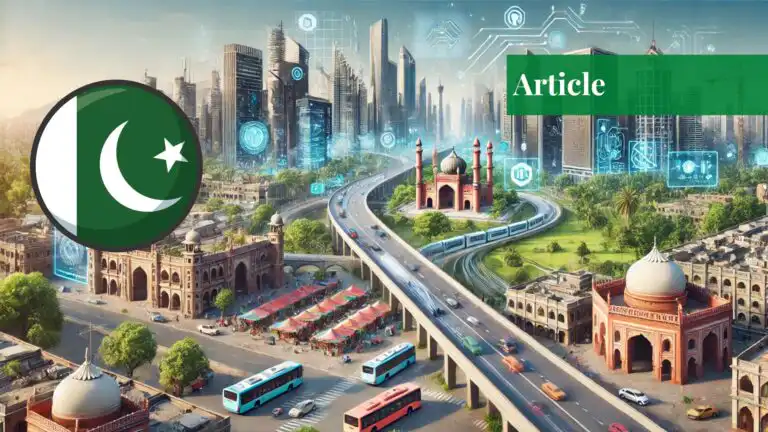
Now that a foundation for urban planning ideals has been established, let’s explore the phenomenon in the landscape of Pakistan. A bird’s-eye view of Pakistan indicates urban development concentrated in a few densely populated areas, while the rest of the landscape would show an underdeveloped rural environment. Pakistan has a huge potential for urban development which remains unmet as the focus remains on the development of its major metropolises only. Since its advent in 1947, Pakistan’s focus on the development of new cities has been meager.
According to the statistics collected by the World Bank, Pakistan’s urban population was 33 percent in 2000 and by 2023, it reached 38 percent. Although a huge number of people are still living in rural Pakistan, the stats show that colossal urbanization has indeed occurred. As per the United Nations Development Programme UNDP, 55 percent of Pakistan’s gross domestic product (GDP) is generated through urban areas.
The FBR published a tax directory of income taxes collected from the major urban settlements in 2018. The results indicated that the urban income tax revenue was PKR 1,03 trillion, 80 percent of which was collected from Karachi, Lahore, and Islamabad. The compilation also reveals that PKR 210 billion in income tax was collected from key marketplaces throughout the nation in 2017-18. Again, a substantial portion (86 percent) of this total was gathered from the marketplaces of the three cities, namely Karachi, Lahore, and Islamabad. These figures speak volumes of the role of the urban sector in the economic standing of Pakistan, while also suggesting that the rural and agricultural basis of the country’s economy is crippling as the days pass.
The Problems with Urbanization in Pakistan
Due to unplanned urbanization, the masses face problems relating to employment, housing, education, health care, sanitation, and whatnot. Between these challenges, the new settlers are more vulnerable. In a race for resources and stringent scarcities in the basic essentials of life, the new migrants have a decreased capacity and skill to compete.
The unemployment ratio of Pakistan changed from 1.9 percent in 2012 to 6.4 percent in 2022. Numerous explanations for such a rise have been circulating. These include the lack of growth in industries and businesses as well as an exponential rise in the population. What often remains overlooked, however, is the fact that massive urbanization has taken place. It has caused an increase in the urban population. The population increases but the skill level of labor is not up to the mark, leaving the migrants at a comparative disadvantage than those who already are a part of the urban labor force. With no new cities developed, new industries, businesses, and opportunities for jobs have also been scarcely created. In the existing labor market, there is high competition, even for the smallest of jobs.
In his book Al Mukadimah, Ibn Khaldun gave some valuable insights for policymakers and sociologists. He extensively described the nature of sedentary as well as Bedouin societies. For ease, the former is the rural society, and the latter is the urban society. He highlighted that in rural areas commodities are comparatively cheap. However, in urban societies, market prices are higher. This is because many luxury items become a necessity in the urban lifestyle, their demand increases, and their prices rise. In order to acquire these items more money is required. Due to such reasons, the rural migrants find life in the city far more difficult than they had initially imagined it to be.
The rapid, and at times unplanned, urbanization in Pakistan has made cities like Karachi and Lahore vulnerable to a range of challenges. In Karachi, for example, the strain on infrastructure has resulted in frequent power outages, water shortages, transportation difficulties, and issues such as urban flooding and clogged drains, which are often linked to the city’s expansion without corresponding upgrades in services. Similarly, Lahore recently experienced severe smog—earning it the distinction of being one of the most polluted cities in the world, as per IQAir—which, along with rising instances of beggary, highlights some of the social and environmental pressures that can accompany fast urban growth.
The above-mentioned aspects of massive and uncontrolled urbanization lead to a number of social evils in society. Increased crime and unrest prevail in urban settings, as is the case with Pakistan. Research suggests that the flocking of cities is directly related to increased crimes. One study reflects that massive urbanization may be one of the causes of ethnic conflicts in Karachi. Murder cases also significantly increased in Karachi over the last two decades. Because of the economic crises as well as ethnic unrest. This is because people revert to unethical and illegal ways of earning money when they find it impossible to provide for themselves and their families by legitimate means.
Another drastic impact of urbanization in Pakistan is also the expansion of cities through housing societies. This horizontal development comes at the expense of agricultural land as well as green patches. Pakistan is already a climatically sensitive country. It has seen about ten thousand climate fatalities in the past two decades. Under such conditions, Pakistan cannot afford to lose its green as well as cultivable land. Other than that, the growth of such societies has only boosted the construction industry of the country. The loss of agriculture as well as the lack of focus on the development of other industries has fatal implications for the economy, some of which have already waked havoc.
Moreover, the massive wave of urbanization is at its peak in Punjab. The rest of the provinces are far behind in this race. Resultantly, the population of Punjab is the highest compared to other provinces. As per the 2023 population census, Punjab has a population of 127,688,922, followed by Sindh with a population of 55,696,147, Khyber Pakhtunkhwa with a population of 40,856,097, and Balochistan with a population of 14,894,402. This implies that Punjab is getting flocked with population, while other provinces may be getting deprived of it. As they get a lower proportion of the population and remain underdeveloped, the economic as well as social future of the country is prone to uncertainties, for the risk of internal conflicts created by the race of resources in Punjab and their unavailability in the other parts of Pakistan are drastic.
Recommendations for Sustainable Urban Development in Pakistan
Some of the most pressing problems regarding urbanization have been mentioned here along with proposed solutions and policy recommendations,
| Problem | Policy Measures |
|---|---|
| Over Crowding | – Strict regulations and bans on the development of urban slums. – Dispersion of the population to newer settlements in other cities as a long-term goal. |
| Urban Sprawl | – Regulations on the development of housing societies. – The societies that have developed by diminishing agricultural land or green patches may be heavily taxed, creating a disincentive for both builders and citizens who live there. – Demarcation of the area and boundaries of various cities – Incentivization of vertical development in the form of skyscrapers for housing and business. |
| Inaccessibility of Education, Healthcare, and Employment | – Development of a robust transport system for adequate rural-urban connectivity. – Development of new and sustainable urban cities to combat problems of overcrowding. – Increase in the quality and quantity of health and educational institutions in suburban and rural areas. |
| Environmental Degradation and Climate Threat | – Demarcation of adequate green patches in all cities. – Regulations on littering and irresponsible waste disposal. – Taxes and Fines on the irresponsible disposal of industrial waste. – Encouragement of environmentally friendly practices in households, businesses, and firms. – Development and incentivization of waste recycling techniques. – Tree plantation campaigns on different levels through public-private partnerships or in collaboration with NGOs. |
| Loss of Cultivable Land | – Demarcation of adequate cultivable area in urban plans. – Investment in agriculture itself! The patches of agricultural land in urban facilities may be dedicated to research and development in the enhancement of agricultural productivity. – Ban on buying and selling the designated cultivable areas for non-agricultural purposes. |
Conclusion
Pakistan is a land of opportunity and home to a very diverse as well as favorable population for economic growth. To achieve its full potential and that of its citizens, the governments of Pakistan will need to evaluate their priorities for optimal development of the urban sector, and the consequential human development that would resultantly boost the country’s economy, taking it out of the dark pits of economic despair.
Rigorous developmental reforms along with a thorough enactment of developmental policies are the need of the hour. Sustainable development is not only crucial for the economic betterment of Pakistan but also ensures that social evils that come with desperation will diminish as opportunities for a better future arise. If only the correct steps are taken at the right time, Pakistan too can sour to new heights, and amaze the world by unleashing its potential and appearing as a modern-day sustainable economic force.
If you want to submit your articles, research papers, and book reviews, please check the Submissions page.
The views and opinions expressed in this article/paper are the author’s own and do not necessarily reflect the editorial position of Paradigm Shift.

Urwa Asghar is a government and public policy graduate from the National Defence University, deeply passionate about development, policy advocacy, and youth empowerment. Her work focuses on bridging the gap between governance and grassroots realities to promote informed discourse on sustainable development and youth-centric policies in Pakistan. She is currently working on establishing a digital forum to engage young minds in meaningful discussions about socio-economic challenges and policy solutions. Through her writing and research, she aims to contribute to a more engaged, aware, and proactive society.