Islamabad, February 5: Kashmiris’ resilience proves their struggle is far from over, and it is the responsibility of young advocates to ensure their voices are heard. This requires more than just solidarity; it demands action. The youth must spearhead digital advocacy, counter India’s disinformation narratives, mobilize the public, and build a compelling, fact-based discourse that keeps the Kashmir cause alive and firmly in focus.
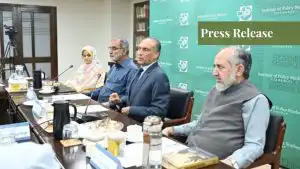
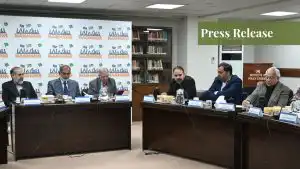
This was discussed during a session on “Kashmir Solidarity and Voices of Youth,” held at the Institute of Policy Studies (IPS) in Islamabad in collaboration with the Youth Forum for Kashmir (YFK), the Youth Association of Pakistan (YAP), and the Youth Diplomacy Forum (YDF).

The session was addressed by Khalid Rahman, Chairman IPS; Ambassador (R) Syed Abrar Hussain, Vice Chairman IPS; Abdul Qadir, Chairman YAP; and a panel of youth speakers, including Alina Zafar, Research Officer, YFK; Musawar Tanoli, YDF; Basim Raza, Research Assistant, The Millennium Universal College (TMUC); Shaheer Ahmad, Research Assistant, Centre for Aerospace and Security Studies (CASS); Abdul Basit, Research Officer, Center for International Strategic Studies (CISS) AJK; Tayyaba Khurshid, Research Officer, CISS AJK; and Hafsa Masoodi, PhD Scholar, The Centre for International Peace & Stability (CIPS), National University of Sciences and Technology (NUST).
The youth panel underscored the ongoing human rights violations in Indian Illegally Occupied Jammu and Kashmir (IIOJK), highlighting the decades-long repression, enforced detainments and disappearances, digital apartheid, unauthorized surveillance, restrictions on religious, political, and social freedoms, and the disruption of lives due to Indian military occupation. These violations are enabled by Indian draconian laws, which are evident to all, they stressed.
The gathering emphasized the role of digital advocacy for the Kashmir cause. It highlighted diverse ideas for how youth can utilize social media platforms, develop AI-driven tools, and create independent digital spaces to counter disinformation and amplify Kashmiris’ voices. The importance of decentralized journalism and artistic expression was also highlighted as a means to circumvent censorship and project the ground realities in Kashmir.

Sharing their thoughts on international responses, the speakers observed that global responses remain largely muted despite the obvious realities. They stressed that since states operate in their geopolitical interests and strategic alignments, global public sentiment can be a powerful force for change instead.
In this regard, they called for the mobilization of global youth, engagement with international human rights organizations, and building international solidarity to counter India’s falsely projective narrative of normalcy. Moreover, the Kashmiri diaspora, particularly those hailing from IIOJK, must take an active part in this mobilization movement.

The speakers also pointed out gaps in Pakistan’s approach. They urged a revitalized strategy, including amplifying the voices of AJK youth and prioritizing the socio-economic development of AJK to strengthen the case for Kashmir’s right to self-determination. They noted that advocacy efforts should extend beyond traditional diplomatic channels to grassroots movements and international public discourse.
Earlier, Ambassador (r) Abrar Hussain provided a historical perspective on the Kashmir issue, emphasizing that history and international law align with the Kashmiri cause. He highlighted that the struggle for self-determination is rooted in historical justice and reinforced by international legal principles, which recognize the Kashmiri people’s right to decide their future through a plebiscite.
In concluding remarks, Khalid Rahman emphasized the need to challenge the growing misperceptions. He pointed out that the continued huge Indian military presence itself is evidence that Kashmiris have not surrendered, and their resilience should reinforce, not weaken, global support for their struggle.

He urged the youth to adopt a mindset of proactive engagement, asking themselves what role they can play in individual and collective capacity in sustaining the cause. He further stressed that long-term and synergic commitment is essential to keeping the Kashmir issue at the forefront of global discourse and ensuring meaningful advocacy for their right to self-determination.
If you want to submit your articles and/or research papers, please check the Submissions page.
The views and opinions expressed in this article/paper are the author’s own and do not necessarily reflect the editorial position of Paradigm Shift.

The Institute of Policy Studies (IPS) is an autonomous, not-for-profit civil society organization dedicated to promoting policy-oriented research, dialogue, and human & technological development for better governance. IPS provides a forum for informed discussion and dialogue on national and international issues. The contributions spanning over forty-three years and the overall impact signifies the importance of pragmatic research on policy issues. The institute highlights the role of think tanks in modern democratic polities.