

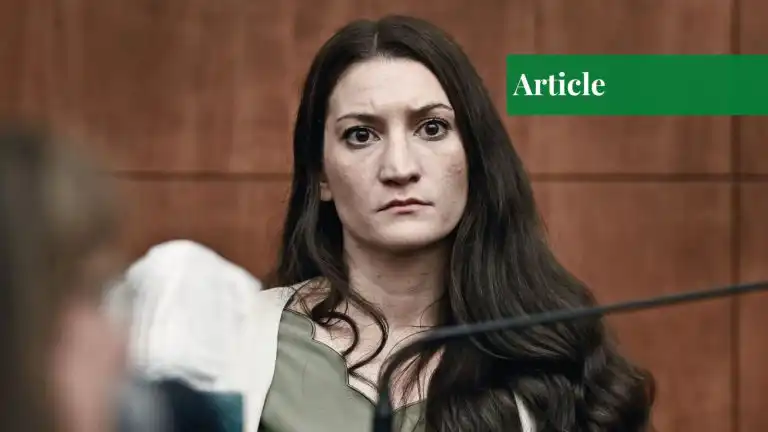
A murder trial can last for weeks, involve dozens of witnesses, and end with 12 people sitting together for hours trying to decide what happened. Yet after all that, a judge can still walk into the courtroom and announce that there is no verdict.
That is what happened in the Lindsay Clancy case in Massachusetts.
In January 2023, Clancy was accused of killing her three children, five-year-old Cora, three-year-old Dawson, and eight-month-old Callan, at the family’s home in Duxbury. Later on, she admitted that she had killed them. Yet, she is uncertain whether she was legally responsible for her actions at the time.

On September 4, 2026, this trial ended in a mistrial. Despite 6 weeks of discussion and more than 38 hours of deliberation, the jury still could not reach the decision the case required.
Reports say that the jury was divided 11-to-1, with 11 jurors declaring that Clancy was not responsible in some way and one juror refusing to agree.
This result raises a question that goes beyond this case: How can one juror stop a verdict when the other 11 are already on the same page?
The Central Question
The facts of the case were never really in dispute.
Clancy had suffocated and murdered her children with workout bands before attempting suicide by means of leaping from a second-floor window. She survived; however, she was paralyzed from the waist down.
However, as she had already accepted, she killed her children, so her lawyer was not defending that she did not kill but instead argued that Clancy had been experiencing extreme postpartum psychosis and therefore was no longer criminally chargeable for what she did.
Psychiatrists and different professionals provided proof of her mental condition at the time of the killing. Clancy’s lawyer pointed to her poor mental health, changes in her behavior, and the treatment she received before the incident.
The prosecution offered another interpretation and argued that although Clancy had serious mental health problems, she understood what she was doing and was capable of knowing that it was wrong. In other words, the prosecution asked the jury to separate mental illness from legal senselessness.
That distinction became the central issue of the trial.
The Jury Deadlocked
When the evidence was finished, the decision moved from the lawyers and experts to 12 ordinary people.
They considered for seven days, and during that period, the jury told the judge many times that it was having difficulty agreeing. Eventually this disagreement seemed to boil down to one juror.
Jurors who spoke publicly after the mistrial said 11 members of the panel supported a verdict that would have found Clancy not criminally responsible. One male juror still disagreed.
Clancy’s lawyer argued the holdout juror was refusing to properly apply the judge’s instructions on reasonable doubt. The defense asked Judge William Sullivan to investigate the juror and dismiss him, but the judge refused. The Massachusetts Supreme Judicial Court also declined an emergency attempt to stop the mistrial process.
This is where the case became more complicated than a normal disagreement between jurors.
One Juror Says “No”
Several jurors later criticized the holdout’s conduct during deliberations. Some described his approach as fundamentally different from theirs and said he was not giving sufficient weight to the evidence presented by psychiatric experts. Those accounts are important, but they remain the accounts of fellow jurors rather than an independent finding that the resistor’s acted improperly.
The judge therefore faced a difficult situation. He could not simply remove a juror because the other jurors disagreed with his interpretation of the evidence.
Why One Vote Matters
To understand the mistrial requires understanding how a criminal jury works. A jury does not usually decide a case by majority vote. In a case that requires a verdict,11 jurors agreeing is not enough.
If 11 people come to the decision and one person does not agree, why not let the majority make the choice? The answer is linked to the idea of doubt. The criminal justice system makes sure there is a level of certainty before someone is found guilty. A person should not be deprived of their freedom just because most people on the jury think they are guilty. If one person on the jury truly doubts, that doubt can stop a conviction.
It seems that protection can be infuriating when it creates a jury. Yet protection can also shield a defendant from a principle by a simple majority. The Clancy case illustrates both sides of protection in one example. From the perspective of the 11 jurors, one person stopped them from reaching the final verdict they thought was correct. From another perspective, that one juror was exercising the exact liberation that jurors are expected to have.
That is the uncomfortable part of agreement: the system gives every juror a voice, even when the voices are not equal in number.
What Does A Mistrial Mean
Another important misunderstanding is what the word “mistrial” actually means.
Clancy was not found guilty. But she was also not found not guilty.
The judge declared a mistrial because the jury remained deadlocked and could not reach the required decision. The case therefore ended without a final resolution of criminal responsibility.
That leaves prosecutors with difficult choices.
Normally, a criminal trial that is stuck because of a deadlock can be followed by another trial. A new jury would hear the case again. Decide the charges from the start.
Clancy’s defense team is now trying to stop that from happening. On September 10, her defense lawyer asked Judge Sullivan to say she is not guilty of letting another trial happen.
The defense says the evidence given by the people who are accusing her was not enough to prove she did something. They believe the case should end without putting Clancy through another trial.
A meeting about this request is set for September 29, 2026. The people who are accusing her have not said yet if they will ask for another trial.
So even though there was a mistrial, the case is still not finished.
What Happens Next
The Lindsay Clancy trial is disturbing because there is no simple ending.
There are three dead children, a mother who admitted killing them, medical experts who agreed that she had suffered a serious psychiatric issue, prosecutors who argued that she was nevertheless legally responsible, and 12 jurors who could not agree on what the evidence meant.
It is appealing to look at the 11-to-1 split and assume that the majority should have won. However, criminal trials are not based on majority rule. Instead, they are built on the principle that a conviction must be supported by a high level of certainty that removes any reasonable doubt.
This principle can lead to results that feel disappointing.
A jury might spend weeks hearing evidence but still not reach a decision. One juror’s disagreement can prevent a conviction. Even a case that appears clear-cut to the public may remain unresolved in a legal sense.
The Bigger Question
The Clancy case therefore raises a question about justice itself. Is a mistrial a failure because the system could not answer, or is it a safeguard because the system refused to make one?
The answer may depend on which side of the jury room we imagine ourselves sitting on.
For now, Lindsay Clancy remains without a verdict. On September 29, 2026, the hearing may determine whether the case proceeds to trial or reaches another legal consequence.
Regardless of the result, the mistrial highlights an important truth that is often overlooked when observing major court cases from the outside: justice does not always follow a simple majority decision.
Sometimes the entire case stops because one person is still not convinced.
Find our FREE quizzes and MCQs here!
If you want to submit your articles and/or research papers, please visit the Submissions page.
To stay updated with the latest jobs, CSS news, internships, scholarships, and current affairs articles, join our Community Forum!
The views and opinions expressed in this article/paper are the author’s own and do not necessarily reflect the editorial position of Paradigm Shift.
Hooria Akbar is an independent researcher and content writer with a strong interest in contemporary issues across AI, technology, society, and emerging trends. She writes research-informed articles, thought pieces, and blogs on a wide range of topics, aiming to present complex ideas clearly and engagingly for diverse audiences.