Introduction
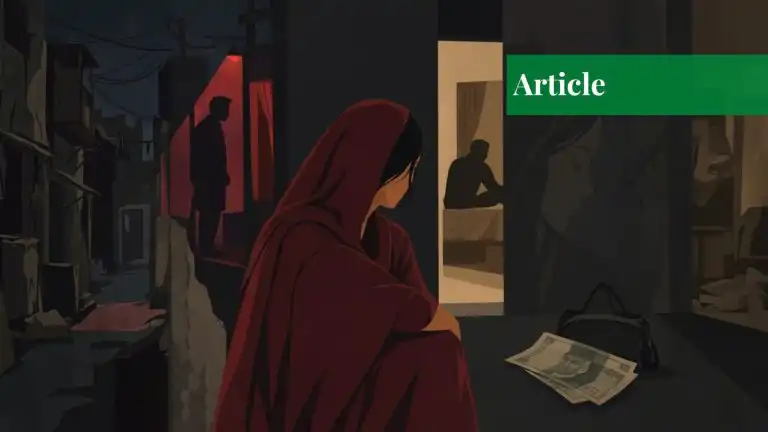
In a dark room of Lahore’s old city, a woman, nearly 20 years old, waits for her next client. Her life is suffocated in the narrow streets of red-light areas. She is young, but her face carries emotions of silence, suffering, and survival as if of an old woman. She is suppressed by her poverty and the power of exploitation.
Pakistan’s brothels, commonly known as kothas, are no secret at all. They exist in urban centers and towns and are mostly hidden behind the names of beauty salons or dance halls. Despite police raids, they are in operation because of an illicit link between police and the owners of brothels. As a result, a system emerges in which justice is delayed, denied, and manipulated. These brothels are not just sites of exploitation, but they are the symbols of our justice system.
Section 377 of the Pakistan Penal Code criminalizes “carnal intercourse against the order of nature.” It is clearly stated that any kind of conjugal act is illegal. While it is framed as a moral and legal safeguard, in practice, it has a deep connection with Pakistan’s underground brothel culture. How are these brothels still functioning in an Islamic republic?
Red-Light Areas Within Pakistan and Their Legal Status in Pakistan
During the Mughal reign, courtesans were trained as dancers and singers; they used to entertain the elite and the royals. Over time, this tradition faded away, and brothels are no longer a place of art and cultural heritage; rather, they have become a place of sexual activities. The line between entertainment and exploitation is thin. Nowadays, performances in brothels are served under the cover of prostitution.
Modern red-light areas such as Heera Mandi in Lahore and Napier Road in Karachi host brothels, dance halls, and also escort networks. Escorts are often known as independent entertainers, but it is a dark reality that they are also exploited by their owners.
Legally, Pakistan criminalizes all extramarital sexual activities under the Hudood Ordinances. But still, many brothels are operating in Pakistan. This shows the nexus of elites and institutions that enables exploitation. Safety is the biggest issue in Pakistan, and what is being done in this case? It is truly said by Thomas Hobbes that “covenants, without the sword, are but words, and of no strength.” Pakistan’s brothel laws exist on paper, but without enforcement, they are useless, leaving women to suffer exploitation.
Case Studies
Sex trade in Pakistan is dispersed across provinces. The following are brief case studies of some famous brothels in Pakistan:
Punjab: Heera Mandi (Lahore)
Lahore’s Heera Mandi was once a place of courtesans, where art and culture were encouraged. Today, those narrow streets echo with calming music and tunes, but not for expressing art or promoting culture, but for exploitation. Now the courtesans in Heera Mandi are presented as prostitutes, symbolizing that virtues left too long can turn into vices.
Sindh: Napier Road (Karachi)
In the late 20th century, there were municipal crackdowns in Karachi’s Napier Road, and some brothels were shut down. Authorities have framed it so that Karachi’s Napier Road is now free from brothels, and this is our moral victory, but truth cannot remain hidden for long, and it came out that some small-scale brothels were still functioning on Napier Road, which further marginalized women who lose even the limited protections of visibility because the media framed public opinion that brothels are shut down on Napier Road.
Islamabad and Rawalpindi: Covert Networks in Twin Cities
In these twin cities, some brothels operate under the guise of massage centers, beauty salons, and guesthouses. The government is silent on the matter since those in positions of power are bribed to be quiet about it. Investigations show that there are no overt red-light areas in Islamabad, but covert red-light operations are functioning.
Beyond the metropolitan cities, these brothels are also working in small cities and border areas, where the sex trade is easy. UNODC has documented that many Afghan women and girls are trafficked in Pakistan to these brothels. The geography changes, but the cruelty does not; the lives of these women remain trapped in shadows. The scars borne by these women speak one language of silence, neglect, and survival.
Victim Profiles: Age Groups and Abuse Modifications
Girls under 12 years old are highly likely to be sold in brothels. Such innocent girls are initiated into evil things. They are raped and abused because of their innocence. A girl born to laugh, play, and enjoy life is sexually exploited and traumatized over the long term.
Families struggling with poverty sell many teenage girls in Pakistan. They are compelled to go on stage before the elites. This is the age when the boundary between performance and prostitution is usually not well drawn, and their owners manipulate their vulnerable minds and subject them to exploitation.
Adults are often presented as escorts. They are marketed online and through hidden networks. They are also sold by their families, and sometimes by kidnappers or traffickers, to entertain men and are made to sell off their dignity to stay alive.
At all ages, its forms of abuse are consistent if stacked: rape, sexual violence, forced prostitution, abuse, manipulation, debt bondage, forced abortions, and trafficking from province to province and across national boundaries. It is important to keep in mind that “no shadow is too dark when justice chooses to shine.”
Causes and Drivers—Why Brothels Persist?
Economic desperation is one of the major causes behind the persistence of brothels in Pakistan. In rural areas, many families suffer from unemployment and a lack of education. For their survival, they often sell their daughters directly to brothels, or sometimes they sell them as housemaids. Mostly, their owners turn out to be connected with brothels, so they sell them in brothels, trading their virtue for a few coins.
Stigma and social exclusion are other causes of brothels’ functioning. Transgenders, widows, and divorced women are seen as stigmas to society. Due to this, they are trafficked to brothels, which are taboo and forbidden in an Islamic republic, a cruel reality of societal hypocrisy. And no one sees the men who come there for exploitation as a stigma or taboo for society. If men stopped going to brothels, none of this exploitation would exist.
Legal ambiguity also plays a pivotal role. With all laws regarding sex work in Pakistan, there is no legal framework for its regulation, due to which these brothels are still in operation. And it is through the very supply chains that feed such brothels that they continue to perpetuate this exploitation. The interdependence between economic, social, legal, and institutional factors is evidence of the fact that simple clamp-downs do not work, and the contribution of the underlying drivers to the realization of significant exploitation cuts must be considered.
Policy Recommendation
The future of brothels in Pakistan is in the hands of the survival of the victims, law reforms, and social welfare.
- Deploy rescue units and shelters for immediate protection.
- Reform the legal frameworks regarding the sex trade.
- Provide educational access to rural areas.
- Introduce responsibility measures to prevent exploitation.
- Introduce awareness within the community.
- Establish national databases concerning the network of trafficking in an effort to increase inter-border collaboration.
Conclusion
The red-light areas in Pakistan are an eye-opener to our society and justice system. The exploitation of women and children is promoted by poverty, social stigma, and elite complicity. The way forward for Pakistan involves both short-term protections to ensure exploitation is minimized and long-term social, legal, and economic reform that eliminates exploitation. “Exploitation runs rampant in the shadows; justice for the victims will only prevail if society is willing to shine a light.”
If you want to submit your articles and/or research papers, please visit the Submissions page.
To stay updated with the latest jobs, CSS news, internships, scholarships, and current affairs articles, join our Community Forum!
Find our FREE quizzes and MCQs here!
The views and opinions expressed in this article/paper are the author’s own and do not necessarily reflect the editorial position of Paradigm Shift.

Syeda Farani Fatima is an undergraduate student of International Relations at the International Islamic University of Islamabad, with a strong interest in anti-corruption, counter-terrorism and geopolitics. Strongly committed to fighting corruption, terrorism, and supporting national reform through research and public service.