

Normalized Numbness
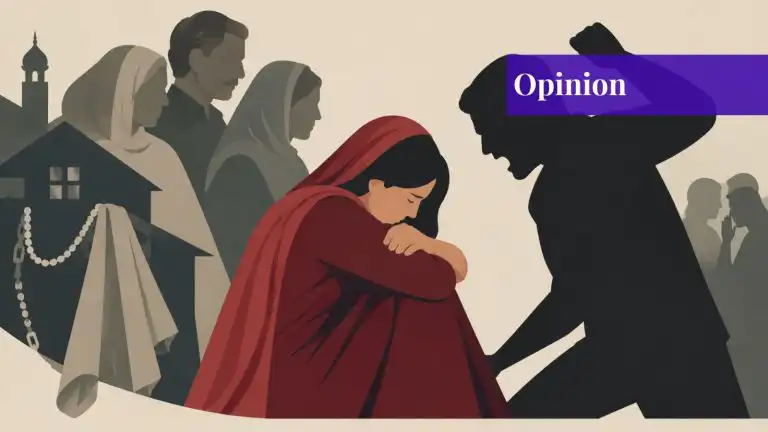
If thinking, according to René Descartes, is what makes us exist, I would cease to exist in the coming days. The daily reports of sexual abuse, domestic violence, acid attacks, and abductions of girls, irrespective of their age, make me unable to comprehend the real driving force behind the surge in the number of such cases. Every day, a new scenario emerges that proves to be an exception to every possible reason or cause we have predicted so far.
This culmination and diversity of violence make me stumble in my thoughts, urging me to stop this quest to find a specific reason. This would ultimately declare me, and anyone who can relate to me, non-existent. This non-existence turns into normalization, rendering it not only dangerous at a personal level but at a societal level too. Being unable to think eventually leaves us distant and aloof from the victims, turning society into a selfish aggregation of people.
Beyond the State: The Unspoken Role of Individual and Family Responsibility
We are always focusing on the state’s responsibility, the courts’ obligations, civil society’s duties, and the media’s role in preventing such incidents, but we rarely take individual or personal responsibility into consideration. We never dare to call out the wrong, entrenched cultural practices that reinforce the occurrence of such incidents. We never dare to look at the situation from the perspective of the victim.
This does not mean that we are trying to evade the culprit from all his responsibility or shift the blame towards the victim. Rather, for the sake of enlightenment, we need to read and criticize the other supporting acts and circumstances in the same way that we question the state’s responsibility. We need to ask ourselves what our families, our social circles, and our own silence are contributing to the continuation of such violence. The state can provide laws and ensure that they are upheld, but respecting those laws is our responsibility.
Take the recent case of the brutal murder of Hina Javed, a resident of Rawalpindi, at the hands of her husband. This case is just one example to make us stop and think about the individual negligence and societal failure that may surround such incidents. It makes us ask questions beyond the crime itself and think about the circumstances that may have left a woman exposed to such violence. It is not just a simple case; rather, it raises a series of questions in the mind of a person who is always struggling to find a way to make every existing case the last one of its nature.
These simple questions ask: What economic, social, and familial constraints made it difficult for Hina to leave such a toxic relationship? Did the parents, friends, or relatives of the victim assume that their responsibility to look after her had ended once she got married? Why didn’t they keep a check on her? Were there signs of the brutality she was facing that those around her failed to recognize or respond to? What made her stay in that toxic household? What were the reasons that made her stay and bear such toxicity that it ultimately cost her life? This pattern must be deconstructed because, once our minds understand the problem, they ultimately find a cause to cure it.
Fatal Traditions
Remember the very advice poured into the ears of newlywed brides that would sound so familiar to your ears. It says, “Shaadi ke baad ab tumhari laash hi is ghar mein wapas aaye” (“After marriage, only your corpse should return to this house”). When all such events of domestic abuse and killing are giving life to this advice, what is the reason to wail? Women, in an attempt to live up to these expectations, have taken this advice so seriously that they make sure to return as corpses and not as divorced or separated women.
Men have taken this advice so seriously as an unchecked authority over their wives that they find themselves entitled to kill them mercilessly and evade all responsibility by saying that she was not of good character or simply was not a “good wife.” When our societies are laying the initial brick of a relationship on this pattern, we should make ourselves ready to hear such tragic incidents.
How Society Penalizes Divorced and Separated Women
The other evil occupying a major space is our abhorrent attitude towards divorced or separated women. What else is left to say when your own mother blames you for a failed marriage?
This attitude towards women is not acting in isolation; rather, it is having serious implications for people’s minds too. These prevalent practices are among the causes why women are not considered worthy enough to be respected, and that is why we hear of harassment cases so often. This discriminatory and disrespectful attitude towards women is legitimizing honor killings, child marriages, and the exchange of women as revenge for the alleged immorality of male members of the family.
Conclusion
Conclusively, the state will act according to the attitude of its masses because that is the essence of democracy. Therefore, we need to check our own mindset first to nip the evil in the bud. This discrimination against women is learned at home, from friends, and through social circles, and these spaces need to be rebuilt on the standards of humanity, equality, and equal respect for women as living beings, rather than as property to be tied to anyone in the name of revenge.
Parents, family, and friends need to understand that it is their responsibility to keep a check on married daughters and assure them of their support, even if the world says otherwise. Support survivors of domestic abuse because they are warriors who have survived and fought for their rights. In this patriarchal society, as women, let us all assume the responsibility of being a source of strength for one another and for every girl who has prioritized her dignity.
If you want to submit your articles and/or research papers, please visit the Submissions page.
To stay updated with the latest jobs, CSS news, internships, scholarships, and current affairs articles, join our Community Forum!
The views and opinions expressed in this article/paper are the author’s own and do not necessarily reflect the editorial position of Paradigm Shift.
Huda Ijaz is a recent law graduate from Government College University, Lahore. She is currently working with Saad Rasool Law Firm as an intern. She had the privilege to author and publish two research papers during her graduation on the topic of comparative analysis of women harassment at workplace laws and child custody laws in Pakistan. Furthermore, she has also published a few articles on online platforms covering contemporary issues.