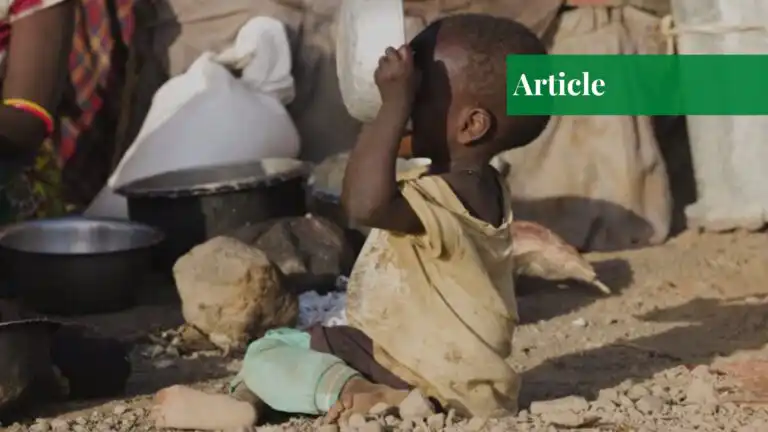
A recent catastrophe has materialized across Southern Africa which has shaken the nation. The United States warns that these droughts in South Africa may become a full-scale humanitarian disaster. It has destroyed the crops and livestock, in turn starving millions of South Africans. As per the UN’s World Food Programme (WFP), the crisis is expected to deepen until the next harvest in March or April 2025. Tomson Phiri, a WFP spokesperson, claims that “A historic drought – the worst food crisis yet – has devastated more than 27 million lives across the region,…Some 21 million children are malnourished.”
Five countries—Malawi, Lesotho, Zambia, Zimbabwe, and Namibia, are especially highly affected by the resultant starvation. Apart from these five countries, Angola, on the west coast of Africa, and Mozambique, on the east coast are also severely affected. People of these regions rely on small-scale agriculture, which is irrigated by rain, for their food and money for provisions. These five countries, in such a critical crisis, have pleaded for international aid.
According to the WFP, around $369 million is required for immediate help. However, as a result of the shortfall of donations, only a fifth of this amount has been received. Zanyiwe Ncube, on the matter of drought, states that there is immense difficulty due to the food situation; “we only eat once a day because we have nothing in the fields not a single grain. Everything has dried up in the drought.” He further adds that they are simultaneously also having problems with sourcing water.
The United States Agency for International Development (USAID) termed it the worst drought in over a century, believing its effects to worsen with time as the lean season progresses. Hence, with October marking the beginning of the lean season in Southern Africa, the nation seems to suffer even deeper deprivation until the March or April harvests.
The drought is further compounded by global climate change and the El Niño phenomenon, which has intensified the further destruction of crops and livelihoods. Rainfall-dependent farming has become almost impossible for farmers as their crops were destroyed due to below-average rainfall accompanied by scorching heat. The UN’s World Food Programme has given much-needed assistance, following appeals from numerous governments, but there’s uncertainty over adequate humanitarian funding being available on such a large scale because of multiple other global crises such as conflicts in Gaza and Sudan.
Up to now, WFP has already disbursed $12.8 million to fight the droughts in Africa that are threatening to soon take over. The hefty sum will be utilized in the implementation of a whole range of anticipatory actions, such as the provision of safe water to communities and livestock, as well as the distribution of drought-tolerant seeds and anticipatory cash among others.
In Zimbabwe and Zambia, the water has dropped so much at the Kariba Dam that power outages have become severe communities are left without electricity, and sustainable development has further suffered. The wildlife is also not spared from the consequences. In Namibia and Zimbabwe, the government recently had to cull elephants as well as other animals for the locals to eat in order to prevent starvation.
This crisis extends beyond Southern Africa, as the global humanitarian resources are already stretched thin, leading to inconsistent food aid for those nations.
The ongoing extreme droughts in South Africa are set to have devastating effects for months to come. Temperatures have soared, and the region experienced its driest February in decades, with rainfall dropping by 20% during a critical period for crop growth. Zambia, Zimbabwe, and Malawi are some of the worst-hit of all declared states of drought disaster. These countries report unprecedented crop failure while maize harvests have been reduced by 40 to 80 %.
This drought unleashed a surge in malnutrition and water scarcity, which is expected to trigger a rise in epidemic diseases. An October 16 report by the World Health Organization claims that over 22 million people in Southern Africa are now suffering from extreme hunger. The report continues to reveal that 2 million children are suffering from acute malnutrition. Furthermore, limited accessibility to clean drinking and household water increases the risk of waterborne diseases, making the situation dire.
The WHO report warns of a likely increase in cholera, malaria, polio, tuberculosis, and measles as malnutrition and poor living conditions take their toll. The energy sector is also at its brink because most countries in this region depend on hydropower. Namibia, for instance, experienced power outages of up to 21 hours daily in September, as reservoir levels plummeted to just 30%, according to a report by the UN Office for the Coordination of Humanitarian Affairs (OCHA). Zambia faces a similar energy crisis, with water levels at the Kariba Dam on the Zambezi River falling below 8%, limiting electricity supply to just three hours per day.
New reports on South Africa’s drought have shown that the situation is worse than anyone could ever imagine. With poor rainfall and erratic high temperatures that came with the El Niño phenomenon in the region, about 47.4 million people have been left helpless, a situation that leaves most of them at the mercy of international aid.
Climate change vulnerability could not come to a region more starkly than Southern Africa at the moment. The region, substantially dependent upon rain-fed agriculture, bears the brunt of these changes, and unless international help is provided quickly, millions are set to linger in this condition.
If you want to submit your articles and/or research papers, please check the Submissions page.
The views and opinions expressed in this article/paper are the author’s own and do not necessarily reflect the editorial position of Paradigm Shift.

Saba Ikram is an English Literature graduate with a love for writing, learning, and exploration.