“In the spirit of the optimist, to whom every difficulty is an opportunity, rather than the pessimist, for whom every opportunity presents a difficulty,” as John Archibald Wheeler once observed. The observation may appear overly tidy for the complexities of West Asian geopolitics, yet it captures an essential truth about the events of April 7, 2026, when Islamabad defied prevailing expectations.
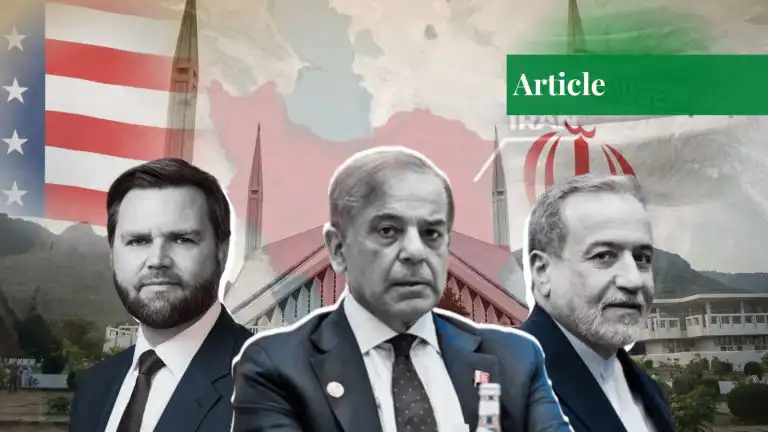
The two-week ceasefire Pakistan brokered between the United States and Iran is, by any serious measure, one of the most consequential diplomatic interventions by a Pakistani government in decades. The Strait of Hormuz, through which roughly one-fifth of the world’s petroleum passes, was days away from becoming the site of a conflict with genuinely systemic consequences: for oil markets, for Gulf infrastructure, for every importing economy from Karachi to Seoul. B-52 deployments were reportedly underway. The window for diplomacy was closing. Pakistan walked through it anyway.
What made this possible was something I find genuinely worth pausing on. Pakistan did not arrive at this moment by accident or ambition alone. It arrived because decades of calculated proximity, to Tehran, to Washington, to Riyadh, to Beijing, had quietly accumulated into a form of trust that no single great power could claim. The great powers chose sides long ago. Pakistan never quite did, and that studied ambiguity turned out to be worth something.
A country bordering Iran along nearly 900 kilometres of frontier, maintaining longstanding security ties with Washington, coordinating economic policy with Riyadh, and holding enough credibility in Beijing to serve as a quiet channel, occupies a position the great powers cannot fill. They are too implicated. Pakistan is merely indispensable. As Andrew Cooper and colleagues established in their foundational work on middle power conduct, conflict mediation functions as a form of “niche diplomacy” through which states of middling capacity amplify influence precisely because they are not perceived as seeking dominance over the outcome.
The mechanics of the ceasefire reflect this structural position. Prime Minister Shehbaz Sharif and Pakistan’s military leadership engaged counterparts in Washington and Tehran simultaneously, coordinating in parallel with Saudi Arabia, Turkey, and Egypt. The two-phase framework Pakistan proposed, an immediate halt to hostilities as a confidence-building measure, followed by formal negotiations in Islamabad on the deeper questions of sanctions, nuclear enrichment, and regional influence, was a considered application of what mediators call ripeness theory, a theory put forward by American Professor William Zartman. The recognition that parties enter negotiations not when they want to, but when the costs of continued conflict exceed the costs of compromise. Iran’s agreement to reopen the Strait of Hormuz as a goodwill gesture, and Washington’s agreement to delay imminent strikes, were both expressions of that calculus.
One should be honest about the fragility of what was achieved. Two weeks is not a settlement. The divergence between American objectives (nuclear rollback, deterrence) and Iranian ones (sanctions relief, regional legitimacy) has not disappeared; it has been deferred. The nuclear enrichment question sits unresolved at the centre of everything. Iran’s own National Security Council statement framed the ceasefire in triumphalist terms that diverge considerably from Washington’s reading of events. Israel’s partial acceptance of the arrangement, excluding the Lebanese front, leaves the regional architecture incomplete in ways that carry their own escalatory risk. The deeper structural questions, the sanctions architecture, the nuclear file, and the question of American force presence in the region have barely been touched. A ceasefire without a political settlement is, at its core, borrowed time.
Yet fragility should not be considered a failure. Dennis Ross, one of the more experienced practitioners of Middle Eastern mediation, has argued that the task of a mediator is to condition both sides to recognise that they cannot achieve their core objectives without addressing what the other side needs. That conditioning has not yet happened between Washington and Tehran. What Pakistan has managed is the prior step: creating the space in which such conditioning might become possible. Time-bound ceasefires, as conflict resolution scholarship has long maintained, are often the only achievable first move when the gap between parties is too wide for a comprehensive agreement. The fourteen-day horizon creates urgency — and urgency, used carefully, is its own form of diplomatic pressure.
The episode points to something larger about the changing grammar of international order. Scholars of middle power statecraft have observed that in a multicentred, networked world no longer organised around the settled authority of a single hegemon, emerging middle powers increasingly turn to mediation and crisis management as instruments of agency. Pakistan’s intervention fits this pattern precisely. It reflects not idealism but calculation: a recognition that the costs of regional escalation, for Pakistan’s economy, its Balochistan frontier, its own energy security, were too high to absorb passively. Islamabad acted because it had to, and found in that necessity a form of standing it had not previously been accorded.
I am not certain the standing will hold, but I hope the ceasefire leads to a long-term cessation of conflict. Pakistan itself is embroiled in a plethora of internal issues. A state managing acute civil-military tension, a fragile balance of payments, and an active insurgency in Khyber Pakhtunkhwa is not obviously suited for the extended diplomatic marathon that converting this ceasefire into a durable settlement will demand. The Islamabad talks, when they begin, will require patience, institutional depth, and the capacity to absorb pressure from competing alliances simultaneously.
Pakistan has demonstrated the instinct for mediation. The institutional architecture to sustain it is another question, and the honest answer is that it remains unbuilt. The potential, I wrote some months ago, was there. It still is. Whether the resolve follows is what the next decade will answer.
If you want to submit your articles and/or research papers, please visit the Submissions page.
To stay updated with the latest jobs, CSS news, internships, scholarships, and current affairs articles, join our Community Forum!
The views and opinions expressed in this article/paper are the author’s own and do not necessarily reflect the editorial position of Paradigm Shift.

Mohammad Zain is an International Relations student at NUML, Islamabad. With an associate degree in English Literature and Linguistics and a BS in International Relations, he brings a unique blend of analytical and literary skills to his writing.