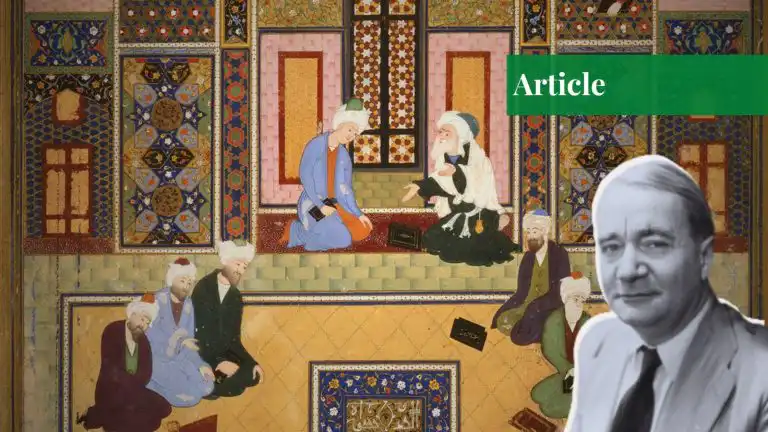
When Henry Corbin arrived in Tehran in 1945 to take up a position at the newly established Institut Français d’Iranologie. He found university philosophy departments teaching almost exclusively Western thinkers, Descartes, Kant, and Hegel, while native traditions of Islamic philosophy persisted largely outside the modern academy. Corbin spent the next three decades working alongside major Iranian scholars like Seyyed Hossein Nasr to reverse that situation. The irony is that the man most responsible for insisting Islamic philosophy belonged within philosophy’s canon itself was a Frenchman from Paris. What do we make of that?

The question matters because it sits at the intersection of two urgent concerns: the debate about who gets to represent whom across the divide of East and West, and the less fashionable question of whether Western intellectual life has amputated something from itself that it cannot recover without looking elsewhere.
From Heidegger to the East
Born in Paris in 1903, Corbin was formed in the rigorous traditions of European philosophy. He studied theology and scholasticism and became one of the first French translators of Martin Heidegger, traveling to Germany to meet the philosopher whose work he found electrifying. Heidegger’s project was essentially an attempt to dig beneath the crust of Western metaphysics and recover the forgotten question of “being,” which centuries of rationalist abstraction had buried under procedure and system. Corbin absorbed this method of retrieval and then followed it in a direction Heidegger never anticipated.
The decisive turn came through an encounter with a manuscript. Louis Massignon, the great French scholar of Islamic studies, placed in Corbin’s hands the writings of Shihab al-Din Suhrawardi. Suhrawardi’s project, which he called Hikmat al-Ishraq or the Philosophy of Illumination, proposed that reality, at its foundation, was not the kind of thing that syllogisms could fully grasp. Reality was structured like light. It proceeded from an absolute luminous source through cascading gradations, and genuine knowledge of it required not merely the operation of reason but a transformation of the one who seeks to know. The knower had to be changed by the known.
Corbin later said that with this encounter, his spiritual destiny was sealed. It is worth pausing over what that sentence means. Corbin was not being rhetorical. He meant that Suhrawardi had answered something in him that Heidegger had only opened. Where Heidegger diagnosed the forgetting of being as the central catastrophe of Western thought, Suhrawardi offered a geography of what had been lost and a method for finding it again.
The Reality of the Imaginal
That geography is called the alam al-mithal, or what Corbin translated into Latin as the mundus imaginalis, the imaginal world. This is perhaps his most original and consequential contribution to philosophy, and it requires careful handling because its name makes it easy to misunderstand. The imaginal world is not the imaginary world. It is, according to the tradition Corbin recovered from centuries of Sufi and Shi’ite metaphysics, an ontologically real domain situated between the world of matter and the world of pure intellect.
Western philosophy since the Enlightenment had progressively narrowed its account of valid knowledge to either empirical sense data or rational inference. Everything that did not fit one of these two categories was either dismissed as superstition or demoted to the status of mere poetry. The Islamic theosophers, as Corbin called them, had never made this amputation.
In the tradition running from Suhrawardi through Ibn Arabi to Mulla Sadra, the imagination in its active, disciplined form was understood as a genuine cognitive faculty that disclosed real features of reality unavailable to the senses or to abstract reasoning. This was not anti-rationalism. These were among the most technically accomplished philosophers of their age. It was, rather, a richer account of what reason was embedded in and what it required around it to function truthfully.
Beyond Orientalism
It is here that the question of Orientalism becomes genuinely complex. Edward Said’s critique, devastating and largely correct in its target, described Western scholarship on the East as a mode of power. The construction of an exotic, legible, subordinate object called the Orient by a rational, authoritative, superior subject called the West.
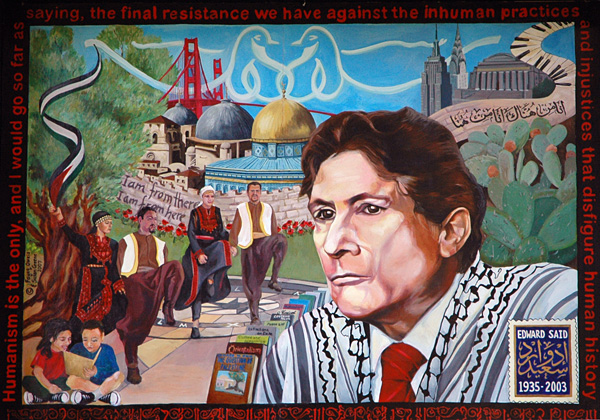
But Corbin did not write about the Islamic philosophers the way a naturalist writes about specimens. He wrote from inside their problems, attempting to understand a doctrine as it is experienced by someone living within it, rather than reducing it to a historical curiosity. His decades-long dialogue with Allameh Tabataba’i, the great Shia philosopher and theologian, produced some of the most remarkable cross-traditional thinking of the twentieth century. It was further refracted through the comparative philosophy of Toshihiko Izutsu, whose engagement brought Buddhist and Taoist vocabularies into the same conceptual space. It is difficult to think of a cleaner example of what dialogical philosophy across civilizations might actually look like.
The Question for Pakistan
None of this exempts Corbin from criticism. His tendency to treat Islamic philosophy as a timeless spiritual repository, somewhat removed from the political and social histories in which it was embedded, reflects real limitations. These are legitimate concerns. And yet the alternative to a flawed dialogism is not a pure and perfect encounter. It is usually no encounter at all. And for postcolonial societies like Pakistan, where the problem is not that Western scholars have said too much about our intellectual traditions but that our own institutions have internalized the assumption that serious philosophy happens elsewhere, Corbin’s example carries a particular provocation.
Iqbal, whose philosophical poetry and prose constitute one of the twentieth century’s most serious attempts to reconstruct Islamic thought in dialogue with Western philosophy, remains largely absent from the syllabi. Students may encounter Iqbal as a national poet, assigned in Urdu literature courses or invoked in civic ceremonies, but rarely as a philosopher whose engagement with Bergson, Nietzsche, and Rumi deserves rigorous critical examination on its own terms. The tradition Iqbal drew upon, including the very illuminationist lineage that Corbin spent his life recovering, needs to be treated as a living intellectual resource.
This curricular failure reflects a deeper, unexamined assumption that the categories of legitimate thought were settled in Europe and that everything else requires their endorsement. Corbin, the Frenchman who annotated his copies of Heidegger in Arabic and Persian and who described arriving in Iran as arriving in a country the color of heaven, did not share that assumption. He knew that the philosophical conversation about the nature of reality, the structure of knowledge, and the life of the spirit has been conducted across many languages, many centuries, and many traditions and that any account of it that begins and ends in Europe is simply incomplete and that engagement, even flawed engagement, is better than the silence of mutual incomprehension. The threshold he crossed remains open. The question is whether we have the courage, on both sides, to meet somewhere in the middle.
If you want to submit your articles and/or research papers, please visit the Submissions page.
To stay updated with the latest jobs, CSS news, internships, scholarships, and current affairs articles, join our Community Forum!
The views and opinions expressed in this article/paper are the author’s own and do not necessarily reflect the editorial position of Paradigm Shift.

Mahrukh Batool studied economics but has always been more haunted by history. She writes about colonialism, the long afterlife of empires, and the ideas that still shape how we think.