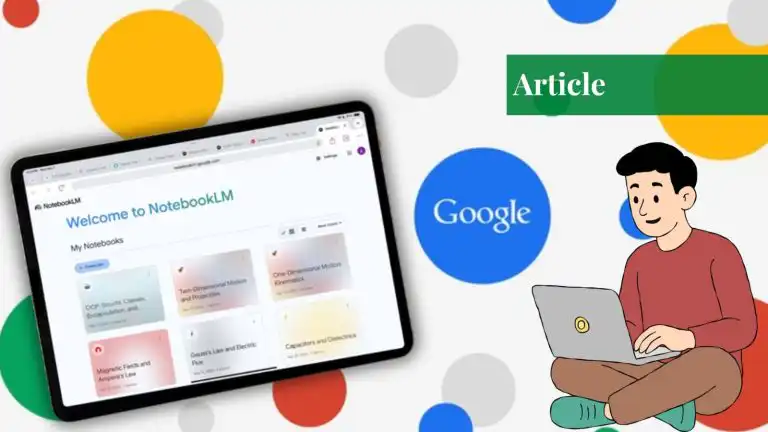
Let’s say you are composing a thesis: twelve news stories, three government reports, forty-seven scholarly papers, and a few YouTube lectures have all been added to your collection. They are spread throughout your desktop in many formats and argument languages, requiring the kind of focused, prolonged reading that is necessary for quality work. Into this situation, with quietly transformative effect, arrives Google’s NotebookLM: An AI research assistant that reads everything you provide, synthesises it on demand, creates mind maps, quizzes, flashcard sets, podcast-style audio summaries, structured reports, and exportable data tables, all based solely on the sources you have supplied and not on what the general public may think. It doesn’t dream up information from other sources. It converses with you after reading your materials. By December 2025, NotebookLM had surpassed Gemini in popularity on Google Trends. People’s perspectives on research, study, and knowledge of work are changing, and this change is not gradual; It’s structural.
NotebookLM is more than just a practical tool; it is a philosophical redrawing of the relationship between a human mind and the information it is attempting to comprehend. This redrawing has real advantages for students who are overburdened with reading, teachers who are under time pressure to prepare, and businesses that are drowning in institutional knowledge that no one can find. However, it also carries a risk that merits careful, objective analysis: the potential for a generation of learners to acquire knowledge without developing the skills that knowledge was meant to develop.
Originally designed as a note-taking application, NotebookLM started off as “Project Tailwind,” an experimental project from Google Labs, in 2023. Source-grounding was its fundamental architectural choice, which sets it apart from general-purpose chatbots like ChatGPT or Gemini in open-ended mode. NotebookLM provides answers based just on the documents you provide, whereas the majority of large language models use their extensive training data to answer any question about anything. The AI is the analyst, and you are the editor. Because its responses may be footnoted back to the precise line of the specific source, users can verify every assertion with a single click, making the tool significantly more dependable for academic and professional work.
By December 2025, the platform had been upgraded to run on Gemini 3, bringing what Google described as significant improvements to reasoning and multimodal understanding. New output formats were made available by the upgrade: Video Overviews, which create slide-deck movies with synthesised voices; Data Tables, which combine uploaded sources into tidy, exportable spreadsheets; infographics; and a more comprehensive Studio panel that provides timelines, mind maps, audio summaries, flashcards, tests, and personalised reports. Then, in January 2026, Google formally integrated NotebookLM into the Gemini app, enabling users to utilise notebooks created in NotebookLM as inputs for Gemini’s more extensive features, along with their carefully chosen sources and synthesised knowledge: creating unique Gems, feeding notebooks into Veo and Canvas, performing extra web research stacked on top of submitted materials or creating graphics inspired by notebook content. Previously operating in parallel, the two products merged into a single, cohesive knowledge ecosystem. A notebook is no longer a closed container. It serves as a launchpad.
With 100 notebooks that can accommodate up to 50 sources of up to 500,000 words each, 50 daily chat queries, and three audio generations, the free tier is still incredibly rich for students. Sources can be PDFs, Google Docs, web links, YouTube transcripts, text files, or Google Slides, almost any machine-readable format that a researcher may come across. Citations that explicitly connect to the source passage are included with every response the system produces, adding a level of transparency that most AI tools noticeably lack. Researchers, teachers, and commercial users have embraced it at an exceptionally rapid pace because of its breadth, accessibility, and source reliability.
Literature reviews, which are typically among the most time-consuming and mentally taxing phases of academic work, are the most obvious and immediate use for students. When preparing a thesis, a researcher can upload fifty publications, ask NotebookLM to find the main theoretical frameworks in the corpus, highlight areas of scholarly disagreement, chart the evolution of a discussion over time, or produce a comparative analysis of methodological methods. It just takes hours to finish tasks that could take days of careful reading and taking notes. Effortless Academic’s review of NotebookLM for researchers identifies it as “reliable” for this usage because it adheres to the parameters of the uploaded sources, lowering the possibility of fake citations that afflict other AI tools. Students with ADHD or other learning disabilities who benefit from multimodal content presentation especially appreciate the Studio panel’s on-demand quiz generation from lecture notes, personalised flashcard sets, and audio summaries for listening in between classes.
The argument is different but just as persuasive for teachers. In minutes instead of hours, a teacher planning a lesson on a complicated historical period can upload scholarly articles, documentary transcripts, and primary materials to NotebookLM, which will then create a timeline, a set of discussion questions, a structured briefing document, and a quiz. The Ditch That Textbook guide for educators highlights how the audio overview feature can serve as a differentiated resource for students who struggle with dense written text, providing the same information in podcast format without requiring teachers to spend more time getting ready. Additionally, NotebookLM may be used to construct student-facing research notebooks in which students engage with a selected collection of sources on a subject through structured AI-assisted research. The teacher-as-curator approach replaces the teacher-as-information-dispenser model, which many educators believe to be a more intellectually honest arrangement.
For businesses, the use case is knowledge management at scale. itGenius, which uses NotebookLM for client onboarding, explains how all standard operating procedure documents are uploaded into a single notebook so that new hires may query the knowledge base in simple terms instead of spending their first few weeks looking through folder structures. Legal teams evaluating contract libraries, compliance officials keeping an eye on regulatory documents, consultants synthesising client research, and executives requiring quick situation briefs from massive document collections all follow the same reasoning. The institutional knowledge of a company, which usually resides in disorganised document archives or in the heads of senior people, becomes searchable, queryable, and actionable. Organisations that successfully use tools like NotebookLM will process information more quickly and with fewer resources than those that do not.
Along with numerous benefits, the risk is also mentioned in Florida State University’s Canvas Support Center’s official NotebookLM recommendations for students. “Over-Reliance and Intellectual Dependency,” a shortcut trap that can “undermine your education and take away from your opportunities to develop critical thinking skills,” must be kept in mind. Relying too much on AI can impair your analytical abilities and result in superficial learning, while relying too much on summaries can cause you to avoid reading. The caution is not speculative. Over-reliance on AI can result in the atrophy of cognitive processes, according to a peer-reviewed study published in Frontiers in Artificial Intelligence in late 2025. The study used the example of a navigation app dependency, where the user is unable to navigate independently when the application fails. Every cognitive task that AI takes on is subject to the same premise.
The concern goes deeper than individual skill loss. Tiffany DeRewal, Associate Teaching Professor of Writing Arts at Rowan University, when writing for Critical AI, outlines the “challenging, recursive and often messy work of identifying, evaluating, analysing and synthesising” literature; a critical foundation for scholarly development, that systems like NotebookLM run the risk of ignoring. In this context, the literature review is more than just a document that summarises academic opinions. It is a method by which a researcher has the capacity to place themselves into a discourse, discern between arguments that are debated and those that are merely superficially different, sense the texture of a field, and comprehend why some questions are still unresolved. You might get the product but miss the formation if a tool completes that process quickly for you. According to an ACM conference presentation from 2025, NotebookLM’s original tagline, “Think Smarter, Not Harder,” purports to reduce cognitive effort in the exact activities that help students develop the metacognitive skills they most need.
What happens to the connection between reading and comprehension is another issue. Reading challenging academic work intently and continuously is a mental training regimen as much as a way to extract information. These are not inefficiencies that should be eliminated, such as the irritation of not understanding an argument right away, the discipline of going back to a paragraph, or the experience of progressively becoming comfortable with a difficult theoretical terminology. In a significant way, they are education itself. When a student asks NotebookLM to summarise a fifty-page chapter, they might get an accurate description of its argument without ever gaining the patience, focus, or intellectual tools that would have resulted from closely reading the original. The summary is accurate; however, throughout the course of a degree, a career, or a generation, the differences between students who read the chapter and those who merely read the summary become more pronounced.
All of this does not imply that NotebookLM is flawed or that its adoption ought to be opposed. On its own terms, it is a remarkable piece of engineering that democratises the kind of quick synthesis that was previously the sole domain of seasoned researchers with strong institutional support, genuinely lessens the friction between a researcher and the sources they must interact with, and makes knowledge more accessible to people whose learning differences make conventional reading laborious. It is practically essential for professionals, practitioners, working analysts, and teachers with many students and little time.
The problem is that NotebookLM is being used by professionals as well as a growing number of students who are still in the process of becoming professionals; these individuals view the challenging tasks of reading, analysing, and synthesising as a curriculum to be completed rather than a cost to be reduced. The distinction is crucial, and neither Google’s marketing nor the zeal of early adopters has been especially cautious to uphold it. When placed in the hands of a first-year graduate student who has not yet learnt to read the literature it is summarising, a technology that increases productivity for an experienced researcher is not the same. The gadget increases capacity in the first scenario. In the second, it substitutes for capacity that has not yet developed.
The way ahead necessitates precisely the kind of institutional consideration that technology adoption seldom receives in a timely manner. Universities must have policies that differentiate between AI-substituted research, in which the tool reads the corpus so you don’t have to, and AI-assisted research, which uses NotebookLM to traverse a corpus after you’ve read it. Instead of merely prohibiting or allowing NotebookLM without question, educators need educational frameworks that interact with it in an honest manner. Students must possess digital literacy: they must comprehend not only how to use the tool but also the costs associated with using it in specific ways for their own intellectual growth. The most advanced form of this literacy entails knowing when to use NotebookLM and when, consciously and consciously, not to: treating the tool as an extension of thinking rather than as a replacement for it, much like a well-annotated bibliography extends a scholar’s thinking without taking the place of the reading that generated it.
The thinking notepad is here to stay. It is already more in demand than Gemini itself, according to Google Trends. The concern is not whether new technology will change the way research is conducted, but rather whether the organisations that are in place to train researchers will adjust with enough clarity of purpose to guarantee that the future generation can think both with and without it. The territory is not the map. The text is not the synopsis. Even while the summary is factual and helpful, it is not the same as reading. Perhaps the most crucial research skill of the next ten years will be understanding the differences and making the right decisions.
If you want to submit your articles and/or research papers, please visit the Submissions page.
To stay updated with the latest jobs, CSS news, internships, scholarships, and current affairs articles, join our Community Forum!
The views and opinions expressed in this article/paper are the author’s own and do not necessarily reflect the editorial position of Paradigm Shift.

Abdul Basit | MS International Relations | Researching soft power, cultural diplomacy and global politics | Writing on geopolitics, foreign policy and defence affairs.