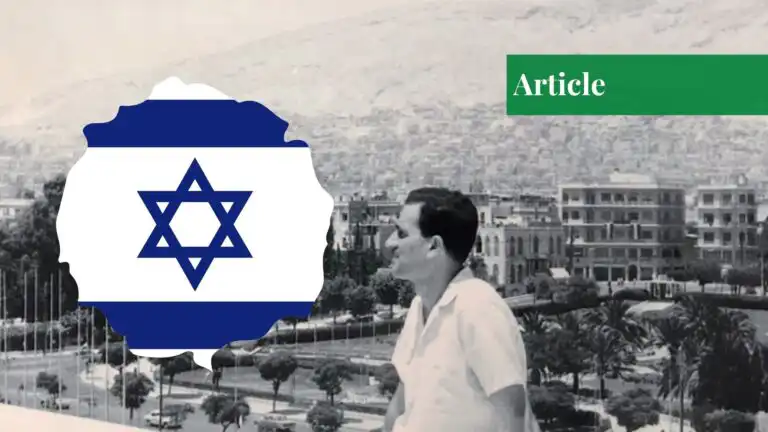
Spies and intelligence officers continue to fascinate and dumbfound the world with their abilities to operate in the shadows. Heroes to their home country, traitors to others, their lives become an enigma to themselves. This article will unravel the canvas on which Eli Cohen, a spy of Israel, performed his espionage gimmicks. Myths will be addressed through facts and research; meanwhile, logical conclusions will be drawn.
Eli Cohen worked in Syria from 1961–1965 during perilous times to conduct his espionage work, providing daily intelligence for an intensive and historic four-year period. During his tenure, he sent intelligence by radio, secret letters, and sometimes in person; he secretly traveled to Israel three times.
Origin of Eli Cohen
Cohen was born on Egyptian soil in 1924 to a Syrian Jewish family. The family had moved from Aleppo to Alexandria in 1914, in the aftermath of World War I, when political instability and the economic situation declined in Syria, forcing thousands of Jewish and Christian families to migrate. The family lineage naturally provided Cohen with a heritage fluency in Arabic, English, and French and a deep insight into Arabic culture and civilization.
He went to Israel in 1955 for a brief espionage training course and returned afterward to partake in Jewish and Zionist activities. During his time in Egypt, his clandestine involvement in the Lavon affair and the Suez Crisis led him to trial and interrogation by the Egyptian interior ministry, and consequently, he was expelled from the country in 1956. He came to Israel as an émigré in 1957 and maintained his duties of translating classified documents gathered from Arab countries for the army.
Mossad Field Agent 88
The political union of Syria and Egypt under the United Arab Republic, which lasted from 1958 to 1971, posed a daring threat to Israel’s safety. It was high time for Israel’s think tanks and intelligence agencies to counter the “alarming” situation. Mossad, the secret intelligence service of Israel, spurred up its search for a suitable spy to be deployed in Syria.
The background and language skills of Eli Cohenmade him an attractive candidate to be recruited by Israel and he was picked by Meir Amit (then-head of Mossad) when he spotted his file among rejected candidates. Unit 131 trained Kamel Amin Thaabet, Cohen’s new cover, very well and professionally over an intensive six-month course.
Eli Cohen was now a katsa or field agent 88 of Mossad, under the alias Kamel, posing as a Syrian businessman returning to his native homeland to work for its prosperity. He executed his spycraft in Syria with excellent proficiency and became the eyes and ears of Israel for a crucial four years.
The Road to Damascus
Cohen’s voyage to Syria was not a straightforward affair; instead, he was sent to Buenos Aires in 1961, where he posed as an expatriate Syrian businessman and started gaining senior officials’ trust in the Syrian embassy there. During those times, there was an ex-pat community from Damascus called the Turcos in Argentina; Kamel infiltrated this Arab club and established trust with essential members of Syrian society.
It is a famous myth that while Cohen was in Argentina, he befriended Amin al Hafez, Syria’s military attaché, who was ousted from Damascus due to his allegiance with the Ba’ath party and was destined to become Syria’s president two years later. However, all the reliable sources claim that these stories were fabricated and false and that Amin al-Hafez never met Cohen while in Buenos Aires.
The most authentic account is that Cohen met Abdul Latif al-Kheshen, editor-in-chief of the “Arab World” newspaper, who gave him a letter of recommendation, which helped him to settle in Damascus easily. His entry to Syria can be credited to a Syrian NATO spy, Majed Sheikh al-Ard, who sailed with him on the “Esperia” towards Lebanon and got him and his belongings to Syria in 1962.
The letter of recommendation given by the editor proved to be a game changer for Cohen, allowing him to develop the most critical contact, Maazi Zahreddine, nephew of the then-commander-in-chief of the Syrian army, who supposedly sponsored his arrival to the Golan Heights. He settled in the neighborhood of Abou Roummaneh, home to ambassadors, diplomats, and elite politicians, which was indeed a great success when Syria’s security was intense.
The headquarters of some significant military institutions were also located close, allowing Cohen to report any movement or activity to Israel’s office immediately. He entered Syria like a pragmatic settler, absorbing everything like a chameleon, while his Syrian contacts, particularly Maazi Zahreddine, helped him access the highest circles of power in Syria.
Operating in the Shadows
Kamel Amin Thaabet, aka Eli Cohen, had plunged into the unknown, being so close and yet so far, in circumstances when the time was unraveling at a breakneck speed in Syria. His endeavors in Syria are pretty exaggerated and have developed perceptions in public minds that are loose of facts and have no verifiable backing. Cohen’s connections inside the higher echelons of politicians were impressive by any standards; he became a true example of the struggling Arab. He made sure that his wish to invest large sums of money in business was heard by any receptive ear as he professed his desire, which eventually earned him many connections.
Wesley Britton, in his research paper, argues on the visit of Eli Cohen to the Golan Heights (the red zone of Syria back then), during which he visited every position on the “Maginot line” of Syrian defense. The paper describes that Israel used the information Cohen gathered to construct three-dimensional models of Syrian positions, which helped it conquer Golan in 1967, at almost the end of the Six Day War.
Golan has immense military significance, providing 30% of Israel’s water sources from the Jordan River. Wesley critiques that the overwhelming credit given to Cohen for the “Golan milestone” is exaggerated and that so many other factors were more crucial for this victory. Despite these arguments, Cohen’s visit to the Syrian fortifications in Golan Heights has raised his name high in the espionage lore.
The Takeover of Syria by the Ba’ath Party
Ba’ath party was founded in 1943 in Damascus, Syria, by Michel Aflaq and Salah al-Din, which was highly centralized and authoritarian in its structure. It was disbanded in Syria when it joined the United Arab Republic, but the 8th March Revolution in Iraq again galvanized the Ba’ath movement in Syria and brought the Ba’athists to power in the 1963 coup d’état.
Events in Syria had taken dramatic turns in 1961 with zealous nationalism and rumblings, placing Cohen in a perfect position to carry out his surveillance activities. Many reports and papers have given fanciful interpretations of Cohen’s involvement in the affair. He is presented as a heroic figure in films and seasons, a major player in turning the tables in favor of the Ba’ath party in the 1963 coup, helping his old acquaintance Amin al-Hafiz become the president of Syria.
Another idea is also promulgated by some sources that al-Hafiz returned the favor of Cohen by appointing him as the defense minister and that he was given military briefings on crucial matters. All these versions seem baseless when one dives deep into the facts, Amin al-Hafiz has negated all the claims of his affiliation with Cohen, and the Mossad agents also affirm that he never supported or took the side of any party.
In light of these two statements, the hype of the “offer” given to Cohen by Amin to become the defense minister of Syria seems false. After all, the Syrian intelligence was not naïve not to spot a spy while he was being crowned to the top seat of the security department. This highlights the role of digital myths in the formation of historical memory.
The Perceived Spymaster
He played phenomenally in the Syrian hub, taking notes on every new event, and building a web of noteworthy links when his hand lay on a treasure trove. He met a Lebanese engineer, Michel Saab, who briefed him on the most dangerous gambit, a “water diversion plan” for the Jordan Valley, which was about to be played by Syria on Israel. As soon as Israel got the information, it retaliated by bombing the water diversion centers via warplanes. This was a huge success on the part of an individual espionage operation.
Many researchers critique that the issue of the “water diversion plan” was already made public at the summit of the Arab League by Syria, and it was nothing unique that Cohen procured. Yet, he had gotten first-hand information and had given Israel a commanding position. It is also believed that he was invited to attend the historic sixth national convention of the Ba’ath party in March 1963 due to his close relationship with Amin al-Hafiz; however, no authenticity can be found regarding this, especially after Hafiz and Mossad denied his alliance with the party.
Mission Uncovered
The downfall of Cohen began when he met two spies whom Syria knew. Following the 1963 Syrian coup, newly appointed intelligence colonel, Ahmed Suidani, suspected Cohen due to his anomalous connections and way of living. When Cohen last visited Israel in 1964, he conveyed his fears to Mossad of being discovered and asked Amit to terminate his assignment in Syria, but his concerns were not addressed.
The biggest blunder he made was using the Morse code transmitter excessively and sending radio messages for longer. Each embassy in Damascus was allotted specific times for transmission; it was then that the Indian embassy reported continuous disruptions, which happened almost daily at the same time. Ahmed Suidani was to find out the reason for the interference. He brought in Soviet Union surveillance technology and successfully caught Cohen red-handed. Cohen was publicly hanged in Marjeh Square in Damascus on May 18 May 1965, and his body was never returned to Israel.
If you want to submit your articles and/or research papers, please check the Submissions page.
The views and opinions expressed in this article/paper are the author’s own and do not necessarily reflect the editorial position of Paradigm Shift.
Aamina Ikram is currently pursuing her degree in international relations from International Islamic University. Her areas of interest lie include Middle Eastern politics and espionage operations.