
Title of Case:
Usman Shahid and Aqeel Abbas v. Nadia Sarwar & others (C.P.L.A. Nos. 1011 and 1113 of 2026)
Background:
Nadia Sarwar (the “Respondent”) has been working at the National Bank of Pakistan (NBP) since 2008. In 2012, she complained to the NBP’s President about the harassment of two senior officials, Usman Shahid and Aqeel Abbas (the “Petitioners”). She alleged that they forced her to stay after hours, demanded reasons for her domestic and medical leave, gave her adverse remarks, and used demeaning words. After twice failing to obtain relief from her department, she approached the Federal Ombudsperson under the Protection against Harassment of Women at the Workplace Act, 2010 (Act of 2010).
The Ombudsperson allowed the complaint and imposed compulsory retirement. On a representation under section 9, the President of Pakistan set that aside, and a censure was ordered. The President held that the words were not proved and that an allegation about a demeaning sketch appeared only in her later affidavit. The Islamabad High Court (IHC) in its writ jurisdiction restored the Ombudsperson’s order.
Questions of Law Discussed in the Judgment:
- The scope and definition of “harassment” in section 2(h) of the Act of 2010.
- The amenability of the President’s order under section 9 of the Act of 2010 to judicial review.
Ruling:
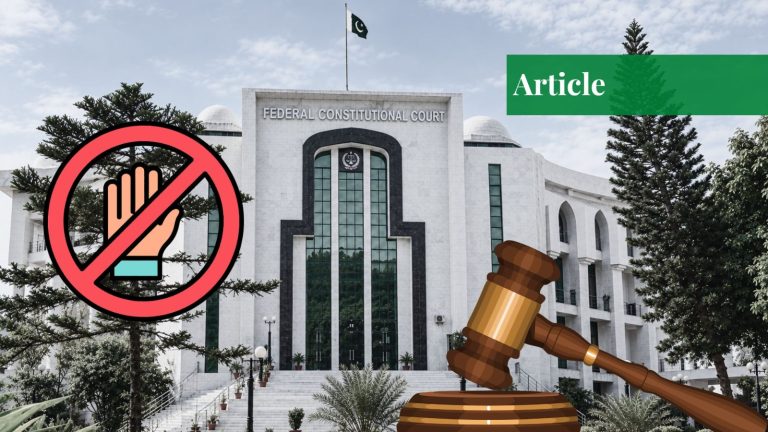
The Federal Constitutional Court (FCC) set aside the IHC’s judgment.
- On the first question, it was held that the definition is exhaustive and not extensive and is confined to sexual conduct. It reasoned that every sexual harassment is a harassment, but every harassment is not a sexual harassment. The word “sexual” was understood as relating to physical attraction or intimate physical contact. The Court further held that the standard of proof in cases of sexual harassment is the requirement of impartial, credible material reinforced by convincing or independent evidence.
- On the second question, it was held that the President’s order should not be interfered with routinely under certiorari unless there is a complete failure to follow judicial norms.
Analysis:
- The Logic
The Court’s argument rests on a categorical syllogism. In paragraph 13, the FCC held that, “Undoubtedly, every sexual harassment is a harassment, but every harassment is not a sexual harassment”. In a logical sense:
- Premise 1: Every sexual harassment is a harassment.
- Premise 2: Not every harassment is a sexual harassment.
From this, the judgment authored by Justice Ali Baqar Najafi concludes that Section 2(h) reaches only sexual harassment. Both premises are true. But the problem lies in the conclusion. It only tells us that sexual harassment is one kind of harassment and that other kinds exist. It says nothing about what this particular Act covers. To conclude, the Court needs a third premise: “section 2(h) protects only sexual harassment”. That is the very point in dispute, so the argument becomes circular.
The Court also shifted the question twice. First, the Act defines “harassment”, and its title and preamble use that word, not “sexual harassment”. The judgment continuously refers to “the very definition of sexual harassment under Section 2(h)”, replacing Parliament’s defined term with a restricted label and then reasoning from the label. Second, it framed the choice as sexual conduct versus every unpleasant behaviour at work. Nobody argued for the second option. The Supreme Court’s review in 2023 lays out the case in the following three steps.
- Sexual Harassment is a form of Gender-Based Harassment
The review judgment treats sexual harassment as a form of sex discrimination, and observes that it is often less about sexual interest and more about reinforcing existing power dynamics. The Court’s own sentence accepts this much: sexual harassment is a part of a bigger problem.
- Gender-Based Harassment is wider than Sexual Harassment.
The review judgment describes behaviour promoted on account of gender through unequal power, which is harmful and “not necessarily a product of sexual desire”. Belittling or excluding a person because of her gender, without any sexual overture, is an illustration of this wider conduct. It is apparent in the text. There are two common uses of the term “sexual”: sexual (as in physical attraction) and sexual (as in gender). In paragraph 2 of his concurring note, Justice Afridi observed that “sexually demeaning attitudes” makes sense only in the second meaning, because an attitude cannot demean a person based on physical attraction.
- The Scope of the Act
This is the step the FCC never took. The review judgment supports it with the text, the Standing Committee report, the parliamentary debates, the statement of objects, and Pakistan’s treaty obligations. The 2022 amendment, which added gender discrimination “which may or may not be sexual in nature”, was confirmed by this judgment. It shows what Parliament understood the Act to be doing.
- Parliament and Precedent
The 2010 Act was passed to comply with Pakistan’s international commitments, such as the Convention on the Elimination of All Forms of Discrimination Against Women (CEDAW) and International Labour Organisation Conventions (ILO) 100 and 111. The intent of the parliament was to eradicate all forms of discrimination at work.
- Text and history
The FCC held in paragraph 12,
The word “sex” is an adjective, and the word “sexual” is related to instinct, physiological processes, and physical attraction or intimate physical contact between two individuals. A gesture, therefore, made to another person for gaining sexual gratification would fall within the definition of harassment under the Act, 2010, but may have different forms; i.e., verbal, non-verbal, or physical, but the expression harassment is understood in its ordinary sense explained in the dictionaries.
The review judgment in 2023 examined the words first, then the record. It found “sexual” used four times in the definition, in two senses. It then considered the Standing Committee report of 29 September 2009, the National Assembly debate of 21 January 2010, the Senate debate of 25 February 2010, and the Statement of Objects, which guarantees a workplace “free of sexual harassment, abuse and intimidation”. It concluded that Parliament intended to address harassment based on gender and implement CEDAW and ILO Conventions 100 and 111. The FCC reaches its conclusion about what Parliament “would have” made manifest without looking at any of this.
- The 2023 Supreme Court Review
The FCC’s arguments are based on the 2021 Nadia Naz v. President case. That judgment was set aside on review in 2023. The FCC fails to refer to the review. Without a subsequent history, it is a fundamental error of legal method to rely on a judgment. So, the FCC has nullified both the 2022 legislative amendment and the 2023 Supreme Court review.
- Article 189
Since the 27th Amendment, Article 189(1) makes FCC decisions on points of law binding on all other courts, including the Supreme Court. It cannot be argued that the FCC lacked power to depart from earlier Supreme Court decisions. The FCC, however, should have engaged with the previous Supreme Court jurisprudence and explained why it is departing from precedent. The FCC disagreed with three Supreme Court decisions. The review rested on text, two dictionary meanings, parliamentary records, and treaty obligations. None of them are answered by the FCC. The FCC never mentions the review, never answers its dictionary analysis, and never engages Justice Yahya Afridi’s textual point that “sexually demeaning attitudes” yields no rational meaning unless “sexually” means “relating to gender”. That textual argument is untouched by the FCC’s charge of “reading into” the provision.
- The Burden of Proof
The FCC in paragraph 12 held that,
“To prove sexual harassment, a bare minimum requirement is the impartial, credible material, capable of surviving the test of reasonableness and it must be reinforced with convincing/independent evidence.”
There are no such conditions specified in the Act. The Act creates a remedial process. The Ombudsperson is authorized to hold proceedings as the office deems appropriate, and parties are not required to be represented by counsel, and the Rules of 2013 have the goal of making decisions quickly. It is done by adopting its own procedure. This is a civil forum. When there is a need for independent corroboration, it brings with it the logic of the criminal trial, where doubt benefits the accused. The Court’s own survey of the Code of Conduct says that failure to report immediately does not affect the merits, and the Supreme Court review says the victim’s perspective is relevant, measured by a reasonable woman standard viewed “objectively and subjectively”. The corroboration rule is a counterweight to those principles.
Conclusion:
The premise of the SC review in 2023 and the FCC judgment are different. The FCC decision on harassment raises more questions than it answers. Not a single paragraph actually applies the much-debated definition to the facts of the case. To say the least, it creates a chilling effect by taking away the protections recognised by the 2023 review. Ultimately, rather than weaponising a flawed logical syllogism, a correct ruling would have recognised that women in Pakistan already face severe restrictions in access to employment opportunities, particularly due to high levels of workplace harassment.
If you want to submit your articles and/or research papers, please visit the Submissions page.
To stay updated with the latest jobs, CSS news, internships, scholarships, and current affairs articles, join our Community Forum!
Find our FREE quizzes and MCQs here!
The views and opinions expressed in this article/paper are the author’s own and do not necessarily reflect the editorial position of Paradigm Shift.