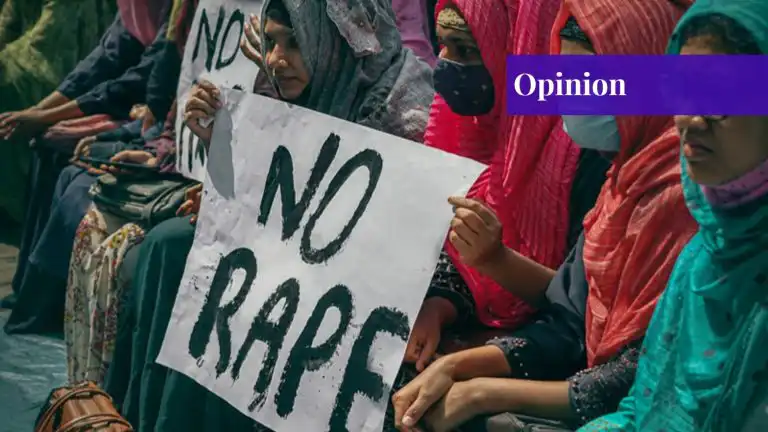
Pakistan has finally declared that a victim’s body cannot be used to determine whether they have been raped.
The Lahore High Court, in the case of Sadaf Aziz and others v. Federation of Pakistan and others. (2021 P Cr. L J 205) held that the two-finger test and hymen examination without medical backing are now unconstitutional.
The two-finger test is also known as the virginity test and was used in rape or sexual assault cases to determine whether the survivor was a virgin or if they were habituated to sexual intercourse. The reasoning behind this was that a woman’s sexual history could somehow indicate whether she had been raped.
Justice Ayesha Malik authored the judgment and also pointed out the negative impact that this type of testing has had on the mental health and dignity of victims. The judgment was reported by Dawn at the time.
The Supreme Court of Pakistan followed suit in the case of Atif Zareef, etc. vs. The State (PLD 2021 SC 550, where it held that observations about whether a vagina “admits two fingers easily” or whether a hymen is ruptured have no scientific or evidentiary relevance to determining whether rape has taken place or not. The Court also questioned the main assumption which lies behind these practices, which is that women who are sexually experienced may be less credible or may be more likely to have consented to sexual intercourse.
Section 13 of the Anti-Rape (Investigation and Trial) Act 2021 specifically prohibits two-finger virginity testing and says that it doesn’t have probative value. It also says that evidence showing that a victim is generally of “immoral character” is inadmissible. This part is crucial because it shows that Parliament was not just trying to change a medical practice, but also the thinking behind it.
Enforcement of Section 13 of the Anti-Rape (Investigation and Trial) Act 2021 inside courtrooms is also important. Previously, defense lawyers have a long history of relying on attacking a survivor’s character to create doubt, using aggressive questions about her past, lifestyle, or relationships to undermine her credibility. Even though there are clear legal bans on virginity testing, defense strategies still try to raise the same doubts through indirect questions. This puts the burden on trial judges to strictly enforce Section 13 during trials in order to put an end to character-based arguments.
For a long time, police officers expected that a medico-legal certificate (MLC) would include a line about the victim’s vaginal laxity or hymenal status. Investigative officers were used to these physical observations because they required minimal police work and shifted the focus of the investigation to the victim’s morality instead of the perpetrator’s actions. Even with the formal prohibition in place, eliminating this practice requires dismantling years of institutional habits. While the Anti-Rape Act mandates Special Sexual Offences Investigation Units (SSOIU) and Gender Protection Desks, many local police stations still don’t have training nor basic understanding of trauma-informed interviewing.
Historically, medical reports and court proceedings included descriptions of women as “habituated to sex”, “non-virgin” or women of “easy virtue”. These labels were not just offensive to women; they influenced that way a survivor’s allegation was understood. The banning of this practice shows how a woman’s reputation does not determine whether she can be raped, and neither does her being sexually active mean that she has given permanent consent.
The two-finger test was actually about the belief that a woman’s body can reveal her sexual history and that this could be used to determine if she is a credible rape survivor or not. This belief also has no medical backing. The World Health Organization, UN Human Rights, and UN Women have all stated that there is no scientific examination that can establish if a woman has had vaginal intercourse, and the appearance of the hymen also cannot prove whether she has had sex.
This shows how the real test is whether Pakistan is actually prepared to change the way it thinks about women who report rape. Now that Parliament and the courts have done their part, it is time for society to play its part too. This change is necessary so that Pakistani’s can move on from backward practices such as this for good.
This acceptance is very important because true change can only happen when the thinking behind those practices changes too.
If you want to submit your articles and/or research papers, please visit the Submissions page.
To stay updated with the latest jobs, CSS news, internships, scholarships, and current affairs articles, join our Community Forum!
The views and opinions expressed in this article/paper are the author’s own and do not necessarily reflect the editorial position of Paradigm Shift.

Anoushey Khurram is a third-year LLB (Hons) student at the University of London. She is currently a student ambassador for the University of London, has interned at multiple law firms such as ABS&CO, Axis Chambers, and and Bhandari Naqvi Riaz, and has two published submissions to the United Nations Office of the High Commissioner for Human Rights (OHCHR).