Groundwater at Risk: Water Insecurity in Islamabad and Rawalpindi
Introduction
Pakistan stands at the precipice of a water crisis, with projections indicating that the country faces absolute water scarcity. While the national discourse often emphasises surface water shortages and dam storage issues, the critical role of groundwater, which meets nearly 60% of Pakistan’s domestic, agricultural, and industrial needs, remains alarmingly under-addressed (Qureshi et al., 2025).
In an urban setting like Islamabad or Rawalpindi, groundwater acts as the hitherto invisible lifeline to local provision. Coupled with unregulated bore well drilling and failure to recharge the aquifers significantly, the rapid increase in terms of urban fringe sprawling has led to an acute depletion of this resource. This article examines the environmental, social, and economic implications of groundwater depletion in the Twin Cities, examines the institutional and planning gaps, and suggests a sustainable urban water governance model.
Water Scarcity in Pakistan
The issue of scarcity has become a topical issue around the globe, especially in terms of agglomerated cities. Metropolitan centres in Pakistan are facing the issue of increasing gaps between supply and demand, which are determined by growth in population, migration to urban areas, low reserves of surface water, and non-sustainable use of groundwater in Ramna. Among the 25 major cities, Islamabad and Rawalpindi, the geographic and economic epicentre, are facing a water crisis, compounded by climatic uncertainty as well as geographic expansion.
The present predictions indicate that, by the year 2030, national demand, which is currently around 3.2 million acre-feet (MAF), is expected to grow 1.5 times (5.1 MAF); and by 2050, it will almost double (7.0 MAF) (Basharat, 2015). The situation in Islamabad is particularly vulnerable. Despite regular shortages of potable water, 30 % of it is actively produced using 190 urban tube wells, even though the Capital Development Authority (CDA) relies most heavily on Simly and Khanpur dams as the main sources of its potable water.
Islamabad and Rawalpindi, the twin cities, reflect the problems in water security today, most specifically the instances of disparate access in various sectors and a steadily growing reliance on the groundwater, which is fast receding. Based on empirical data, yearly groundwater depletion in Islamabad is around 1 meter on average and up to 1.5 meters in the city of Rawalpindi (Yi et al., 2019)
Groundwater Depletion
The volume of recharge zones is shrinking with the growing number of buildings under construction. Since the population of Islamabad continues to grow, long-term possibilities of water sufficiency are compromised by inadequate expansions of surface storage (PBS, 2023).
In the meantime, the two cities are facing threatening patterns of groundwater depletion caused by uncontrolled over-pumping and rampant urbanization. In Islamabad, the water table has been decreasing at a maximum rate of 5-8 feet (1.5-2.4 m) per year since 2013, which means a depth difference of approximately 30 feet (~9 m). Rawalpindi is demonstrative of a crisis of acceleration, with groundwater levels decreasing at a rate of roughly 600 feet (~183 m) to 700 feet (~213 m) annually.
According to the hydrological surveys, the depth of groundwater in Islamabad is recorded to have moved by 5.2m, that is 22.8m in 2008 to an estimated 56m in 2024, whereas in Rawalpindi, the depth of groundwater is supposed to have risen by 21.7m, from 37.3m in 2008 to an anticipated 59m in 2024. Simultaneously, land-use changes (from 68% open areas to 41% built-up land between 2013 and 2023) have reduced recharge while demand was increasing.
Water supply in the twin cities relies heavily on surface reservoirs like Simly, Khanpur, and Rawal dams, supplemented by a sprawling network of over 9,000 public and private tube wells and boreholes. Despite this, Islamabad’s daily demand (~125 MGD) exceeds supply (~74 MGD), and Rawalpindi needs 68 million gallons daily (MGD) while 51 MGD are being provided from the existing resources. These deficits – 51 MGD in Islamabad and 17 MGD in Rawalpindi – underscore significant reliance on groundwater.
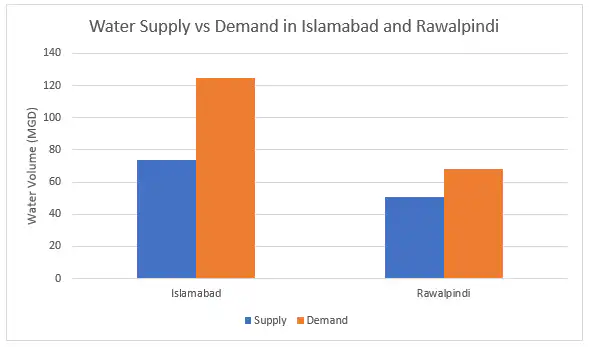
The twin cities of Islamabad and Rawalpindi are witnessing deepening social, environmental, and economic costs due to accelerating groundwater depletion.
Impacts of Groundwater Depletion
As groundwater levels drop, many shallow wells dry up, forcing deeper borehole drilling, which further strains the aquifers. The loss of aquifer pressure can also lead to permanent compaction of clay-rich strata, reducing aquifer storage capacity.
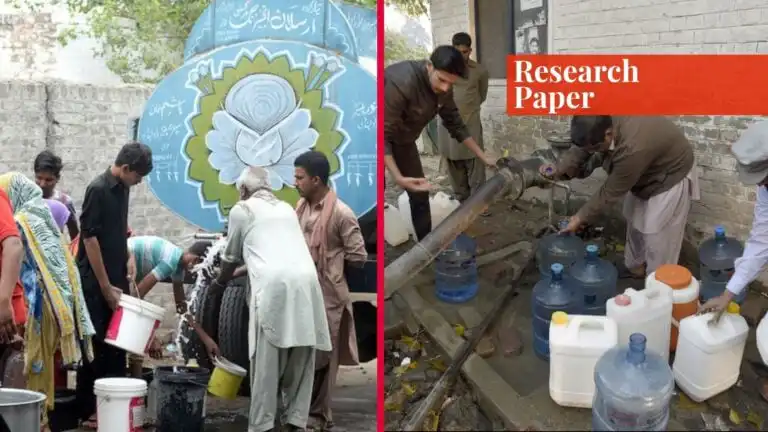
Water access becomes increasingly inequitable when private boreholes dominate the supply. Public water supply coverage remains deficient: approximately 63% in Islamabad and 52% in Rawalpindi (Zafar et al., 2024). Households without private wells often pay up to 3-4 times more for delivered water or receive irregular municipal service. Health impacts have been reported, particularly in low-income localities, where the only accessible water is contaminated borehole run-off (Sohail et al., 2023).
Municipal budgets are heavily strained. WASA Rawalpindi faces a ~17 MGD supply deficit requiring investment in tankers and emergency infrastructure, while Islamabad suffers a ~51 MGD shortfall requiring costly rationing and surface-water pipeline expansions (Rana et al., 2025). Residents pay higher prices for drilling, pumps, and tanker services. Meanwhile, subsidence necessitates expensive infrastructure repair, compounding municipal and private costs.
Underlying Drivers
Islamabad’s built-up land area surged from 3.6% to over 35% between 2000 and 2020, converting permeable land to impermeable surfaces and reducing recharge zones. As neighbourhood developments expand unchecked, groundwater replenishment capacity plummets. Thousands of unregulated private tube wells and tankers operate without metering or licensing (Tariq, 2025). This decentralized over-pumping accelerates groundwater drawdown far above natural recharge rates (Hafeez, 2024; Khan et al., 2022).
Although pilot recharge wells have been implemented, coverage remains minimal compared to extraction intensity. Institutional land-use planning often overlooks watershed protection, drainage retention, and recharge infrastructure. Fragmented governance – split among CDA, WASA, and provincial water authorities – results in coordination failures. CDA regulates recharge wells but lacks enforcement power; WASA struggles to service expanding urban fringes; provincial bodies lack jurisdiction over urban groundwater.
Bani Gala – an affluent peri‑urban settlement – exemplifies these dynamics. Numerous private bore wells drilled to meet demand have significantly lowered local water tables, while excess impervious landscaping prevents recharge. Despite high economic capacity, residents face intermittently dry wells and must rely on water tankers, illustrating groundwater insecurity in even wealthy estates.
Policy Recommendations
The following are some recommendations that directly respond to the environmental, social, and economic pressures outlined previously and call for a coordinated policy response. By reframing groundwater as a shared public trust and embedding sustainable practices across regulatory, technical, and community layers, Islamabad and Rawalpindi can plan a more resilient urban water future.
- Establish a Unified Urban Water Management Authority
A dedicated regulatory body combining CDA, WASA, and provincial agencies can harmonize planning, data collection, and enforcement for aquifer protection and urban water resilience.
- Regulate Private Groundwater Extraction
Mandatory permits and metering for bore wells and tankers, combined with zoning and extraction quotas, will help control over-extraction and enhance supply equity.
- Scale Rainwater Harvesting & Recharge Infrastructure
With pilot projects in Islamabad and Rawalpindi, recharging over 50 million gallons annually, broader implementation of rooftop systems and recharge wells must be mandated across public and private buildings.
- Promote Water Conservation Practices
Launch sustained public awareness campaigns and incentivize adoption of water-efficient technologies, especially focused on high-consuming sectors and households.
- Integrate Groundwater Data into Urban Planning
Embed aquifer maps and recharge potential in zoning regulations to safeguard critical recharge zones and guide infrastructure placement.
- Enforce Zoning for Recharge Zones
Legally designate and protect pervious land areas within city limits and new developments to ensure systemic recharge.
- Public–Private Partnerships (PPPs)
Encourage collaborative investment in water infrastructure – such as decentralized wastewater reuse, storm water treatment, and recharge systems – through PPP models that bring innovation and shared risk.
In conclusion, the twin cities of Islamabad and Rawalpindi remain emblematic of Pakistan’s larger groundwater crisis, where unchecked urbanization, married with institutional inefficiencies, has severely compromised aquifer stocks. Groundwater tables are receding by up to 2.5m annually, displacing subsidence-fronted infrastructure stress and exacerbating water inequity. This trend is not incidental but rather the outcome of chronic urban mismanagement – unordered real-estate expansion, fragmented governance, and unsustainable extraction – all contributing to escalating urban water insecurity.
References
- Basharat, M. (2015). Groundwater management in the Indus Plain and an integrated water resources management approach.
- Hafeez, D. M. (2024, March 30). Role of nature-based solutions for improving urban water security. https://www.nation.com.pk/30-Mar-2024/role-of-nature-based-solutions-for-improving-urban-water-security
- Khan, J., Ren, X., Hussain, M. A., & Jan, M. Q. (2022). Monitoring land subsidence using the PS-InSAR technique in Rawalpindi and Islamabad, Pakistan. Remote Sensing, 14(15), 3722.
- PBS. (2023). Home | Pakistan Bureau of Statistics. https://www.pbs.gov.pk/
- Qureshi, A. S., Gill, M. A., & Sarwar, A. (2025). Sustainable groundwater management in Pakistan: Challenges and opportunities. ResearchGate. https://doi.org/10.1002/ird.455
- Rana, S. A., Ali, S. M., Ashraf, M., Iqbal Gondal, N., Rahman, S., & Akhtar, N. (2025). Estimation of the domestic water demand‒supply scenario and its key driving factors in the Islamabad-Rawalpindi Metropolitan Area, Pakistan. PloS One, 20(3), e0293927.
- Sohail, M. T., Manzoor, Z., Ehsan, M., Al-Ansari, N., Khan, M. B., Shafi, A., Ullah, J., Hussain, A., Raza, D., & Usman, U. (2023). Impacts of urbanization, LULC, LST, and NDVI changes on the static water table with possible solutions and water policy discussions: A case from Islamabad, Pakistan. Frontiers in Environmental Science, 11, 1018500.
- Tariq, J. T. (2025, July 7). Groundwater exploitation in Pakistan and India: Investigating the role of tanker mafia. Paradigm Shift. https://www.paradigmshift.com.pk/tanker-mafia/
- Yi, L., Dong, N., Zhang, L., Xiao, G., Wang, H., & Jiang, X. (2019). Radium isotopes distribution and submarine groundwater discharge in the Bohai Sea. Groundwater for Sustainable Development, 9, 100242.
- Zafar, W. A., Javed, F., Ahmed, R., Shah, M. A., Ahmad, M., Khan, M. Y., Abdullah, G. M., Khan, D., Najeh, T., & Gamil, Y. (2024). Time series subsidence evaluation using NSBAS InSAR: a case study of twin megacities (Rawalpindi and Islamabad) in Pakistan. Frontiers in Earth Science, 12, 1336530.
If you want to submit your articles and/or research papers, please visit the Submissions page.
To stay updated with the latest jobs, CSS news, internships, scholarships, and current affairs articles, join our Community Forum!
The views and opinions expressed in this article/paper are the author’s own and do not necessarily reflect the editorial position of Paradigm Shift.