
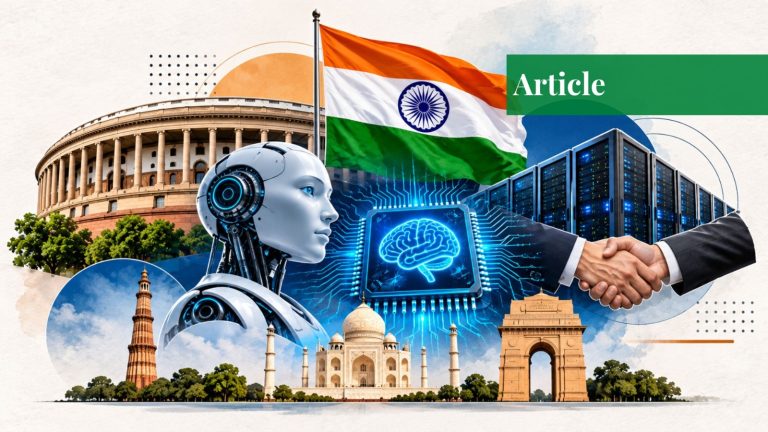
The emergence of AI has opened a new arena for competition among states. The extent of national power, once measured by the number of troops, is now being replaced by the capacity of data centers. AI is estimated to contribute $15.7 trillion to the global economy by 2030, with generative AI alone adding up to $4.4 trillion. The pace at which states are integrating AI into their national security mechanisms is alarming. South Asia is particularly a vulnerable region because India and Pakistan are both nuclear-armed rivals with unresolved disputes and limited strategic transparency. India is pursuing AI-related capabilities and developing bilateral and multilateral partnerships intended to expand its access to research, computing infrastructure, advanced hardware, and technical expertise.
There are increasing concerns regarding the dual-use of AI applications such as Large Language Models, Image Recognition Systems, and autonomous drones, which are open to potential misuse. Currently, there are no mutually recognized regulations or control mechanisms on AI software, which makes it easier to proliferate. Existing treaties or agreements are not satisfactory in their current form. Although states are adopting unilateral regulations, a regional or international approach is needed to address this issue effectively. Otherwise, this technological transformation could have severe security implications.
The following sections will attempt to analyze India’s AI adoption through foreign partnerships, including bilateral and multilateral agreements, and the impact of these developments on the strategic stability of South Asia.
India’s AI Development
India’s AI policy is based on the foundational principle of strategic autonomy. In recent years, its focus on algorithmic sovereignty has shifted the dynamics of AI development in the country. AI has taken the central stage in its quest to achieve self-reliance based on the policy of Atmanirbhar Bharat. According to a report by the International Data Corporation (IDC), AI spending in India is expected to reach $5 billion by 2027. While this growing investment in AI may be beneficial for the economy, its potential risk to security cannot be ignored. Since most AI technology is dual-use in its application, it carries significant strategic implications for the region as a whole.
Interestingly, India’s commercial AI adoption is twofold: on one hand, it focuses on empowering the domestic market by encouraging indigenous AI start-ups. On the other hand, technology transfer arrangements with foreign partners, primarily with the United States and Israel, open the pathway for direct commercial and, more dangerously, military procurement. In recent years, India has fostered partnerships with many other countries to accomplish the targets set for its national AI policy. Apart from the acquisition of dual-use AI equipment, it also aims to reduce supply-chain dependency and produce domestically manufactured goods.
Central to India’s AI expansion is its partnership with the US, which includes several bilateral and multilateral agreements. Most importantly, signed in February 2026, the US-India AI Opportunity Partnership is a bilateral addendum to the Pax Silica Declaration, which aims to enhance economic and security partnership between both states and overcome supply chain vulnerabilities for critical technology. The main purpose of this agreement is to strengthen the physical AI stack, including semiconductor chips and the production of critical minerals. Currently, China holds the semiconductor market by producing 60 percent of rare Earth minerals and refining 90 percent of them. This situation is being seen as a threat by both the US and India. By doing this, India could decrease its supply chain dependence on China.
In addition to that, Trump and Modi also announced the TRUST (Transforming the Relationship Utilizing Strategic Technology) initiative with the intention to provide India with defense and commercial semiconductor chips in February, 2025. The two countries are also involved in multilateral discussion forums such as the Global Partnership on AI (GPAI).
During the last two years, India has widened the scope of its partnerships for the adoption of AI-related technologies. It is coordinating with different military powers, including France, the UK, Japan, and Israel, in order to gain strategic leverage through advanced technology. The following table highlights the major agreements signed during the last two years and their main features.
Indian AI agreements with Major Countries
| Partnership | Date | Nature | Main Targets |
| US-India AI Opportunity Partnership | 20 Feb, 2026 | Bilateral addendum to Pax Silica | To focus on the physical AI stack, including computers, processors, data centres, semiconductor supply chains, etc. Upgrades India’s US GPU-export tier |
| US–India TRUST Initiative | 13 Feb, 2025 | Bilateral Partnership | To remove financing and regulatory barriers to US-origin AI build-out in India. To ease export control barriers on technology suppliers |
| India–France Declaration on AI | 12 Feb, 2025 | Bilateral Partnership | Covers cyberspace, defence-adjacent R&D, and joint AI governance. To deepen India’s access to European dual-use research and defence-innovation ecosystems |
| India–Japan Joint Statement on Cooperation in AI | 2 July, 2026 | Bilateral Partnership | To establish regular India-Japan AI Strategic Dialogues. To send 500 skilled Indian AI professionals to Japan by 2030 |
| India-Israel Memorandum of Understanding on AI | 26 Feb, 2026 | Memorandum of Understanding | To enhance AI research and capacity building. To deepen India’s access to AI and quantum technology |
| India-UK Technology Security Initiative | 25 July 2024 | Bilateral Partnership | To build supply chain resilience; to facilitate trade between UK and Indian industry to develop critical technologies |
As it happens, AI has a wide range of applications spanning both civilian and military uses. For instance, image recognition systems, which are useful in medical diagnosis, can also be used to identify a potential military target. In the same way, satellite imagery, normally used for weather forecasting, when fused with AI, could serve as a tool for Intelligence, Surveillance, and Reconnaissance (ISR). The line between civilian and military use of AI is fading, and such fog is very likely to be exploited. As per its recent policies, India is rapidly moving towards civil-military fusion. A glimpse of it was seen during the India AI Summit, when a suite of indigenous AI platforms was unveiled, designed to serve both defense operations and civilian applications. The key systems included SAM-UN, an AI-enabled situational awareness system designed for mission planning. Furthermore, XFace, which is an AI-powered facial recognition system, was also introduced. It could be used for the identification and verification of the targets. This signaled a push towards dual use of AI applications.
In particular, the proponents of this fusion argue that it is less time-consuming and cost-effective. However, the potential risks must also be taken into consideration. New Delhi has a long history of obtaining dual-use equipment under the camouflage of peaceful development. This was seen in 1974, when Smiling Buddha, demonstrated as a peaceful nuclear project, created a security dilemma in the region and compelled Pakistan to start a nuclear program of its own. Later on, Export Control Regimes such as the Nuclear Suppliers Group (NSG) were established in order to stop the proliferation of nuclear weapons. However, unlike nuclear weapons, AI is a non-tangible power, which makes it more subtle and difficult to detect. This makes the proliferation of AI-enabled systems easier.
Another gravely concerning issue regarding AI is autonomous weapons, which are capable of selecting and engaging targets independently, without human intervention. Autonomous drones have already made their way onto the battlefield. Countries including the US, India, and Israel have been working on autonomous weapons. The main reservations regarding these weapons include compliance with International Humanitarian Law (IHL), particularly the principles of distinction, proportionality, and precautions in attack. Without any regulatory mechanism, this kind of innovation could have serious implications for regional and global security.
Implications for Strategic Stability in South Asia
The India-Pakistan border saw several full-scale wars during these past two centuries. After both states declared themselves nuclear powers in 1998, the region became a nuclear flashpoint. Under the nuclear umbrella, the concept of strategic stability can be best understood through its three pillars: deterrence stability, crisis stability, and arms race stability. Firstly, deterrence stability in South Asia is based on both countries’ nuclear capabilities, along with the means of communication for the credible threat of Mutual Assured Destruction (MAD). The advent of AI is eroding that balance by lowering the threshold for conflict. In simple terms, when AI-enabled autonomous weapons are perceived to be faster, more precise, and cost-effective, with the ability to minimize collateral damage, it becomes easier for a state to initiate an attack. This perceived advantage provides false confidence in offensive strikes. Thus, AI may provide more space for conflict at conventional and sub-conventional levels under the nuclear threshold.
The second pillar of strategic stability is crisis management. As the name indicates, it is a state’s ability to manage a crisis and avoid escalation to a nuclear level. For this purpose, AI could be a double-edged sword. For example, ISR capabilities of semi-autonomous drones provide better situational awareness and help in informed decision-making, which could be useful in any conflict. Conversely, even the slightest mistake on the part of a combat drone or lethal autonomous weapon can escalate a crisis even further. An Unmanned Combat Aerial Vehicle (UCAV), if AI-enabled and decides for itself to attack its adversary’s nuclear infrastructure on a perceived logarithmic threat to its nation’s nuclear assets, could become a trigger for a massive disaster.
The last factor in strategic stability is the arms race stability, or arms buildup. Nations keep building their arsenals, sometimes for prestige and power, other times for protection and survival. When mutual distrust prevails in a certain region, arms procurement by one state could be perceived as a threat to another’s survival. This is happening in South Asia right now. India’s AI-driven expansion of its drone arsenal, paired with its 2030 vision of becoming a drone hub, signals its wider hegemonic ambitions. Pakistan perceives this expansion as a direct threat to its security and survival. In order to maintain strategic balance in the region, Pakistan is being compelled into such a threatening situation. Overall, strategic stability, which was achieved as a result of nuclear deterrence in South Asia, is at stake. This action-reaction cycle is pushing the whole region towards instability.
Recommendations
As India is compelling the region towards a new arms race, there is a need to practice strategic restraint first. In the contest to develop autonomous weapons, India must adhere to the principles of IHL at all costs. Considering the element of risk and AI’s inability to distinguish combatants from civilians, the human cost of this innovation could be high. The following recommendations could be useful between India and Pakistan in this regard:
- Confidence Building Measures (CBMs) are a tried and tested formula for the South Asian security landscape. The advent of AI has created space for new CBMs. A diplomatic channel can be established, which may remain open to dialogue and facilitate communication. However, there remain certain obstacles in the way of effective CBMs, most prominently the aggressive posture of India.
- When historical mistrust prevails in a certain region, bilateral diplomacy could often fail. In such circumstances, multilateral engagement could be an alternative option. Along with the US option for arbitration during the crisis, the World Artificial Intelligence Cooperation Organization (WAICO), through China, has also presented an opportunity to coordinate on AI governance frameworks in order to avoid unnecessary escalation. Pakistan has shown its commitment to the cause by becoming a founding member of WAICO. If India could proceed to do the same, both states can probably find a course of action to further cooperate.
- Pakistan has already adopted a stance at GGE regarding the framework for LAWS. It puts forward a two-tier approach, first based on the ‘prohibition’ of certain autonomous weapons and second on the ‘restriction’ of other technology. While the role of the GGE must be acknowledged in developing an understanding of different aspects of LAWS, there is a need for a new legally binding treaty. Such an approach may be a little premature, given that India’s inevitable intention to develop these weapons and its concerning behavior of escalating conflicts is a threat to the region and global peace and stability.
Conclusion
The idea of an AI-led war, once considered far off, is about to become a reality now. As much as this technology is useful to mankind, its proliferation at such a fast rate could cause undeniable damage to regional security and stability. India is rapidly acquiring these technologies through bilateral partnerships with different countries and shaking the balance of power in the region. Any possibility of cooperation between the two states does not seem imminent in the foreseeable future. This Indian struggle for an unprecedented and unregulated flow of technology could threaten the peace of South Asia. Therefore, there is an urgent need for global or regional AI regulation frameworks in order to regulate the expansion of AI-integrated technology.
If you want to submit your articles and/or research papers, please visit the Submissions page.
To stay updated with the latest jobs, CSS news, internships, scholarships, and current affairs articles, join our Community Forum!
Find our FREE quizzes and MCQs here!
The views and opinions expressed in this article/paper are the author’s own and do not necessarily reflect the editorial position of Paradigm Shift.