
What Explains Germany’s Renewed Turn Towards Asia?
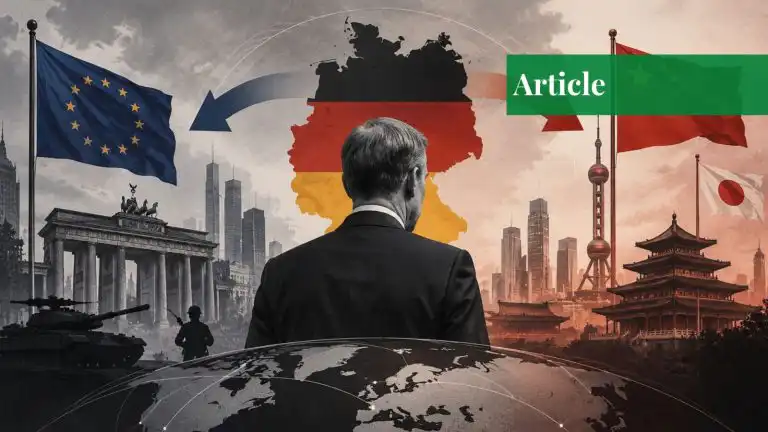
Two German leaders were visiting two different locations in the Asia-Pacific simultaneously at this time of geopolitical uncertainty. From 26 to 30th October 2026, German Chancellor Friedrich Merz visited the Asia-Pacific allies, including Singapore, Japan, and South Korea. Likewise, from 27 to 31st October 2027, German President Frank-Walter Steinmeier paid a high-level visit to China.
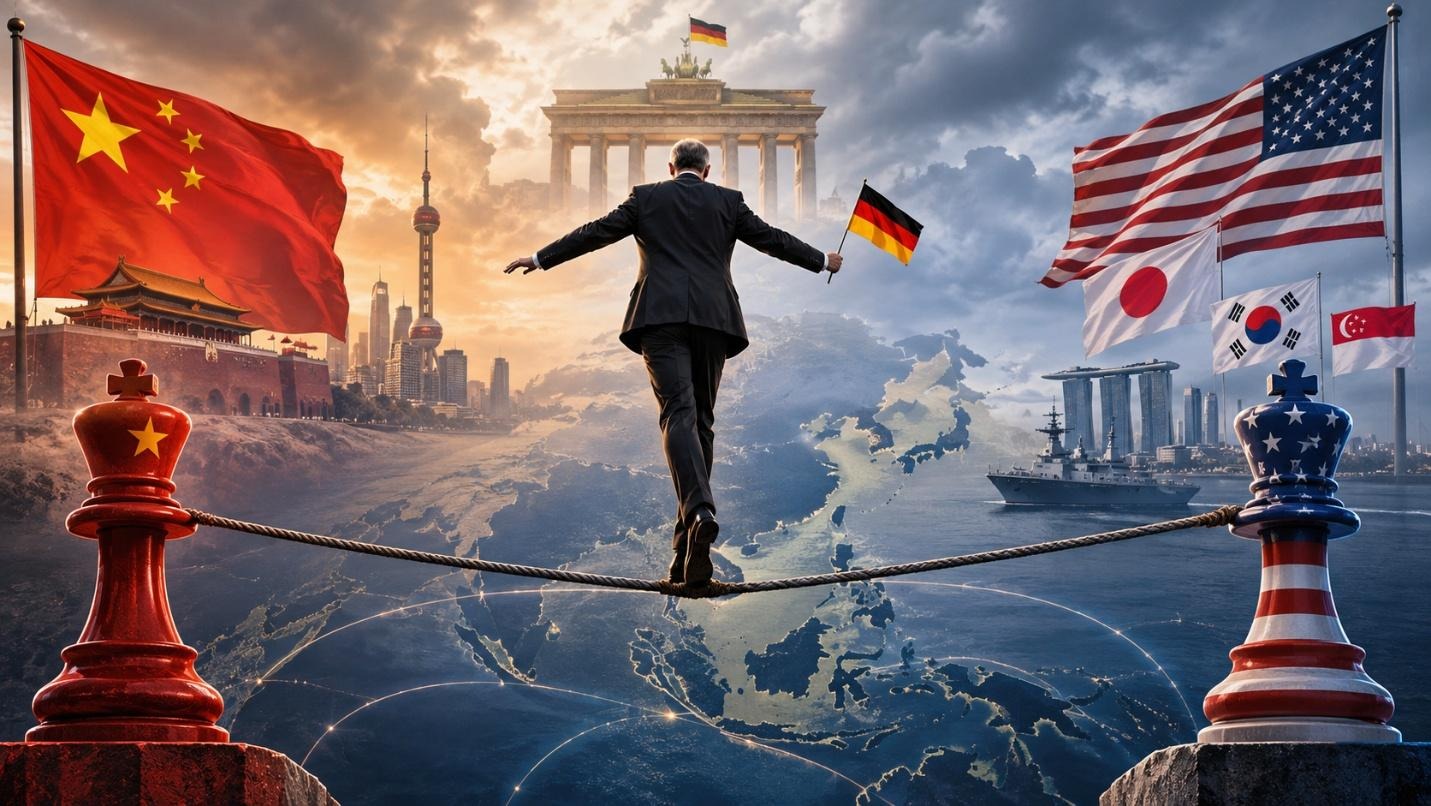
At this critical juncture of geopolitical complexity, these two visits signal Germany’s pivot-to-Asia strategy, which is based on a dual-pronged approach: strengthening Western alliances without jeopardizing its relations with the PRC. Germany is trying its utmost to diversify its partnerships. Yet, walking a diplomatic tightrope between competing power centers is easier said than done.
Steinmeier in China – Why Does Berlin Still Need Beijing?
“We don’t want to decouple from China. On the contrary, we want to shape trade in a way that continues to benefit both sides. We are not afraid of China’s rise. We are watching how China rises,” said German President Steinmeier. The culmination of a five-day visit intended to strengthen ties without stirring up the issues where the governments differ. Steinmeier also engaged in ping-pong diplomacy, playing table tennis. This reminded us of the 1971 exchange of table tennis players between the US and China. This diplomatic move clarified Germany’s stance: before heading towards any future economic partnership, old tensions must ease.
With all its ever-growing partnerships with European and Indo-Pacific allies, Germany simply can’t ignore China. China is considered to be the single largest trading partner of Germany ahead of the US, with trade volume exceeding €251.8 billion in 2025. With the US pursuing protectionist policies against its own allies, Germany now understands the very fact that China must be engaged and taken on board. During the talks, Steinmeier explicitly stated, “Noting that the international order is under strain and the world expects China to play a bigger role, Germany is ready to jointly shoulder the responsibility of safeguarding world peace and development with China.” After all, one cannot have one’s cake and eat it too: Germany cannot enjoy the benefits of China’s economic vitality while simultaneously following a policy that consistently weakens its ties with the world’s second-largest economy.
Merz in Asia-Pacific—What Is Berlin Seeking Through Its Indo-Pacific Engagement?
In the same week, Chancellor Friedrich Merz also visited Asia-Pacific, with a similar message of deepening relationships. Speaking to business leaders in Singapore, he suggested countries in Europe and Asia had shared interests amid changing geopolitics. Merz stated, “In times of growing tensions, we remain open to dialogue and diplomacy. For that, it is imperative to continue dialogue with the great powers, even where our interests and values only align in part. This also applies to China.”
In Japan, Merz visited a company working on nuclear fusion. He clearly believes the so-called middle powers, like Singapore, Japan, South Korea, and Germany, should make common cause, especially on trade and technology. Meeting the Japanese PM Sanai Takaichi, Merz said, “We must reduce one-sided dependencies, whether in our supply chains or with regard to raw materials. A new network of partners will help us in this endeavor. De-risking, diversification, and the strengthening of our resilience—these are the imperatives of the hour.”
In South Korea, Merz signed agreements to cooperate on high-tech industries, energy security, and defense. And he called for what he termed “like-minded partners” to set up a global alliance for a rules-based trade.
Where Do Germany’s Economic Interests and Geopolitical Commitments Collide?
Berlin risks finding itself caught between a rock and a hard place: too much accommodation with China could unsettle its Western partners, while excessive alignment with Washington could undermine its economic interests and diplomatic flexibility. One thing is pretty clear: neither the Global South nor the West could ignore China. The PRC is now an inevitable partner in the international arena. And Germany knows this. Why was the German president in China when Merz was conducting defense deals with Asia-Pacific allies? It’s quite simple: Germany does not want to annoy the PRC at such a time when its traditional security guarantor—the US — is stepping back.
Remember one thing: Japan and South Korea are key members of the US Indo-Pacific strategy, and this has eventually placed Germany in an uncomfortable position. Deeper defence cooperation with Japan and South Korea may reinforce Berlin’s regional presence, but it could also invite friction with Beijing if interpreted as participation in a broader containment strategy. The challenge is not merely to maintain relations with competing capitals but to prevent great-power rivalry from dictating the limits of German foreign policy.
Can Germany Become an Independent Asian Power Broker?
It’s often said in geopolitics, “Foreign policy begins at home.” As a whole, Europe is caught in a situation where it is facing some of the most violent protests due to domestic volatility, while on the other hand, Europeans are selling Russian threats at alarming levels. In such a situation, leaving behind the problems at home, Germany is somehow trying to overstretch. On one hand, Germany, along with the EU, is promoting enmity towards Russia, while on the other hand, it’s deepening its partnership with key Indo-Pacific allies.
And, lastly, it’s hoping for a sweet relationship with China. Although the PRC is open to dialogue and cooperation, as President Xi urged, “As the world’s second and third largest economies, China and Germany bear significant responsibilities for the development of China-EU relations and the stable growth of the world economy,” the question here is: Could Germany be strategically autonomous in its decisions while remaining deeply embedded in the transatlantic security architecture? Rather than allowing itself to become another pawn on the geopolitical chessboard, Berlin should seek to establish a position that preserves its freedom of action.
Conclusion
Germany’s concurrent diplomatic efforts with Beijing and the Indo-Pacific showcase a nation striving to manage a progressively divided international landscape while maintaining relations on both fronts. Nonetheless, the true challenge is forthcoming: whether Berlin can maintain its diplomatic relationships without getting caught up in the conflicts of competing power factions. Gazing east may be a strategic requirement, yet turning west continues to be a political fact. For Germany, the art of balancing both directions may ultimately prove more difficult than choosing either one.
If you want to submit your articles and/or research papers, please visit the Submissions page.
To stay updated with the latest jobs, CSS news, internships, scholarships, and current affairs articles, join our Community Forum!
Find our FREE quizzes and MCQs here!
The views and opinions expressed in this article/paper are the author’s own and do not necessarily reflect the editorial position of Paradigm Shift.

Syed Hammad Ali is pursuing a BS in International Relations programme from the International Islamic University, Islamabad, and has a keen interest in research works, policy analysis, defence and strategic studies, and conflict resolution.