
Introduction
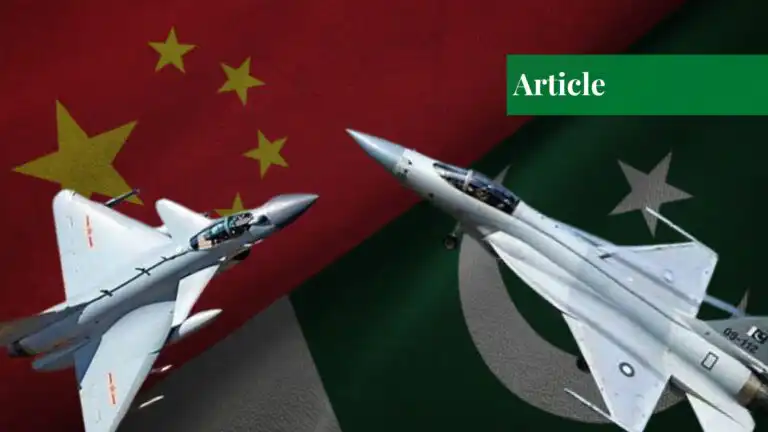
In an era where air superiority defines geopolitical influence, China is expanding its strategic control in contested regions of its global diplomacy, increasing its military footprint. Two aircraft that are symbols of China’s air deterrence are the J-10 Vigorous Dragons and the JF-17 Thunder. The JF-17 Thunder is a Sino-Pakistani jet that uses cutting-edge radar and missile integration to realign aerial dominance. These multi-role fighter jets are used to demonstrate and exert Chinese dominance in disputed airspace, such as the Taiwan Strait, the South China Sea, and the Kashmir region.
These jets are now seen as a representation of strategic and military might in the wake of the 2025 Indian-Pakistani escalation. Notably, Pakistan became the first country to down Indian Rafale jets using a combination of JF-17s and J-10Cs—an event that signaled a paradigm shift in the aerial balance of power in South Asia. These jets demonstrated their operational worth following the 2025 Indo-Pakistan military escalation, particularly Operation Sindoor and Operation Bunyan um Marsoos.
Notably, Pakistan successfully deployed the J-10Cs and JF-17s, which were a turning point in regional air combat. This article will explore the features and deployment of China’s J-10C Vigorous Dragon and J-17 Thunder in conflict regions through geopolitical paradigms.
The J-10: Frontline Power Projection in a Live Conflict
The Chengdu J-10 is commonly known as the “vigorous dragon.” It emerged as one of the first indigenous fighter jets of China. Its development began in the 1980s under Project 8610 as part of China’s strategic vision to modernize its military blueprints. The jet was first taken for a test flight in 1998 and was officially launched into service in 2005. Originally designed as an air superiority fighter, the J-10’s later version was capable of air-to-air combat and precision ground strikes.
Its aerodynamic structure had a delta wing and canard configuration that gave it higher stealth and agility as compared to Western 4th-generation fighter planes like the F-16. The J-10 is a symbol of China’s shift from Soviet-based blueprints to self-reliance in air warfare. While its initial models were inspired by russian designs, the later variants were fully Chinese. Thus, the Chinese J-10 series is a hallmark of the transition from Russian AL-31FN to Chinese WS-10 engines—a symbol of China’s stepping stone in the self-reliant defense industry.
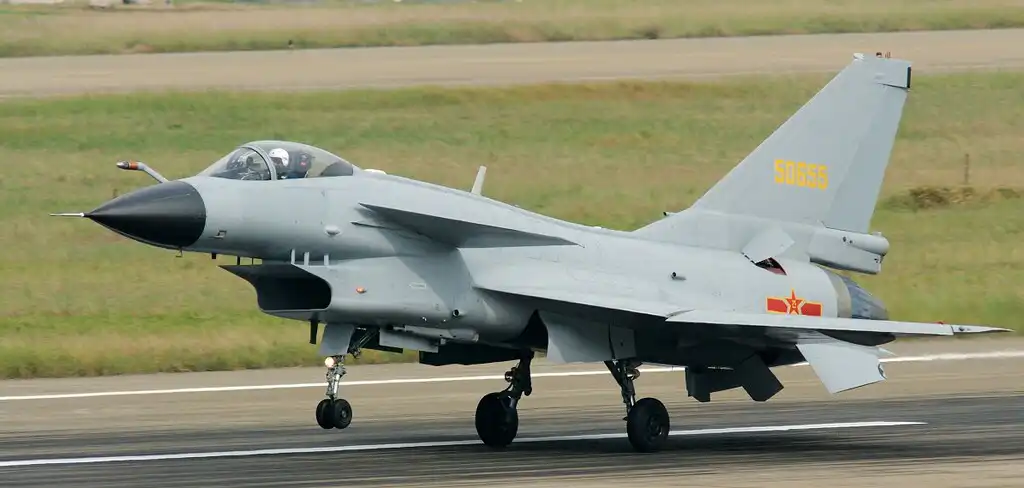
China has successfully deployed the J-10s in active war theaters, especially in the Taiwan Strait, the South China Sea, and the shared border with India. The Chinese government regularly displays the J-10s during military exercises and ADIZ (Air Defense Identification Zone) near Taiwan. China considers Taiwan a territorial conflict and actively uses the “grey-zone warfare” strategy to intimidate adversaries using the J-10s. Moreover, the J-10 has been part of its joint military exercises with Russia, such as the “ Aviadarts” drills, and is used in patrolling the South China Sea.
The deployment of the J-10 in such tense zones is of strategic significance for China. Unlike the J-20 stealth jets, China more commonly uses the J-10 as a visible workhorse to conduct patrolling, high-profile drills, and precise flyovers because it is meant to be seen. Its visibility is directly related to deterrence, sending a clear message to Taiwan, India, and the South China Sea competitors that China claims and asserts strategic dominance in these areas and contested airspace.

Moreover, the state media portrays the J-10 as a symbol of China’s self-reliance and national pride. The J-10s are also used for external signaling in challenging the status quo and international norms. The newer variants of the J-10, particularly the J-10C, are a modern version having an Active Electronically Scanned Array (AESA) radar, electronic warfare pods, and the PL-15 Beyond Visual Range (BVR) that makes it a great competitor to fighter jets like the Rafale. After the 2025 India-Pakistan escalations, the price of the J-10C has increased by 40%.
The JF-17 Thunder: Combat-tested and Export-ready
The JF-17 Thunder is also known as the “FC-1 Xiaolong” in China, a benchmark of China’s military diplomacy and joint development strategy. The fighter jet was co-developed by China’s Chengdu Aircraft Corporation (CAC) and Pakistan Aeronautical Complex (PAC). Both countries have co-developed a low-cost, exportable, multi-role fighter jet tailored for countries that cannot afford the Western F-16s and Rafales. It was launched in the 2000s and was a strategic move, as it reduced Pakistan’s dependency on Western powers and the U.S. and helped China step into the Military export markets of the world.

Pakistan currently operates over 150 JF-17s and is actively upgrading to the Block III, with upgrades featuring:
- AESA radar
- Helmet-mounted display
- PL-10/PL-15 air-to-air missiles
- Infrared search and track systems
These upgrades have made the JF-17s a 4.5-generation fighter jet with modern radars and tracking systems.
The JF-17 is being actively used by the Pakistan Air Force (PAF), most notably in the 2019 India-Pakistan standoffs. It was effectively deployed by the PAF in Operation Swift Retort and in the recent 2025 Operation Bunyan um Marsoos. Although Pakistan remains the primary operator, China has marketed the JF-17s to countries in Africa, Southeast Asia, and Latin America to shift global military alliances towards itself.

The JF-17 is a major part of China’s export military diplomacy, as it mainly targets the nations that are looking to Western alternatives in military domains. By offering a modern 4.5-generation fighter jet with the latest technology for $25-30 million per unit, China is building long-term military relations with countries around the globe, contesting Western supremacy in the military export domain, and positioning itself as a reliable partner in comparison to the U.S. and the EU.
Deployment in the Recent Indo-Pak Escalation 2025
The Chengdu J-10Cs were equipped with PL-15 long-range air-to-air missiles and proved to be highly capable in the defense system. Notably, the J-10C and the JF-17 shot down six Indian aircraft, including three Rafales, SU-30s, and Mig-29s, PLUS (6+1) an Israeli-made Heron UAV. They were deployed successfully by the PAF and helped establish the PAF’s operational supremacy around the globe. PAF emerged as the only aerial force that has downed three Rafales—France’s first line of aerial defense—using J-10Cs and the JF-17 Thunder.
Interestingly, this success has led to a significant surge of 40% in the price of Chengdu Aircraft Corporation’s stock, while Dassault Aviation, the manufacturer of the Rafale, immediately experienced a sharp decline.

The JF-17 Pakistanis were equipped with CM-400AKG missiles, which can move at hypersonic speed and have the capability to disarm S-400 air defense systems. A Pakistan Air Force briefing also stated that the S-400 “cheeseboard” radar was crippled beyond repair. The satellite images of Udhampur corroborate the PAF’s narrative through numerous impact craters. Subsequently, any Indian attempts to parade the S-400’s operational prowess were reduced to flexing a launcher, which only reinforced the idea that the radar had indeed been destroyed. More importantly, those attempts were limited to showing off a launcher instead of proving the system’s functionality.
Military Marketing in the Middle East: Egypt and Beyond
China’s strategy of spreading its defense hardware comes as Egypt, for the first time, integrated the J-10C into its joint air exercises with China on June 01, creating a new paradigm in Beijing’s defense diplomacy. These drills offered military region-wide live evaluations of capabilities, integration potential, and interoperability, far exceeding symbolic meaning.
Historically, the Middle East was the territory of US, European, and Israeli drones and defense systems. However, inflation, political bias, and unpredictable supply chains have created an emerging need for alternatives. China fills in the gap with no restrictions on end users, competitive pricing, and an increasing track record of battlefield testing.
Egypt’s interest is telling; a state formerly dominated by the West has now begun to eye Chinese aid as a new cornerstone alongside the country’s Western and Russian aircraft. China’s outreach also includes Saudi Arabia, the UAE, Algeria, and Nigeria, demonstrating their strategy of forming military alliances through displayed strength. Exercises, not expos, are becoming China’s global marketing stunt.
The Geopolitical Significance and Implications
In regional power dynamics, China’s deployment of the J-10 and export of the JF-17s directly shift the regional power balance. In the South China Sea, it is a constant reminder of China’s historic claim, despite the ICJ rulings. In the Taiwan Strait, J-10 overflights into Taiwan’s ADIZ assert military deterrence and the political message that reunification is not ideological but is also backed by military strength. And the JF-17’s vertical proliferation to Pakistan allows China to play proxy, especially in defiance of India’s self-proclaimed hegemony.
In the Global arena, China has bolstered the JF-17’s success to become a major global arms supplier, a domain previously dominated by the U.S., Russia, and the EU powers. China is reshaping the global arms export domain by offering cheaper, customizable, and politically unencumbered platforms. Moreover, many third-world countries face U.S. arms sanctions and embargos and turn to China for defense technology, allowing Chinese military proliferation. Furthermore, China provides training, after-sales support, and platforms for joint production arrangements, as seen in Pakistan’s collaboration.
All of this results in China’s strategy of building dependence-based relationships with nations around the world entrenching itself in the security architecture of multiple regions.
Conclusion
The use of the J-10 and the JF-17 Thunder aircraft in active conflict zones by China signals that China is leveraging these 4.5-generation aircraft not just for military enhancements but to assert dominance, strategic control, and geopolitical supremacy. The deployment and constant patrolling in the contested South China Sea reefs, Taiwan Strait, and Indian borders sends a message of deterrence.
Moreover, China has entered the domain of arms trade to defy the talons of the Western powers, capturing the domain. China, with its JF-17 proliferation, is competing by exporting modern and cost-effective aircraft to the embargoed world. In sum, the J-10 and the JF-17 Thunder are more than just aircraft, they are the testaments of China’s regional and global supremacy. Their deployment in the 2025 Indo-Pakistan conflict has proven them to be battle-tested and stealthy.
If you want to submit your articles and/or research papers, please visit the Submissions page.
To stay updated with the latest jobs, CSS news, internships, scholarships, and current affairs articles, join our Community Forum!
The views and opinions expressed in this article/paper are the author’s own and do not necessarily reflect the editorial position of Paradigm Shift.

Areeba Imran is a third-year law student at Pakistan College of Law with a focused interest in constitutional law, environmental law, and the emerging field of space law. She serves as the general secretary of the Environment and Law Society and has interned at the Advocate General’s Office. Through her writing, Areeba aims to contribute to nuanced legal discourse on both national and global platforms.