Federalism exists on several planes simultaneously. A boundary that creates a majority in one area creates a minority at the same time.
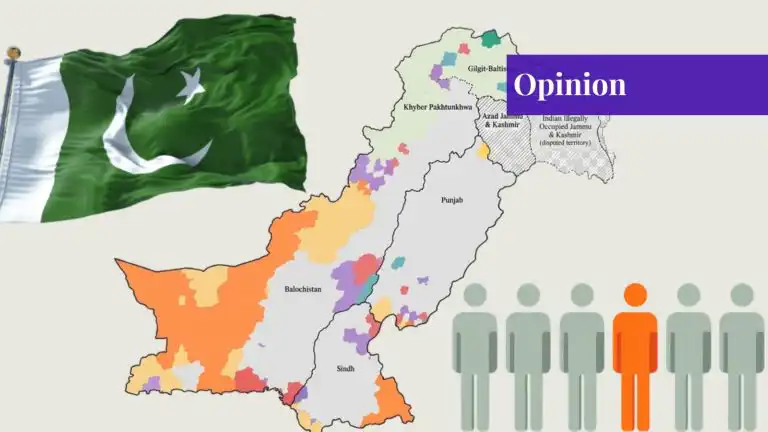
The most powerful argument for a reorganization of Pakistan’s map is an ethical one. The Saraiki speaker in Rajanpur has rarely had a government which views his language as anything but a dialect. Karachi and Hyderabad contain a significant portion of the population of Sindh and, as MQM-P contends, accordingly have little control over issues of water, sanitation, and waste. To these groups, a new province offers not a clean-up but the possibility of a first majority.
This argument merits scrutiny rather than praise, because federalism exists on several planes simultaneously.
Consider the South Punjab idea in its most generous interpretation. Draw the line, and there is a Saraiki-speaking province. In it, right away, are Punjabi settlers of the canal colonies, Urdu-speaking urbanites of Multan and Bahawalpur, Balochis of the western districts, and migrants in the cities. Yesterday, they were part of a provincial majority. Today, they are minorities in a province created to respond to somebody else’s call for identity. Everything that has happened is simply a change in their relative position, which, in politics, is all that really counts.
The mirror image works no matter where the line is drawn. Split Sindh, and you get a predominantly urban province where Sindhis are minorities, and another, rural one, where Urdu-speakers are. Separate Hazara, and the Hindko-Pashto ratio is inverted in opposite directions at the same time. Every boundary defines not one category of people, but two.
Pakistan has too little in place to deal with this. The Constitution recognizes the rights of citizens with distinct languages and cultures to preserve and promote them, but there is no comparable system of reserved representation for linguistic minorities in provincial legislatures, nor a strong framework for protecting them when the provincial majority changes. The 18th Amendment distributed much power to the provinces while Article 140-A required provinces to devolve political, administrative and financial authority to elected local governments. In practice, that devolution remains weak. We have the base, but we lack the railings.
The interior minister understands the threat. He says new administrative boundaries will have to emerge through a consensus process and not be imposed. He also says identities would not be affected. Mustafa Kamal makes the same argument. He says the demand is not directed against Sindhis. He also insists that no territory will be transferred between the provinces.
Both assertions may be honest, but they are not enough. Intention is not a barrier. A boundary drawn for administrative purposes creates the same demographic mathematics as one drawn for ethnic reasons. The map is agnostic about the purpose behind it.
The reaction in Sindh provides the perfect example. This month, its provincial assembly adopted a resolution against the division of the province. The chief minister pointed to a long series of prior resolutions opposing division, dating back decades. When a demand is framed administratively but perceived existentially, the framing has already failed.
The comparative evidence is revealing, even if inconsistent. Ethnicity became constitutionalized as the organizing logic of the Ethiopian federation; territory became identity, identity became entitlement, and movement became a security issue, contributing to the outbreak of civil war. Belgium accommodates its linguistic groups territorially so extensively that the country is regularly left without a functioning government for months because of the unresolved problem of Brussels, where the logic of territorial arrangement breaks down. Spain recognizes autonomy for its historic nationalities and discovers that autonomy does not necessarily resolve the nationalisms it was intended to accommodate. Nigeria, in turn, divided itself from three to thirty-six states in an attempt to achieve a more balanced ethnic equation, only to end up with states that struggle financially and minorities whose grievances have often been reproduced at a smaller scale.
Despite their differences, the message from these examples is unambiguous: territorial recognition does not resolve the minority problem. It fragments it.
This is not an argument for rejecting the claims of communities that have been administered as afterthoughts for seventy-nine years. The dismissal of their claims as ethnic mischief, which has been Islamabad’s practice for decades, is precisely how grievances turn into movements.
But recognition without guarantees simply moves the problem elsewhere.
The guarantees therefore have to be incorporated into any amendment redrawing the map. This means language rights for whichever community ends up as the minority in the new province; meaningful representation for minorities in the provincial assembly; an anti-discrimination clause protecting communities from discriminatory provincial policies; and strong local governments in areas with concentrated minorities, so that the community outvoted at the provincial level can still exercise meaningful authority where it actually lives.
And this is the guarantee nobody wants.
What enables a minority to be a minority without being powerless is functioning local government under Article 140-A. That reform has been on the books since 2010. It has never been fully implemented — not because the mechanism is unclear, but because meaningful devolution would dilute the very provincial power that new-province advocates and provincial defenders alike are fighting over.
Perhaps that is the real question Pakistan should ask before drawing another line on the map: not who gets to become the majority, but what happens to everyone who does not.
If you want to submit your articles and/or research papers, please visit the Submissions page.
To stay updated with the latest jobs, CSS news, internships, scholarships, and current affairs articles, join our Community Forum!
The views and opinions expressed in this article/paper are the author’s own and do not necessarily reflect the editorial position of Paradigm Shift.

Mohamin Zeeshan is a scholar of International Relations at the National Defense University, Islamabad.