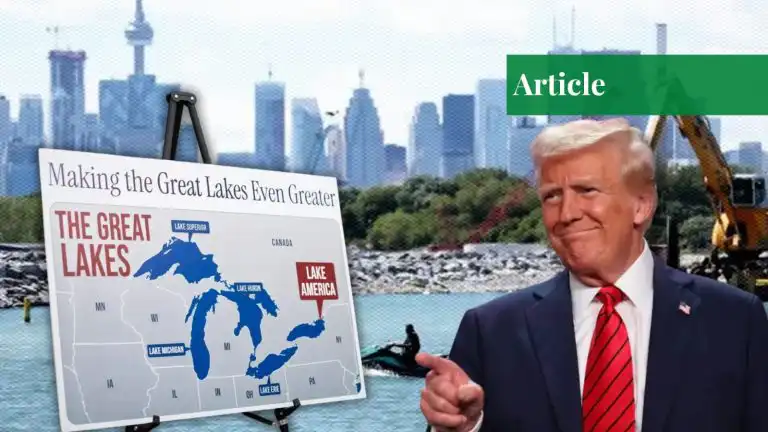
Maps provide not only information on the geographical features but also the vision of the government on the issues of power, sovereignty, and national identity. President Donald Trump signed an executive order on August 27, 2026, which renamed Lake Ontario to “Lake America.” It is not possible for this executive order to change the borderline in the lake or to convince the Canadian government to rename the lake. Nevertheless, this event is of great political importance. Being the example after renaming the Gulf of Mexico to “Gulf of America” in 2025, it shows how geography could be used as another means to apply the “America First” policy.

A Shared Pattern, Different Systems
This does not mean that this case is an end to the international system based on rules. This is quite the contrary since this case is just one example of the trends prevalent across many nations in the world. National sovereignty, historical identity, and national greatness are becoming more important than any international limitation in case they conflict with each other.
According to Michael Kimmage in Foreign Affairs, a similar change from “universalistic internationalism” to strong leadership and great nations and civilizations’ politics takes place in international affairs. Yet, Putin, Xi Jinping, Modi, and Trump are different leaders. While Putin is an authoritarian leader, Xi Jinping is at the head of the single-party system, Modi is ruling a competitive and increasingly majoritarian democracy, and Trump is working in an institutional context of elections and a constitution. They are not the same political phenomena, but they are just different manifestations of the same trend in international politics.
Russia: Sovereignty Through Force
Russia exemplifies its most aggressive stance. With Putin’s attack on Ukraine and the Russian annexation attempt of Ukrainian territory, Russia violates one of the most important principles of the international order after 1945: that borders must not be changed using force. On October 12, 2022, the United Nations General Assembly passed Resolution ES-11/4 by a majority of 143 to 5 votes with 35 abstentions, denouncing the Russian attempt to annex the territories of Donetsk, Kherson, Luhansk, and Zaporizhzhia. As such, Russia’s moves put into question the most clear-cut constraint, the prohibition of territorial acquisition through the UN Charter.
China: Selective Multilateralism
China is an example of how states engage international constraints in their own unique way. China continues to operate deeply embedded within international organizations and gets many benefits from those organizations. But when any international decision contradicts what China considers a vital interest of the state, sovereignty wins. The best example was in 2016, when the arbitral tribunal ruling on the Philippine case rejected many aspects of China’s claims regarding the South China Sea. China dismissed the decision of the international arbitration tribunal. China still does not give up multilateralism; instead, it uses it selectively as a tool for testing the limits of international adjudication.
India: Sovereignty Within the System
India is complex, so it requires a more detailed and thoughtful perspective. Modi’s India cannot easily be classified along with Russia and China. It is an active participant in the United Nations, the G20, BRICS, and the QUAD, and it is still an electoral democracy. India also represents the new trend towards sovereignty. In 2019, the Indian government repealed the special constitutional status of the state of Jammu and Kashmir despite international concerns and continues to refuse third-party mediation of the Kashmir issue. The crux of the issue for India, though, does not appear to be the outright rejection of the international system but the degree to which such scrutiny or mediation by the international community may infringe on issues that New Delhi views as those of its national sovereignty.
The United States: Withdrawal on American Terms
The most relevant case is the United States, owing to its pivotal role in the construction of the post-war order currently being challenged. The “America First” doctrine that Trump has put forward has gone well beyond electioneering and trade wars. His administration has, since taking office, pulled out of the Paris Agreement and the World Health Organization, ended participation in the United Nations Human Rights Council, and made it known that the United States would withdraw from UNESCO. The United States left UNESCO in 1984, rejoined in 2003, withdrew again in 2018, rejoined in 2023, and is now scheduled to leave again at the end of 2026.

In January 2026, Trump issued a presidential memorandum calling for the United States to exit from and/or no longer participate in a number of international organizations and institutions that the United States believed to be working against its national interest. In the realm of trade policies, when its tariffs were taken up in the World Trade Organization, the United States accepted the requests to enter into consultations but maintained that tariffs linked to national security were not susceptible to review or capable of resolution through WTO dispute settlement. It is pertinent to ask then how much authority multilateral institutions could exert on the power behind them.
A Counterargument: Just Bargaining?
A convincing argument still stands. Perhaps it can be assumed that Trump employs the bargaining technique but not a principled rejection of multilateralism. Tariffs, threats, and institutional pressures can become tools of attaining better conditions of participation and not signs of a principled stance against multilateralism. The argument is convincing in a number of ways. For example, even if Trump does not withdraw from NATO, the pressure put on European allies has produced an increase in defense contributions.
Yet, the framework of bargaining becomes less convincing if the same tendency applies not only to trade but also to other areas like climate agreements, global health organizations, UNESCO, UN organizations, and international bodies resolving disputes. It is clear from the tendency that withdrawal is not happening, but participation takes place under tougher and tougher conditions.
Conclusion: The Map as a Warning Sign
Such dynamics explain the importance of the idea of “Lake America” in spite of its ineffectiveness in shaping any territorial changes. Names cannot alter anything in international relations. But political symbols are used to communicate the worldview of governments to their citizens. “Lake America” sends a clear message that the current state of things is not eternal and can be changed or questioned if it is inconsistent with the power or national pride of a country.
The rules-based order is not disappearing. The role of international institutions is preserved, and even great powers need them. What is diminishing is the expectation that great powers will accept common constraints when they contradict national interests.
Putin, Xi Jinping, Modi, and Trump are not advancing the same agenda. Their political systems, approaches, and aims are quite different. Still, in each of their ways, they reflect a general trend of moving away from the belief in the universality of rules towards a world where sovereignty becomes a priority. “Lake America” did not trigger this process, but it illustrates it in geopolitics.
If you want to submit your articles and/or research papers, please visit the Submissions page.
To stay updated with the latest jobs, CSS news, internships, scholarships, and current affairs articles, join our Community Forum!
The views and opinions expressed in this article/paper are the author’s own and do not necessarily reflect the editorial position of Paradigm Shift.