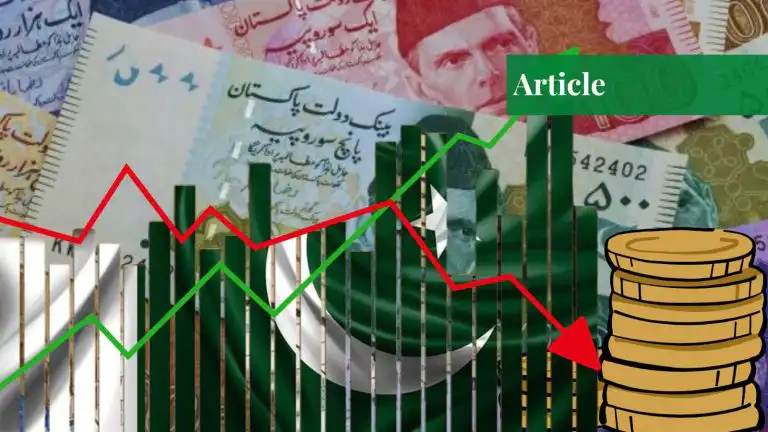
The story of Pakistan’s economy has been following a familiar pattern for years: one crisis after another; crises approach and are resolved after some economic adjustments. Some of the major crises are the fall of foreign exchange reserves, the rise of inflation, the depreciation of the rupee, and the country asking for foreign investors or lenders to help with economic stability until the next crisis.
Though somewhat, it is now going to change.
But recently, in August 2026, Moody’s has upgraded Pakistan’s sovereign credit rating from Caa1 to B3 and expects the country’s credit rating outlook to be stable. Not only that, but the agency drew attention to governance improvements, robust economic conditions, and a drop in Pakistan’s external liabilities. Moreover, Moody’s said Pakistan’s economic condition is far better than in 2022 to withstand external fiscal or economic shocks based on two years of macroeconomic stabilization and current governance actions.
The word “resilience” sounds encouraging, but it needs to be understood carefully. Pakistan has not suddenly become an economically secure country. Moody’s assessment is better understood as evidence that the country has built a larger buffer between itself and the kind of crisis that nearly overwhelmed it four years ago.
What Moody’s Resilience Assessment Means
An economic shock is an event that occurs randomly and turns up the heat on a country’s finances, e.g., oil prices start to rise, exports decline, and foreign investments or trade disappear due to local conflict.
These economic shocks are very dangerous for Pakistan because they require foreign currency to pay for imported items, such as fuel and machinery, while also servicing external debt.
This is where foreign exchange reserves matter. Reserves are essentially the country’s emergency pool of foreign currency. When reserves are too low, a country can struggle to pay its external bills, defend confidence in its currency, or meet debt payments.
Pakistan’s position has improved considerably. The State Bank of Pakistan reported total liquid foreign exchange reserves of about $23.7 billion on September 4, 2026, including more than $18.3 billion held by the central bank. That is a significant improvement from the severe reserve pressure seen during the 2022–23 crisis.
But a bigger cushion does not mean the underlying problem has disappeared.
How Pakistan Became Better Prepared for External Shocks
Pakistan’s recent stability has not come from a single policy or a lucky break. It has been built through a series of measures, many of which have been politically difficult, and the IMF programme has played a major role. In May 2026, the IMF stated that Pakistan’s programme remained on track, restored macroeconomic stability with timely implementation of policies, and also recovered foreign exchange reserves and improved economic conditions.
For this purpose, the government has been working on revenue collection, controlling spending, and maintaining a primary financial surplus. In other words, a primary financial surplus means the government is imposing more taxes than it spends before paying interest on its existing debt.
Moreover, these high taxes and reduced state expenditure put pressure on individuals and households and small businesses, especially people who are already burdened by expensive electricity, fuel, and necessities.
That creates an important distinction: economic stability is not necessarily the same thing as economic comfort.
The Role of IMF Support and Economic Discipline
Another reason Pakistan can absorb shocks more effectively today is that it has stronger external support than it did during its most vulnerable periods.
The IMF’s latest review said Pakistan had met key programme targets, including its reserve and fiscal commitments. The Fund also projected that official reserves would continue to increase over the medium term.
This matters because investors and lenders are not only looking at how much money Pakistan has today. They are also asking whether the country has access to financing if conditions suddenly worsen.
The IMF
The IMF programme does not just provide that credibility, but it also creates a dependency that becomes difficult for Pakistan to escape. The IMF has supported Pakistan with short-term financing for many years, but this is not enough to solve the root cause behind recurring balance-of-payments crises.
That is why the current improvement should be viewed as progress, not a final solution.
Resilience Does Not Mean Economic Stability
Pakistan’s economy has already faced a difficult external environment in 2026. The Middle East conflict has affected energy prices and created uncertainty around trade and inflation.
Yet the IMF said in May that Pakistan’s policy implementation had helped maintain stability despite the regional conflict. That’s important because resilience is not explained as everything going so well, but it can be explained as when something is not going well, it means the country can absorb the damage without falling.
This is also why Moody’s assessment matters.
The rating agency is not saying that Pakistan has eliminated its vulnerabilities. It is saying that the country’s ability to withstand them has improved.
That distinction is easy to miss.
A household with three months of savings is more resilient than one with three days of savings, even if both still have the same monthly expenses. Pakistan is in a similar position. Its financial cushion is larger, but its underlying income, debt, and spending problems still matter.
The Cost of Managing Repeated Economic Shocks
This is where the idea of “engineered stability” becomes useful.
Pakistan’s recent improvement has been deliberately constructed through fiscal discipline, tighter monetary policy, reserve accumulation, IMF reforms, and efforts to strengthen government finances. It is not simply the result of the economy naturally becoming stronger.
That can be considered a positive development, but governments cannot build long-term growth while facing a currency or debt crisis.
Can Temporary Stability Become Sustainable Growth?
However, stability can be sustainable only in that case when the country can finally generate enough economic revenue, exports, investment, and tax revenue to be able to support itself.
The IMF itself continues to emphasise structural reforms, including broadening the tax base, improving public financial management, reforming state-owned enterprises, strengthening the energy sector, and raising productivity.
These are the less exciting parts of economic reform, but they are arguably more important than a rating upgrade.
Beyond Shock Management: Pakistan’s Next Challenge
Pakistan’s move from Caa1 to B3 is meaningful. It suggests that the country is no longer viewed as being in quite the same immediate danger that it was during the worst period of its recent economic crisis.
But a better credit rating should not be mistaken for economic transformation.
Pakistan has built stronger shock absorbers. It has more reserves, greater policy discipline and stronger external support than it had before. The question now is whether it can use this period of relative stability to fix the weaknesses that repeatedly create crises in the first place.
That means increasing exports rather than simply borrowing more, bringing more people and businesses into the tax system, reducing losses in the energy sector, improving productivity and creating conditions for long-term investment.
The real achievement would not be surviving the next crisis.
It would be reaching a point where the next crisis does not arrive in the first place.
Find our FREE quizzes and MCQs here!
If you want to submit your articles and/or research papers, please visit the Submissions page.
To stay updated with the latest jobs, CSS news, internships, scholarships, and current affairs articles, join our Community Forum!
The views and opinions expressed in this article/paper are the author’s own and do not necessarily reflect the editorial position of Paradigm Shift.
Hooria Akbar is an independent researcher and content writer with a strong interest in contemporary issues across AI, technology, society, and emerging trends. She writes research-informed articles, thought pieces, and blogs on a wide range of topics, aiming to present complex ideas clearly and engagingly for diverse audiences.