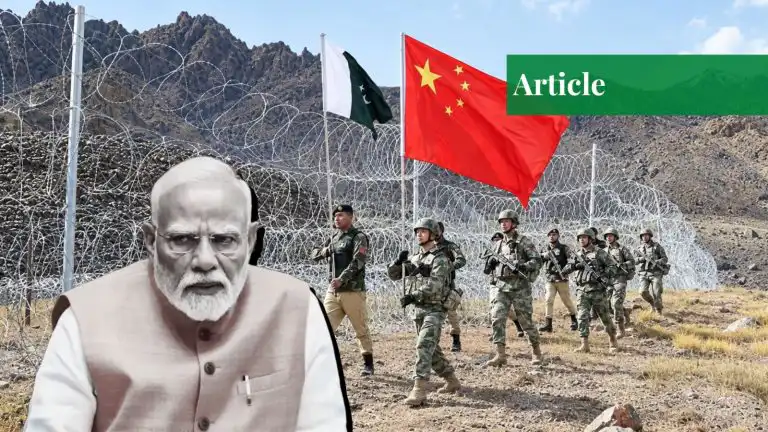
For many years, India has not accepted the boundary between Pakistan and China. Besides that, there has been a dispute over the Himalayan region for a long time. Delhi claims that part belongs to India, but recently this dispute came under discussion in September 2026, when Pakistan and China signed an agreement known as the ‘Pakistan-China Boundary Joint Commission’. As part of this, the inaugural ceremony was held in Islamabad on September 16-17, which Pakistan described as a very significant milestone that will strengthen cooperation along the border between India and Pakistan—improving trade, making trade stronger, and facilitating connectivity.
Why India Rejected the Agreement
India’s Ministry of External Affairs did not mince words. Spokesperson Randhir Jaiswal told reporters that there is no boundary between Pakistan and China to speak of and that the so-called Joint Commission has no legal basis whatsoever.
This is not a new position for India. Delhi has said versions of the same thing for decades, ever since Pakistan and China signed their original boundary agreement back in 1963. What makes this moment worth paying attention to is the timing and the fact that a dormant mechanism has now been switched on, rather than any brand new territorial claim being made.
The 1963 Agreement Behind the Dispute
So, how did India reject this agreement? In 1963, Pakistan and China mutually signed a boundary agreement regarding areas under Pakistan’s control.
Under this deal, Pakistan ceded control of a 5,180-square-kilometer area to China—an area known as the Shaksgam Valley or the Trans-Karakoram Tract.
India did not accept this at the time. Delhi maintained that the entire region—including Jammu & Kashmir and Ladakh—was Indian Territory, and asserted that Pakistan had no legal right to cede any part of it to a third country.
Interestingly, the 1963 agreement itself seemed to acknowledge that its terms were not final. It included a clause suggesting that the boundary would be renegotiated once the wider Kashmir dispute was resolved, depending on which country ended up controlling the territory.
That provisional nature is part of why India views any move to formalise or institutionalise the arrangement, sixty years later, as an attempt to lock in something that was never meant to be permanent.
Why Has the Commission Been Activated Now?
According to Jabin T. Jacob, a professor at Shiv Nadar University who studies India-China relations, what happened in Islamabad was really the revival of an existing mechanism, rather than the creation of something entirely new. He pointed out that the 1963 agreement already provided for a boundary commission, so the real question is why China chose this moment to operationalize it.
One likely explanation is that Beijing has been on a broader push lately to demarcate its various borders formally, and another is that Pakistan’s other frontiers have seen a fair amount of instability recently, which may have made this particular relationship look comparatively easier to establish.
Husain Haqqani, Pakistan’s former ambassador to the United States, offered a slightly different but complementary reading of the situation. This Joint Commission has two main objectives. If viewed from a practical standpoint, this commission will prove beneficial in two ways: it will assist in border management, such as preventing illegal crossings.
Secondly, it relates to our infrastructure connected to the China-Pakistan Economic Corridor (CPEC)—such as road networks, various energy projects, and especially our trade routes connecting Western China to Gwadar Port on Pakistan’s coast, for which this will be quite helpful.
If viewed at a political level, as Husain Haqqani noted, this move sends a clear message to India that China views the Kashmir dispute through Pakistan’s perspective, which is supporting Pakistan’s stance rather than India’s.
What Does This Mean for Regional Stability?
The situation could have effects on how borders are managed, how trade happens, and how different areas are connected. The bigger picture is probably linked to the different claims and strategies of Pakistan, China, and India.
The group could help Pakistan and China work together along their border and support projects related to CPEC. At the time, India’s refusal shows that this setup does not fix the deeper disagreement about who owns the land.
This difference is important. A way to handle a border does not always decide who owns the land. In this case, Pakistan and China might see their agreement as correct while India still says it is not valid.
More Than Border Management
Another significant point worth noting here is that Beijing and Delhi have been attempting to de-escalate the military tension and strain along their disputed border—the Line of Actual Control—persisting since the 2020 Ladakh clash.
Against this backdrop, when China expanded border cooperation with Pakistan in that same disputed Himalayan region, Indian officials did not view it as a neutral or merely administrative move. Husain Haqqani observes that the timing of this announcement was deliberately chosen to follow President Xi Jinping’s visit to the BRICS summit; the aim was, on the one hand, to reassure Pakistan of the strength of their strategic partnership, and on the other, to quietly remind India that sitting together at multilateral forums does not alter China’s fundamental policy regarding South Asia.
Jacob, however, cautioned against reading too much military significance into the move. He noted that there do not appear to be any immediate or obvious implications for the Line of Actual Control as things stand right now.
That is an important nuance, because it suggests the real impact of this development may be slower and more symbolic than dramatic, rooted in the gradual normalization of arrangements that India has spent six decades rejecting rather than in any sudden shift on the ground.
The Bigger Question Is Not Just the Border
Haqqani made one more point that is worth sitting with. He argued that the core disagreement between India and China over this border is fundamentally geo-strategic rather than about the precise location of lines on a map, which means there is only so much that border commissions and management mechanisms can realistically achieve.
Pakistan, in his view, continues to function as China’s secondary deterrent against India, and this latest step is simply another way for Beijing to keep sending that message.
For India, the frustration is less about a single meeting in Islamabad and more about watching a decades-old dispute slowly get treated as settled business by two neighbors it does not fully trust.
Find our FREE quizzes and MCQs here!
If you want to submit your articles and/or research papers, please visit the Submissions page.
To stay updated with the latest jobs, CSS news, internships, scholarships, and current affairs articles, join our Community Forum!
The views and opinions expressed in this article/paper are the author’s own and do not necessarily reflect the editorial position of Paradigm Shift.
Hooria Akbar is an independent researcher and content writer with a strong interest in contemporary issues across AI, technology, society, and emerging trends. She writes research-informed articles, thought pieces, and blogs on a wide range of topics, aiming to present complex ideas clearly and engagingly for diverse audiences.