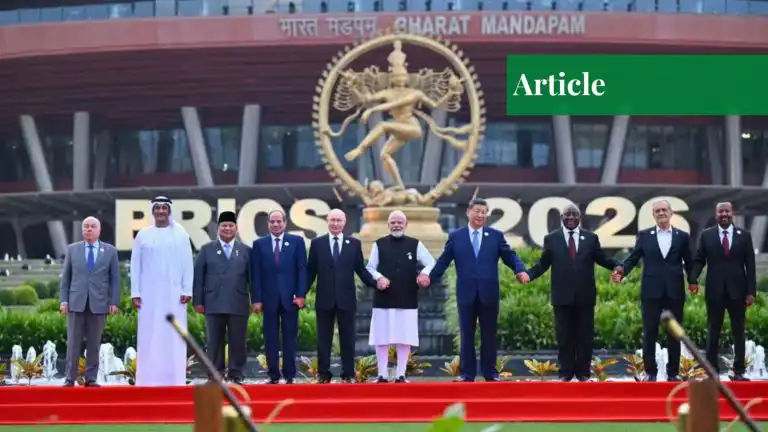
On September 12, 2026, eleven governments sat down in New Delhi and did something BRICS hadn’t managed in years: agree on a joint declaration without a single member objecting. Within 48 hours, the world’s press had read that same document in three different ways. The South China Morning Post’s headline said BRICS had taken a step towards de-dollarisation. The Diplomat, reporting from inside the summit, said the New Delhi Declaration made no mention of de-dollarisation at all; it simply backed more trade in national currencies, a far softer commitment. A third outlet called it the most ambitious challenge to the dollar-dominated financial order BRICS has mounted so far.
Three readings of one two-day summit, and none of them is technically wrong. That’s usually the tell that a story isn’t really about what got said in the room—it’s about what “threat to the Western-led order” is even supposed to mean, a quarter-century after Goldman Sachs coined the acronym as a stock-picking shorthand, not a geopolitical project. Settling that takes the trade, reserve, and lending numbers sitting underneath the summit, not the language of the communiqué.
What BRICS Actually Is Now
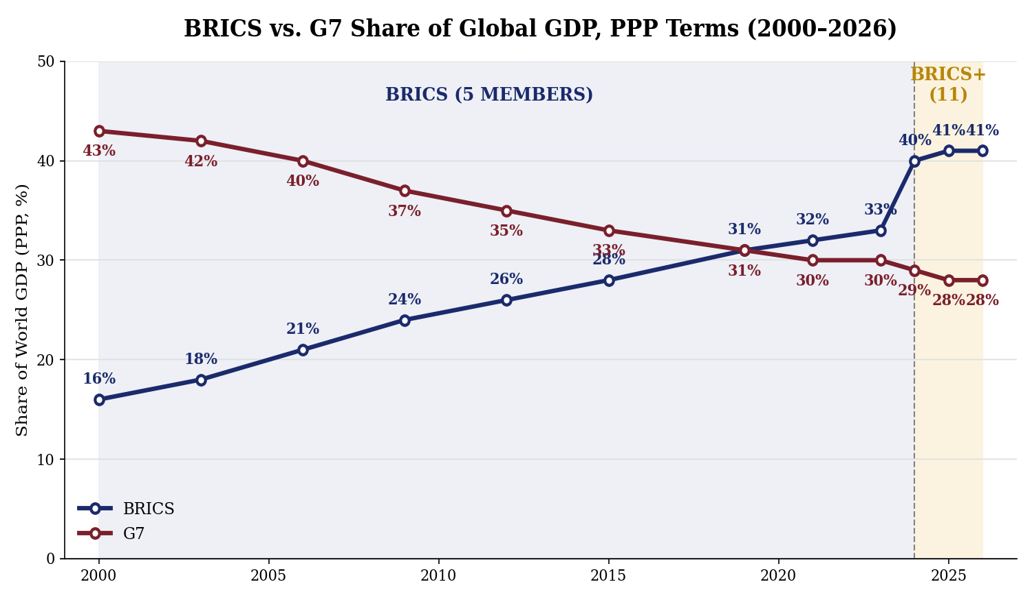
BRICS is no longer the five-country club of 2009. Egypt, Ethiopia, Iran and the UAE joined as full members in January 2024, Indonesia followed in January 2025, and Saudi Arabia’s status is still, technically, unresolved—more on that later. The resulting eleven-member bloc accounts for something like 48% of the world’s population and, by the IMF’s purchasing-power-parity measure—how far a country’s income actually stretches at home, not what it converts to abroad—40% of global GDP, a share the IMF projected would edge up to 41% in 2025. Set against the G7, whose PPP share sat at 28.4% in 2025 on a population share of just 9.6%, the contrast is obvious: a bloc with roughly five times the G7’s population commanding a bigger slice of world output, at least by this one measure.
The bloc also sits on real physical leverage. Its own members put BRICS in control of proven rare-earth reserves at roughly 72%, alongside more than 40% of global oil production and most of the world’s coal. Intra-BRICS trade has grown 13-fold since 2003, to $1.17 trillion. The New Development Bank, the bloc’s answer to the World Bank, has approved 112 projects worth roughly $37–39 billion since 2015, with a stated goal of pushing 30% of its lending into members’ own currencies by the end of 2026. None of this is invented. It isn’t the whole picture either.
The Bloc’s Own Case And Where It Gets Confusing
The claim BRICS officials repeat most often is the PPP crossover: the bloc first overtook the G7’s share of global output somewhere around 2018 or 2019, depending on whose dataset you use, and the gap has only widened since. That’s real. What’s harder to reconcile is that two credible analyses, published months apart in 2025, put BRICS’s 2025–26 PPP share at two very different numbers. One, tracking the original five-country trend line, puts it at roughly 34.6%. Another, using the IMF’s figures for the now eleven-member bloc, puts it at 40–41%.
Both numbers are correct. They’re just counting different things. The first tracks how much Brazil, Russia, India, China and South Africa have organically grown relative to the G7 over two decades. The second folds in Egypt, Ethiopia, Iran, Indonesia, the UAE and, nominally, Saudi Arabia – economies that didn’t get bigger in 2024; they just got counted. Roughly six of those forty-odd percentage points arrived by invitation, not by growth.
The Dollars, Not the Percentages
PPP is also, on its own, the wrong tool for measuring a threat to Western order, because it measures how far a country’s income stretches at home, not how much weight its currency, its banks or its companies carry abroad. On that score the picture reverses. In nominal dollar terms—the units of capital actually move in—the G7 still commands something like 44% of world GDP against BRICS’s roughly 28–30%. The G7’s economies, with a tenth of BRICS’s population, still do more than 40% of world trade; BRICS’s eleven members, with nearly half the planet, do about 26%.
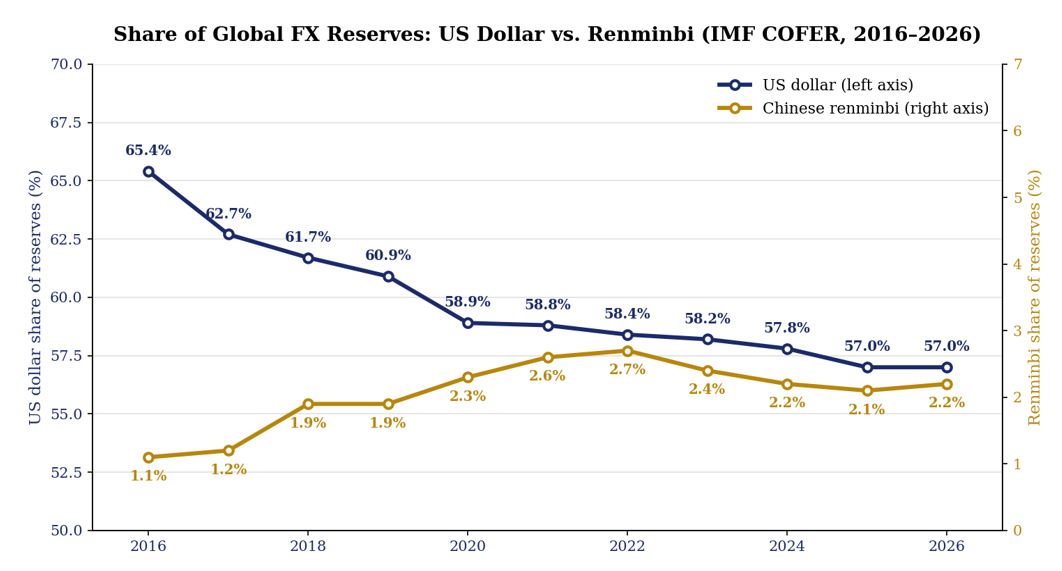
Currency tells the same story more bluntly. The IMF’s COFER data — the quarterly survey of what the world’s central banks actually hold in reserve – put the dollar’s share at 57% in the first quarter of 2026, down gently from around 65% a decade earlier. That’s a real decline, but a slow and largely mechanical one: most of the recent wobble reflects the dollar’s own exchange-rate swings against the euro, not central banks actively dumping it. The renminbi, BRICS’s own flagship alternative, has spent the last three years oscillating between roughly 2% and 3% of global reserves, occasionally losing ground month to month. It remains the fifth or sixth most-held reserve currency in the world, behind the dollar, euro, yen and sterling.
| Metric (current) | BRICS (11 members) | G7 |
|---|---|---|
| Population share | ~48% | ~10% |
| GDP share, PPP terms | ~40% | ~28% |
| GDP share, nominal terms | ~28–30% | ~44% |
| Share of global trade | ~26% | >40% |
| Reserve-currency share (RMB vs. USD) | ~2% | ~57% |
Read the percentages, and BRICS looks like it’s closing in. Read the dollars, and the G7 hasn’t really moved.
What’s Actually Changing Hands?
Where de-dollarisation is real, it’s real in one specific, sanctioned corner of BRICS, not across the bloc. Russia and China now settle somewhere between 92% and 99% of their bilateral trade in roubles and yuan, up from under 2% before 2022—a genuine, structural shift, forced by Western sanctions rather than chosen out of conviction.
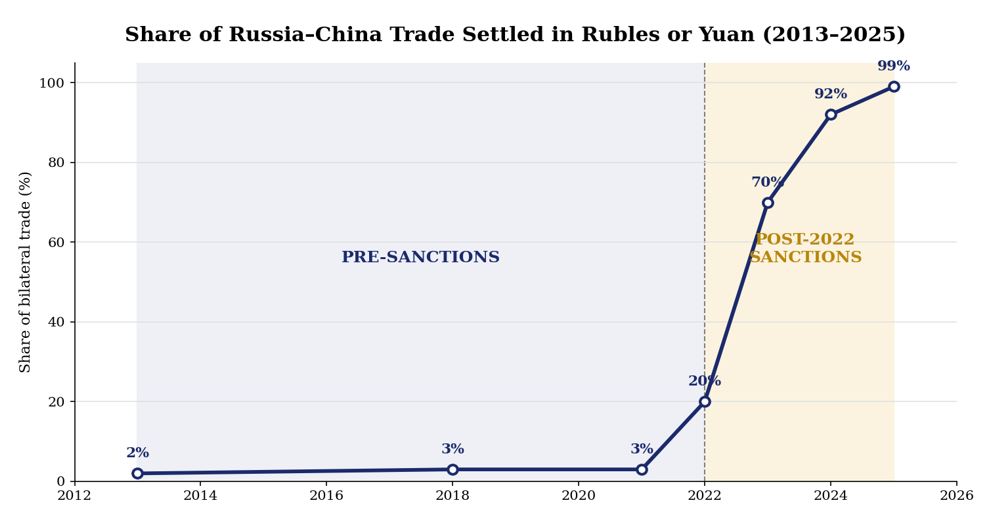
It’s also a shift confined to a relationship that isn’t very big by global standards. Russia accounted for under 4% of China’s total trade turnover even at the relationship’s post-invasion peak, and that trade actually shrank by 6.9% in 2025, to $228 billion, as sanctions enforcement tightened further.
India’s experience cuts the other way and says more about the bloc’s coherence than the Russia-China numbers do. New Delhi spent two years lobbying Moscow to settle its oil imports in rupees—the obvious BRICS-branded alternative to the dollar. Russia said no. Rupees earned from selling oil to India are hard to spend anywhere that isn’t India, since the currency isn’t freely convertible, and Moscow didn’t want to sit on a growing pile of money it couldn’t easily use.
Today, under 5% of India’s payments for Russian crude are settled in rupees; most of the rest move through the Chinese yuan or, increasingly, the UAE dirham. That’s real de-dollarisation, in the narrow sense that dollars aren’t changing hands. It’s also a patchwork of bilateral workarounds, not a common BRICS alternative—India’s own currency lost out to two other members’ currencies inside its own flagship BRICS relationship.
The New Development Bank tells a smaller version of the same story. Local-currency lending crept from about 21.5% of its book in 2023 towards roughly 25% by mid-2025, still short of its own 30% target for this year, and bank officials have said openly that most of that local-currency lending has been denominated in yuan. The Bank’s entire cumulative loan book, roughly $37–39 billion since 2015, is a real and useful pool of financing with fewer strings attached than a World Bank loan. It’s also less than a third of what the World Bank Group alone committed in fiscal year 2025—$118.5 billion, in a single year.
A Bloc That Can’t Agree on What It’s For
The internal cracks show up most clearly at the edges of the bloc’s own membership list. Saudi Arabia was invited to join back in 2023 and still hasn’t formally accepted, three years on. Official BRICS material lists Riyadh among the eleven full members; Saudi Arabia’s own government communications around the New Delhi summit described the kingdom as merely an invited participant.
The country holding some of the world’s largest proven oil reserves has spent three years declining to say yes outright—reportedly because it doesn’t want to complicate a relationship with Washington that includes active negotiations over nuclear and defence technology. That’s not a rounding error in the membership count. It’s the bloc’s most economically consequential prospective member publicly hedging on whether it wants to be counted as a challenge to the dollar order at all.
The common-currency idea – the one initiative that would have actually threatened dollar dominance rather than nibbling at its edges – is effectively dead, and India killed it. New Delhi, a founding member, rejected the idea outright, and by 2025 most other members had reportedly stopped discussing it too. The New Delhi Declaration, drafted under India’s own chairmanship, pointedly avoided the phrase “de-dollarisation” altogether, opting for the vaguer language of trade in national currencies.
That wasn’t an oversight. India runs a large, fast-growing economy, hosts the QUAD alongside the US, Japan and Australia, and has no interest in being cast as the leader of an anti-Western bloc. China, which alone accounts for something like 70% of BRICS’s combined GDP, would obviously be the chief beneficiary of any real common-currency project. The bloc’s second-largest economy said no to underwriting the largest economy’s currency ambitions and dressed the refusal up as consensus.
Whether the West Actually Felt Any of It
Trump has now threatened BRICS members with 100% tariffs over de-dollarisation twice – in November 2024 and again in early 2025 – plus a further 10% tariff on countries “aligning” with the bloc’s “anti-American policies” that July. None of it has been imposed. BRICS hasn’t backed down from expanding, either.
Both things being true at once is itself informative: the threat has been loud enough to shape the summit’s language, but not loud enough, or credible enough, to actually stop the bloc’s growth. The Peterson Institute’s own modelling concluded that neither current conditions nor BRICS’s de-dollarisation talk posed an immediate danger to American interests – and that an actual 100% tariff would hurt American and Chinese growth in tandem.
The more useful test is what happened when real tariff pressure did land. Washington’s 2025 tariff escalation against China was the sharpest trade shock the world economy has faced in years, and yet the redirection of Chinese exports away from the US market totalled around $150 billion for the full year – about 0.6% of global trade, by one estimate, and most of it landed in ASEAN, sub-Saharan Africa and the Gulf rather than inside BRICS specifically.
The dollar’s share of global FX turnover held at 89% through early 2025. Its share of trade invoicing sat at 54%. None of the numbers that would actually indicate the Western financial order is losing ground – reserve share, invoicing share, FX turnover – moved by more than a point or two, even under the most direct pressure the system has faced this decade.
To Be Fair to BRICS
None of this makes the bloc a paper tiger. Its resource leverage is real, and unlike GDP shares, it can’t be manufactured by inviting new members: 72% of rare-earth reserves and over 40% of oil production is genuine structural power, and the 2025 dispute over Chinese rare-earth export kerbs showed Washington taking that leverage seriously. The New Development Bank, even short of its own targets, is a functioning alternative lender that Bangladesh, Egypt and half a dozen African borrowers have actually used, with faster approvals and none of the policy conditions a World Bank loan carries.
Russia’s and China’s near-total de-dollarisation of their own trade is a genuine, durable achievement, even if it was born of necessity rather than ideology, and it isn’t obviously going to reverse even if the Ukraine war ends. And the bloc’s staying power under direct American pressure is itself a data point: a two-year-old 100% tariff threat hasn’t stopped Indonesia, Egypt or the UAE from joining, hasn’t stopped more than 30 countries from applying and hasn’t stopped India from hosting a unanimous eleven-country declaration in its own capital.
The Verdict
BRICS has genuinely grown. In population, in raw resource control, and in the sheer number of governments willing to sit in the same room, it is a larger and more consequential grouping than it was even five years ago. What it hasn’t done is convert that mass into a working alternative to the system it periodically claims to be replacing. The dollar’s reserve share has barely moved. The renminbi, its best-positioned substitute, is still a rounding error next to it. The one initiative that would have actually mattered—a common currency—was killed by BRICS’s own second-biggest economy. And its most oil-rich invitee still can’t decide whether it wants to be counted as a member at all. A quarter-century after the acronym was coined, BRICS has the economic mass to be a threat to the Western-led order. It hasn’t yet built the coherence, or the currency, to be one.
If you want to submit your articles and/or research papers, please visit the Submissions page.
To stay updated with the latest jobs, CSS news, internships, scholarships, and current affairs articles, join our Community Forum!
Find our FREE quizzes and MCQs here!
The views and opinions expressed in this article/paper are the author’s own and do not necessarily reflect the editorial position of Paradigm Shift.

Asnan Asad is a final-year BS International Relations student at the University of Gujrat, Pakistan, with research interests in Pakistan's foreign policy, the China-Pakistan Economic Corridor (CPEC), and regional security. He has interned at Inter-Services Public Relations (ISPR) and the Institute of Regional Studies, and is an active member of IIRIS, his university's IR student society.