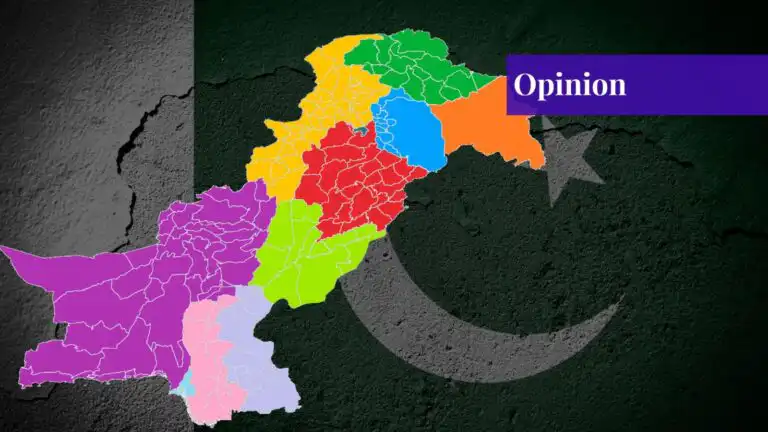


The stench of a putrid carcass is not lessened by cutting it into four or forty pieces. If anything, the division exposes more of the rot and worsens matters. That is exactly the solution that is being proposed, when it is suggested that dividing four provinces into more will solve the scourge of corruption, inefficiency, lack of resources, and development due to distance from the center, etc.
Reviewing the history of the Indian Subcontinent alone lays bare the falsity of this premise. There have been cyclical periods of a multiplicity of small kingdoms and fiefdoms, alternating with amalgamation into a few larger kingdoms or an empire. The mini-states are synonymous with a time of decline, while unification heralded a period of unprecedented progress and power.
Of course, each new province will require its own administrative machinery. Therefore, the bureaucracy will readily replicate itself like amoebae into however many provinces are created. They say that an apple does not fall far from the tree. Why then would one expect the progeny bureaucracies to be different from their parents? Where is the logic in assuming that multiplication makes bureaucracies more efficient, less corrupt, and enables development? It is not unreasonable to anticipate that it will further increase the cost of running the country. There will be more provinces fighting for their piece of the pie. A cash-strapped nation should be running lean and mean, not becoming top-heavy and too corpulent to move at all. There may be more government jobs created, but only to put the country in a greater hole. A burgeoning bureaucracy only creates obstacles to progress and development.
The question still goes begging: How will turning four provinces into more be a change for the better? The inhabitants will be the same, the civil services will be the same or likely worse, and the politicians (behind the proposal) will be the same. There will certainly be more fingers in the pot.
Imagine the possibilities for the current political parties. They could make many more individuals happy with the gift of governorship, chief ministership, and so on, down the pecking order. More get to play chiefs in their little fiefdoms.
Nor will there be any credence in assuming that new provincial capitals (i.e., new centers of power) will bring development to areas distant from the current provincial capitals. The new provinces may discover that it was a pipedream. For example, if Chakwal is currently denied the same consideration or resources for its development as Lahore, that will remain the case even if it becomes the capital of its own province. Most probably, Chakwal may find itself worse off because, as a separate province, it will no longer be Lahore’s problem or responsibility. Rather, the province incorporating Lahore will be an outright competitor for funds and resources. Based on Pakistan’s formula for revenue sharing, the outlook may be poor for the distant provinces. A province’s share depends on its population. In that regard, the current major cities or capitals will continue to hold sway.
The history of compensating provinces for their resources is also unpromising. Formerly NWFP, now KPK, has consistently been hampered by not being fully reimbursed for the hydroelectric power that it supplies to the rest of the country. Naturally, the substantial arrears have curtailed the province’s own development over the decades. That engendered resentment towards Punjab and Sindh, who charged ahead using KPK hydroelectric power but did not pay their bills, which languished in a perpetual ‘past due’ status. For the same reason, the matter of the “Kalabagh Dam” became an ongoing controversy for decades. Understandably, the lesson learnt from Tarbela Dam by the KPK denizens was that an even greater swathe of their province will go underwater and people will be uprooted from their ancestral lands, largely for the benefit of other provinces. The natives of the other provinces believed, making the dam was the “patriotic” thing to do and in the national interest.
Starkest is the example of Baluchistan. Forget gold, copper, and coal; just taking into account the natural gas it has provided the country over many decades, it should be the wealthiest, not the poorest, province of the country. However, when the decks are stacked such that there are agreements where it gets 2% for its resources, the federal government 48% and a Chinese mining company 50%, it is hard not to think the province is short-changed. And, it is first the federal government, not the investing foreign entity, that has some explaining to do. Will such matters between four provinces go away by turning them into many? Or, compounded further with grievances piling up? It feels like a divisive recipe for national disintegration.
Interestingly, more than half a century ago, the same problem (disparity of resources) led to the conclusion that four provinces were one too many. So, for a decade and a half, there was ‘one unit.’ Then, as now, political expediency was camouflaged as a sound solution. One unit is an almost forgotten experiment, gathering dust somewhere in a heap of history. On the other hand, if one starts dividing, where does it end? If the current administrative divisions (thirty-six) are turned into provinces, then there will be those who argue that a more natural division is on the basis of language or dialects. Why not Hazara and Potohar? Tribes and ethnicities may demand their own distinction. In which case, Hazara alone may need further division between Pashtun and Hazarewaal. Or, to parse further, consider Yousafzai, Jadoon, Khattak, Durrani, Tareen, Dilzak, Tanoli, Swati, Kohistanis, Gibaris, Abbasis, Gujjars, Awans, Sheikhs, and so on. That is just one division! In a province like Sindh, there may be an argument to make Karachi the capital of the industrialized region around it, separate from agricultural or rural Sindh. The already underdeveloped, impoverished part of Sindh will get the shorter end of the stick in such an arrangement. Who will be seriously bothered about the province of Mirpur Khas? Common sense dictates that a balanced, middle-of-the-road approach is more likely to succeed, rather than swinging to extremes. That middle of the road may well be the four provinces. Hence, their durability. The current provinces are distinct enough ethnically and historically to have a natural and loose demarcation while maintaining national cohesion.
If not Balkanization, then what? Glibly, one could state that good governance requires curbing endemic corruption. It is a big ask. Corruption exists in the DNA of our administrative systems. Practically, today’s civil servants are indistinguishable from the clerks of the East India Company, their vocational ancestors. Just like their forefathers, the current civil servants fervently amass wealth while their tenure lasts. No matter how well-intentioned and idealistic at the time of induction, it is frequently next to impossible for those entering the services to remain incorruptible. Nor have the country’s politicians unlearnt the ways of servility to a master. In their current form, politicians will be brought forth or discarded, as their puppet masters see fit. If they don’t think on their feet, grow a spine, and demonstrate a modicum of integrity, others will find answers at their peril. Let’s revisit the matter of hydroelectric power as a case in point. For decades, Pakistanis have suffered electricity shortage. The various iterations of government proved ineffectual in resolving the matter. Then, the Kalabagh dam was proposed not just as a panacea but as a matter of national survival. KPK and Sindh were dead set against it. There was an impasse. Citizens continued to suffer intolerably protracted load-shedding. Those in power were comfortably detached from the public predicament. The Emperor of India, King George VI, willingly suffered rations, including the limit of hot water in his bathtub (five inches) during World War II. However, those in power at any level in an independent Pakistan have been much too grand to share in the indignities of the hoi polloi.
Promises of energy independence were made with a forked tongue and pursued half-heartedly. Just as in other poorly run states, the people were largely left to their own devices. Fortuitously, the market became saturated with an oversupply of (and therefore cheap) solar panels. The people beaten down by scarce and overpriced energy made the best of the unexpected opportunity, turning Pakistan into one of the biggest global markets for solar energy! Pakistan’s government, on the other hand, may have been left holding the purse. Moving at glacial speed, it had set up the much-needed energy-generating infrastructure too late. It was left saddled with circular debt to the tune of tens of billions of dollars and a shrunk consumer base for its overpriced government energy, thanks to the availability of solar power. Who would trust ideas and solutions from the exponents of such a setup?
Just like they have had to sort out the problem of energy using their own resourcefulness, the sorting out of the government into a more accountable and responsive body also rests with Pakistanis. It may not happen overnight. Nor does it have to take “eighty years”, as has long been fashionable to declare authoritatively. In all likelihood, the solution to good government does not lie in more provinces. Nor does it lie with any particular political party (all have proven dismally incapable, time and again), or in the persons of their ‘Great Leaders.’
It is not to be found in military dictatorships or, in the might intended for national defense, that convinces some of its bearers into believing they could run civil matters better than the ‘civilians.’ The solution will eventually come from the people. It lies in persistently questioning their government and challenging false narratives. To hold the vote like a sword of Damocles over their elected representatives, from municipal posts to the highest office. To realize they may owe a thanks and an honest salary, not a realm, to those who take up the job of defending national borders. As much as humanly possible, to stand up for the greater good in national matters.
The last one is not a tall ask of a Pakistani. After all, disparate people came together not just to set the sun on the British empire, but to create a nation that stonewalled any attempts at being made a religious minority in a united India. Collectively, they chose well. Nor have the 78 years of national existence lacked in examples of effective collective action. It was the common Pakistanis who brought down strong military juntas when they had had enough. During great earthquakes or contagions, they make the unofficial network that comes to the aid of citizens, making up for the inept and lacking civil services. The country stands, carries o,n and even to a degree thrives because of the ordinary Pakistanis, and despite a pedestrian leadership too busy making hay while the sun shines. If the people raise their voice as before, it will be heard loud and clear.
The paragraph above may cause a few groans. What is the place of an expatriate comfortably ensconced abroad, to preciously lecture the obvious to those who live the everyday reality of Pakistan? Yet, there is something to be said for perching far from the noise and looking in from a distance. Time and distance expand perspective. Those expatriates may have something to offer their compatriots with their opinions. They may not be a writer or a poet, nor a painter, just amongst the ‘all standing aloof,’ looking in at a beloved piece of earth.
If you want to submit your articles and/or research papers, please visit the Submissions page.
To stay updated with the latest jobs, CSS news, internships, scholarships, and current affairs articles, join our Community Forum!
The views and opinions expressed in this article/paper are the author’s own and do not necessarily reflect the editorial position of Paradigm Shift.