
Introduction
Pakistan, known to be the fifth most vulnerable country regarding climate change, has seen visible impacts of global warming in the past few years. From devastating floods to destructive earthquakes, from untimely hailstorms to prolonged droughts, from unrelenting heat waves to delayed seasonal variations, all depict the story of a nation that equates to the race of a hare and a tortoise, but with a different climax. It is a story wherein neither the hare nor the tortoise reaches the final line. As the two started running, a deadly fire ensnared the woods, and both were burned to death.
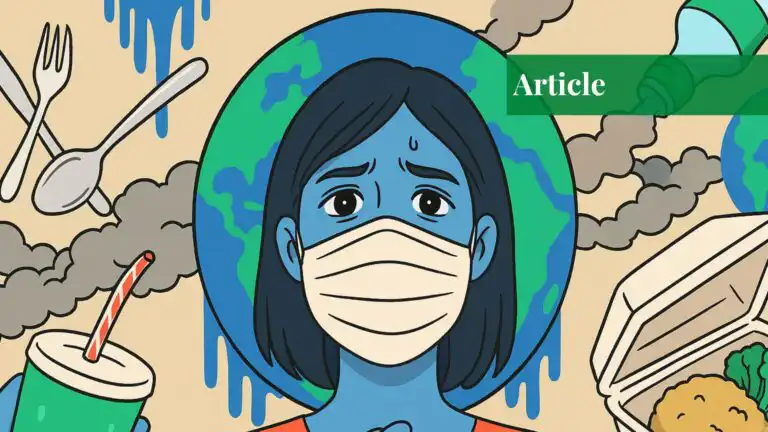
Unfortunately, Pakistan, despite a modicum of contribution to carbon emissions, has become a home to such untimely natural disasters because of global warming and the non-serious attitude of the world’s largest carbon-emitting countries. However, with the physical impacts that are widely discussed among scholars, there is a crucial yet neglected aspect to it—mental health. A large number of Pakistanis suffer from eco-anxiety—a fear of environmental catastrophe. Hence, it becomes very important to discuss the mental health impacts of the ever-increasing climatic hazards to understand and promote public health and social resilience among the masses.

Conceptualising Eco-anxiety
Just like clinical anxiety, which comprises the fear and worries of the future, eco-anxiety is the fear of upcoming environmental crises. Unfortunately, in Pakistan, it is not an abstract fear. The people have lived through their experiences. Be it the earthquake of 2005, the massive floods of 2022, or the recent series of hailstorms and earthquakes across the country. The fear couples up with the physical destruction, adding to the eco-anxiety of the natives.
The farmers who lose their crops to excess rainfall, the flood victims who witness water sweeping away their homes and belongings, and the heat waves that take away hundreds of lives all narrate a story of how eco-anxiety has become a psychological burden of climate change. Thus, eco-anxiety is not like clinical anxiety, but it develops from the real-life experiences of people over time due to the forces that are out of humans’ control.
Impact of Climate Change on Mental Health
Over 33 million people became homeless in the floods of 2022 in Pakistan. Almost one-third of the country was underwater. Similarly, the droughts in parts of Balochistan and Tharparkar, Sindh, have contributed to malnourishment, increased death toll, and an overarching fear of what else is in the bucket! The smog-covered winters in Lahore and the heat-stricken summers in Karachi all add to the environmental fears of the people. Moreover, the most affected populations in Pakistan are the poor, the youth, internally displaced people (IDPs), rural populations, women, and children.
The survivors of the catastrophic events report chronic stress about the food and water shortages, price hikes, homelessness, and survivors’ guilt among the urban population who stay safe because of their locations and better standards, and stress because of migrations. All these psychological issues are very crucial to address. Resilient nations are not born but made through social inclusion and collective efforts towards addressing the reasons for such issues. That is where the role of social media comes in.
Media and Doom-scrolling
In the modern era of social media, every event and every happening is taken more as a source of entertainment and videography and less as a lesson and opportunity to help. People, instead of helping out, start making videos and posts to catch up on some likes and followers. Such an attitude causes nuisance and more “doom-scrolling,” increasing anxiety rather than involving constructive engagement over the issues. Moreover, the reports are more based on statistics, which creates a sense of helplessness and hopelessness among the people. Furthermore, some scholars of doom advocate for divine punishments in the face of natural disasters, thus making people more stressed and psychologically handicapped.
Coping Mechanisms and Resilience-building in Pakistan
Over the pages of history, Pakistan has shown resilience over many events and the nation has a strong ability to go through challenges with grace. However, psychological support is a need of the time for the victims and sufferers to help them recover from the calamity and let go of the fears and worries they have for the future. In my humble opinion, coping strategies should be incorporated at the grassroots levels for all communities.
Similarly, professional counseling should be made easy and accessible to all. In Pakistan, unfortunately, for every 100,000 people, only 0.19 psychologists are available (World Health Organisation reports). This shows a very bad picture of the mental health in the country. However, strong policies can help the situation get better. At a governance level, not only should “psychological first aid” be made accessible, but also strong ecological action is required. Moreover, recovering from psychological traumas post-disaster should be inculcated in the national disaster response plans to make them holistic.
A good step in this regard was the addition of Article 9A to the Constitution of Pakistan under the 26th Amendment, which gives the right to a clean environment to all citizens. If rightly implemented, such actions can bring a great change in the lives of the people of Pakistan.
Conclusion
I will end it by advocating the importance of eco-anxiety being considered a challenge to public health in general and mental well-being in particular, so that the right actions can be taken in this regard. A two-pronged strategy will be appropriate to fight eco-anxiety: by promoting psychological aid as well as focusing on ecological interventions to bring Pakistan to a better place environmentally. In the era of global warming, hope and resilience should be built on collective action and responsibility towards the nation. To me, the largest hope that Pakistan has is its people, resilient, strong, and able to come out of eco-anxiety through informed actions and potential environmental care.
If you want to submit your articles and/or research papers, please visit the Submissions page.
To stay updated with the latest jobs, CSS news, internships, scholarships, and current affairs articles, join our Community Forum!
The views and opinions expressed in this article/paper are the author’s own and do not necessarily reflect the editorial position of Paradigm Shift.

She is a clinical psychologist and author with over six years of experience in freelance writing, specializing in mental health, social issues, and global affairs. She co-authored L’Art de Vivre, a book on positive psychology, and contributed to flood relief efforts in 2022. She also qualified the CSS Special Competitive Examination in 2023. Through her work, she is committed to promoting resilience, raising public awareness, and fostering informed discourse by combining psychological insight with socio-political analysis.