
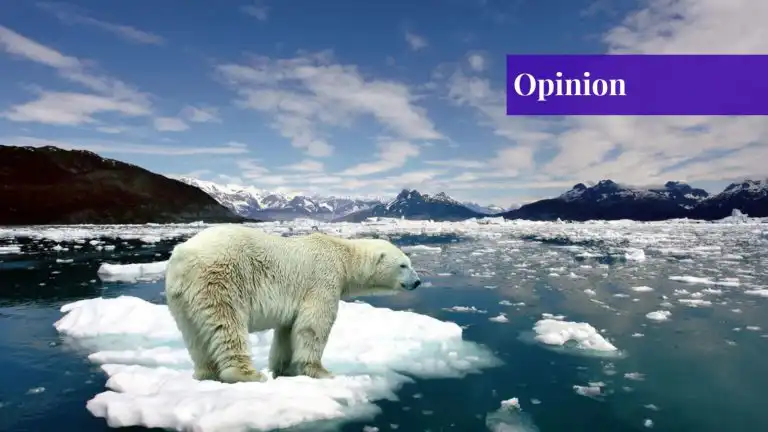
The Ursus Maritimus, more commonly known as polar or ice bears, due to their physical characteristics, are becoming victims of a crisis, which is a result of our actions. Found in the Arctic regions, sea ice is essential for their survival as it is their hunting and breeding ground, but due to consequences, it is slowly but steadily melting away, not only affecting them, but also disturbing our whole environment, creating a domino effect that is harmful for everyone.
Polar bears almost entirely depend on sea ice for their survival, and the melting of it causes them to swim larger distances, exhausting them. Without this sea ice, their population is declining as they cannot hunt seals anymore. As a result, they navigate to land in food search, which leads to more human-bear conflicts. No more prey means a change in the balance of the prey-predator dynamics. Melting of sea ice contributes to the rise in sea level, aiding floods, frequent disasters that become stronger, and the destruction of coastal habitats.
This highlights the urgency of the United Nations Sustainable Development Goal 13: Climate Action. The 17 Sustainable Development Goals were created by the UN in 2016 to combat problems related to climate, humanity, and the betterment of the world by 2030, signed by 193 countries to also follow. They signify the urgent need to mitigate climate change and make the world fairer. The official aim of SDG 13, stated by the UN, is “Take urgent action to combat climate change and its impacts.” To save endangered species from extinction, habitats from fading away, and stop global warming, SDG 13 was created. The main goals of SDG 13 include reducing greenhouse gas emissions, which contribute to other problems such as global warming, preparing for climate disasters, climate education and awareness among the youth and remote areas, and, most importantly, international cooperation to save the earth. This matters immensely to save polar bears as global warming causes sea ice to melt and food scarcity to rise, which affects their survival and population as polar bears become less and less.
The Arctic is warming at a rate four times faster than the average global rate, and studies show that sea ice has fallen sharply, about 58% in September extent since 1979. Scientists have warned that if global warming exceeds 1.5° Celsius, Arctic summer sea ice may disappear for most of the century. In addition, the world has lost seven trillion tons of ice from glaciers and sea ice, which is still melting, contributing to nearly a 2cm rise in global sea level this century, expanding warmer oceans. This is bad because it worsens cyclones, which have become angrier and increasingly more chaotic due to warmer, moist conditions and high sea levels.
When greenhouse gas emissions are released in the form of carbon dioxide, nitrogen, methane, and cluoroflurocarbons oceans absorb over 90% of it, producing more extreme marine conditions. SDG 13 includes the use of renewable energy as alternatives for non-renewable energy such as oil, gas, coal, and burning of fossil fuels. They can replenish and produce little to no greenhouse gases. Examples include solar, hydropower, wind, geothermal, tidal, and biomass energy. The reliance on fossil fuels is what has contributed to global warming, and so a shift to these alternatives can cause it to slow down.
Renewable energy reduces extreme weather, slows sea level rise, and protects habitats from loss, also contributing to cleaner air, which is beneficial for our health. Use of sustainable things is highly encouraged so pollution can be mitigated, for better health. Countries are also shifting to climate-friendly technology and sustainable policies to promote sustainability in order to not only protect polar bears, but also many other species from extinction and more frequent natural disasters. In Arctic countries, many efforts are being taken to protect polar bears, including stricter hunting laws, agreements signed, such as the Conservation of Polar Bears agreement signed in 1973 by various countries, including Canada, the US, Denmark, the former Soviet Union (Russia today), and Norway. Organizations like the World Wildlife Fund and Wildlife conservation groups have also been taking part in the efforts for the survival of Polar bears. However, only protecting them is not enough. We need to address the root cause of the problem and mitigate it by raising awareness, reducing greenhouse gas emissions, and making an effort to conserve habitats.
This isn’t fate; It is a reminder of how our actions have consequences. It is an indicator of the condition of our world right now, and all this harm has been caused by us. We need to save our world not only for us, but for the future generations ahead. It is a reflection of our ignorance. Polar bears are only one of the many species endangered, victims of a crisis that we have created. It is our responsibility to save them and maintain practices that keep our environment healthy and safe.
If you want to submit your articles and/or research papers, please visit the Submissions page.
To stay updated with the latest jobs, CSS news, internships, scholarships, and current affairs articles, join our Community Forum!
The views and opinions expressed in this article/paper are the author’s own and do not necessarily reflect the editorial position of Paradigm Shift.

Fatima Naeem, Student of Prep III C, The City School E-11 Campus, Islamabad.