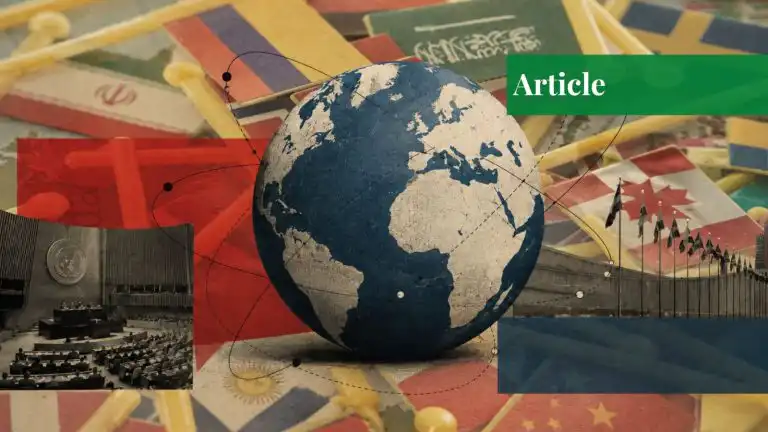
A principles-based international system set up at the end of World War II seems to have disappeared in 2026. Fragmentation is contributing to a great power competition, economic nationalism, and institutional weaknesses.
Multilateralism – the practice of resolving common issues through multilateral organisations such as the UN, WTO, and NATO – is being tested. But it’s too early to say goodbye just yet. The future is not a romantic reconstruction of the past or a complete breakdown of anything, but rather an adaptation to the fact that there are realities in terms of raw power, as well as space for collective action – flexible coalitions, rethinking institutions, cooperation on issues that arise.
Things are getting worse. The UN Security Council still has its working procedures and legitimacy and effectiveness problems with regard to major conflicts. WTO dispute settlement is paralyzed, and the world trade growth has slowed down in the wake of geoeconomic tensions. The WTO forecast of merchandise trade volume growth falls significantly to 1.9% in 2026 from 4.6% in 2025, and services growth will decline from 5.3% to 4.8%.
It is a great-power competition that is the main driver. Multilateral forums have become sites of competition in the US-China rivalry. The second Trump administration has emphasized transactional bilateralism and the “America First” principle, focusing on burden-sharing and selective engagement, rather than on wide-ranging multilateralism, while China has been pressing other platforms, like the Belt and Road Initiative and financial institutions, as alternatives to the West.
The expansion of the BRICS also enhances this change. Recently, this membership has grown, with Egypt, Ethiopia, Iran, Saudi Arabia, and the UAE recently joining. Now more than 1/3 of the world’s GDP (in PPP terms) and population belongs to the group. It aims at putting the voice of the Global South on the stage and calling for new balances in the voting rights of the IMF, the UN’s mechanisms, and the international financial architecture. BRICS is still heterogeneous and does not have a common agenda against the West, but it does highlight a general trend to multipolarity and the formation of alternative forums for cooperation.
In comparison, NATO has a more robust narrative in these times of strain. In 2025, military spending by all allies went over the 2% of GDP level, as did the military spending of European members and Canada, which increased by 20% compared to 2024. Continued adaptation to changing security needs and a possible decrease in the reliance on the U.S. is evident in a new commitment at the 2025 Summit to 5% of GDP in defense and related areas, out of which 3.5% must be spent on core defense (the remaining 1.5% on related areas) by 2035.
This isn’t really the cost of conventional multilateralism. Geoeconomic fragmentation can slow down the supply chain, help push up prices, and impede the delivery of solutions to transnational challenges such as climate change, pandemic, AI governance, and cybersecurity. In some areas, ‘minilateral’ collaborations are still proving effective and practical, even amid the overall decrease of more than 20% in the World Economic Forum’s Global Cooperation Barometer 2026 compared to 2019. It seems like it is the obvious answer, and perhaps leaders and practitioners feel that the days of multilateralism are done, a period of stability and prosperity over the last few decades may be coming to an end, and a new age of power politics is returning.
I think, and I think I am correct, that in a multi-polar world, the universal multilateralism, consensus, and liberal norms have lost their footing. But it’s not so good to say goodbye to it altogether. The world’s issues, including pandemics, climate change, controlling technology, and so on, need some level of collaboration, if not perfect and not comprehensive.
The way forward is Adaptive Multilateralism, a combination of “minilateralism” (a small group of like-minded or interested states), plurilateralism (partial universalism), and reformed universalism (a small group of all states). Already, there are some positive models to emulate: there are climate “coalitions of the willing,” there are flexible security partnerships, regional trade pacts like the CPTPP and USMCA updates. Institutions should be more representative and voices and emerging powers from the Global South should be included without sacrificing effectiveness and the speed of decision-making. The initial steps have been taken by the UN’s Pact for the Future (2024) and ongoing WTO reform, though implementation is lagging and remains contentious.
But it will take a high degree of political commitment on the part of the big powers. The U.S. must use its advantages and assets selectively and with a results-based approach instead of retreat. China and the BRICS countries need to step beyond rhetoric to pragmatism in their efforts to find common ground on global public goods. There is a pivotal role for middle powers like Brazil, European countries, and ASEAN countries in pragmatic diplomacy and coalition-building in India.
To sum up, multilateralism is not a thing of the past; it is a great transformation in the making. In an order that is becoming increasingly fractured, humility regarding the limits of universal solutions and creativity in terms of building overlapping networks of cooperation across issues will be crucial for success. The other choice — spheres of influence, unabated competitiveness, and eroded global governance — will result in increased economic, security, and human costs for all countries, particularly for smaller, developing countries. Leaders need to take the choice of dialogue and incremental reform, as well as targeted cooperation, rather than fatalism. The consequences of 2026 and the coming years are more dire than ever.
If you want to submit your articles and/or research papers, please visit the Submissions page.
To stay updated with the latest jobs, CSS news, internships, scholarships, and current affairs articles, join our Community Forum!
The views and opinions expressed in this article/paper are the author’s own and do not necessarily reflect the editorial position of Paradigm Shift.

Nisar Khan Kakar is a writer and poet and a BS English student at Quaid-i-Azam University, Islamabad, Pakistan, hailing from District Killa Saifullah, Balochistan. He serves as Assistant Coordinator for Literary Prose at the Quaidian Debating and Literary Society (QDLS).