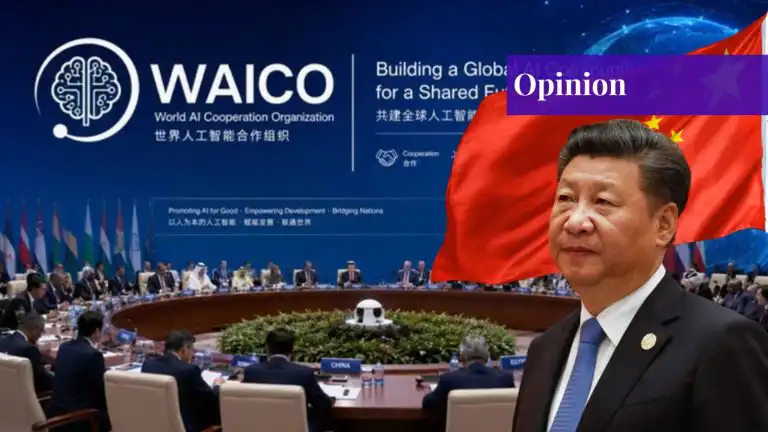
China’s World Artificial Intelligence Cooperation Organization (WAICO)
On July 16, 2026, representatives from 29 states signed the agreement to join China’s World Artificial Intelligence Cooperation Organization (WAICO) in Shanghai. WAICO is an intergovernmental organization aimed at promoting international cooperation and AI governance, with a particular focus on the Global South. Speaking at the conference, President XI emphasized that AI should not be dominated by a single state, but it should be open, fair, and inclusive for all states. This WAICO agreement aims to enhance Beijing’s influence in global AI standard-setting, to position it as a leader of the new AI order, and to challenge Western frameworks.
By bridging the digital divide and promoting inclusive, open-source AI access for all states, WAICO seeks to shape the global AI governance structure. The WAICO framework emphasizes that AI should not serve only wealthy, developed, or major powers but should benefit all humanity, particularly the countries of the Global South. The global AI governing body will enhance China’s influence through a multilateral platform. It will enable Beijing to promote its preferred AI standards, technical principles, and governance norms.
As more states join the organization, this will help China to gain international support to shape AI norms and reduce Western monopoly. While Western AI frameworks place emphasis on democracy, human rights, and strict regulatory measures, China’s model is centered on sovereign equality, fairness, and free access to AI. It seeks to bridge the digital divide between the Global North and the Global South. Countries from the Global South will get greater access to and opportunities for AI knowledge, technical expertise, capacity-building, and research collaboration programs. Through participation in shaping global AI rules, developing countries will gain a much stronger voice in AI governance.
How Will WAICO Increase China’s Influence?
Through WAICO, China seeks to expand its influence by creating an alternative multilateral institution. This institutional framework will enable Beijing to influence global norms, strengthen technological partnerships, and challenge the dominance of the Western-led AI governance model. As AI has become a strategic asset, states are competing to set governing rules, norms, and ethical standards that will determine its development and use.

Geopolitical competition over AI will increasingly shape economic advantage, military capabilities, technological breakthroughs, and national security. Many developing countries face restrictions in accessing advanced AI technologies, infrastructure, and expertise. WAICO is central to the Global South countries, as it provides equal access to modern AI tools.
China can strengthen its partnerships with the developing nations that may align with its global AI vision by addressing this gap. China advocates a multipolar AI governance so that no single state will dominate the development and regulations of artificial intelligence. This agenda reinforces China’s image as the leader of the new global AI order, based on equitable development. and greater decision-making powers for developing states.
What Does WAICO’s Future Look Like?
Chinese Premier Li Qiang first unveiled plans for WAICO in July 2025. After years of intense geopolitical competition over AI governance, followed by the G-7, the United States, the European Union, and the United Nations-led AI governance initiatives, China has finally decided to launch WAICO due to the absence of universally accepted global AI norms. Since the 2020s, AI has become a major arena of great-power politics.
As AI has emerged as critical to national security, military modernization, and technological leadership, the US and China are competing heavily to shape international AI regulations and standards. WAICO will be able to enhance its influence once its governance framework becomes operational and member nations adopt its policy recommendations. Its success depends on coordinating common AI positions among developing countries at international diplomatic forums. WAICO could begin challenging the Western-led AI governance framework if it accepts competitive standards and attracts broader international participation. If its governance principles garnered support across the Global South, it can help to promote a more inclusive global AI governance architecture rather than one dominated by a single power.
To conclude, the establishment of a global AI organization marks a shift in the emerging landscape of AI governance. As China seeks to shape global AI norms and values through multilateral collaboration with Global South countries, building around its own vision of AI governance cooperation, it represents more than just a platform for technological cooperation. A new dimension of great power competition is emerging to shape the AI governance structure.
Economic competitiveness, military innovation, and national security have become central instruments of AI power politics. China’s new AI architecture based on more inclusive, cooperative, and equitable principles has begun to challenge Western-led AI dominance. Whether the organization succeeds or not, it depends on its ability to harness international support, inclusive participation, and credible governance into universally accepted AI rules.
If its stated objectives are achieved, then it could reshape the regional and global balance of power in the AI sector. A new multipolar AI governance order will prevail, where competing governance frameworks will coexist, and states will have a greater choice over the AI institutional architecture they support.
If you want to submit your articles and/or research papers, please visit the Submissions page.
To stay updated with the latest jobs, CSS news, internships, scholarships, and current affairs articles, join our Community Forum!
The views and opinions expressed in this article/paper are the author’s own and do not necessarily reflect the editorial position of Paradigm Shift.