
Is Pakistan a cohesive nation-state or merely a union of divergent regions, ethnicities, and sectarian identities, stitched together by history and necessity? These have been abiding questions ever since the country’s independence. The answer perhaps lies not in a binary, but in a paradox: Pakistan is one of the few countries that appears deeply divisive and fragmented in times of peace and calm, yet profoundly unified and strong during moments of crisis. This phenomenon could be termed “reactive cohesion,” where national solidarity emerges not from sustained social integration but from shared adversity.
“Adversity does not build character, it reveals it. The same is true for nations.”
James Lane Allen
Fragmentation in Normalcy
At the heart of Pakistan’s internal dissonance are longstanding ethno-linguistic and regional fissures. Punjab, the most populous and politically dominant province, overshadows others politically, economically, and militarily. This imbalance has fueled recurring grievances among the Baloch, Sindhi, Pashtun, and Mohajir communities. The Baloch insurgency, the Pashtun Tahafuz Movement, Sindhi Nationalist stirrings, and urban ethnic tensions in Karachi all point to a federal structure that remains fragile.
Similarly, sectarian divides—especially Sunni-Shia tensions and growing marginalization of religious minorities—further challenge the very notion of inclusive nationhood. Yet, these schisms rarely lead to outright disintegration—instead, they simmer until a national crisis infuses a collagen effect and compels a collective response.
“It is not our differences that divide us. It is our inability to recognize, accept, and celebrate those differences.”
Audre Lorde
Unity in the Face of Crisis
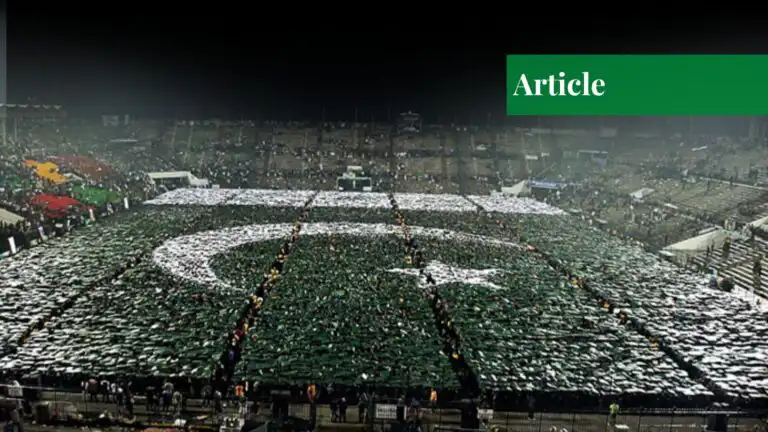
Pakistan’s most compelling moments of unity have been forged in times of crisis: wars, terrorist attacks, and natural disasters. The 1965 war with India, the 2005 earthquake, the devastating 2010 floods, the 2014 Army Public School massacre in Peshawar, and most recently, the May 2025 military conflict with India saw the country rally together like never before. During such times, ethnic, sectarian, and political rifts were momentarily eclipsed by a shared national cause, sense, and purpose.
“In the face of calamity, nations must remember they are families, not factions.”
Anonymous
This crisis-induced nationalism, however, is often state-choreographed, with the state institutions working in tandem to amplify a collective identity, usually framed in religious or anti-India terms. The results are impactful but often short-lived. For enduring unity, there ought to be a national cause and purpose rooted in common aspirations and interests, in the absence of which, the cohesion rests on the basis of national security alone. As evidenced by the unity doctrine of Woodrow Wilson, “National unity is the basis of national security.”
“National identity is not about uniformity, but a shared commitment to a common future.”
Barack Obama
The Elastic Nature of Cohesion
The central dilemma is sustainability. Once the immediate threat passes and the crisis recedes, the sense and spirit of unity dissipate. Structural factors, such as economic inequality, identity suppression, autocratic centralization, and weak federalism, re-emerge and reassert themselves, dominating the main discourse, as seen most recently in the post-Pahalgam scenario. The spirit of national unity faded, replaced by renewed clamor for political inclusion, self-determination, social justice, true liberty, and freedom.
Therefore, the recurring pattern invites deeper scrutiny: Is Pakistan’s cohesion real, or merely a reflexive performance in times of threats and challenges? The consistent invocation of external threat, primarily India, suggests a model of national unity that is externally driven but internally insecure. India, in a way, delivered its best gift to Pakistan in the recent Pahalgam conflict by unifying a divisive nation because when there is conflict, there is nothing that unites like the hate of the enemy, and hence we witnessed a strong rally around the flag effect. Be that as it may, such a strategy reinforces Pakistan’s identity as a security state, where the military remains the arbiter of national interest and prime mover of the national apparatus. Other state organs and institutions remain secondary and conformist, with a marginal role and influence in the statecraft.
“You cannot build national cohesion on the bayonets of the army alone.”
Amartya Sen
Comparative Perspective: India and Israel
Having come into existence in the same timeframe of the mid-20th century, India and Israel provide contrasting models of national cohesion and hence are befitting to draw a comparison of sorts.
India, though scarred by deep religious, caste and ethnic divisions and socio-political fragmentation, has built unity on pluralist democratic values and constitutional institutions. Its unity survives beyond crises because it is institutionally anchored. Israel, by contrast, derives cohesion from existential threat and mandatory military service. Its society, though politically polarized, is bound by shared sacrifice, security consciousness, and a coherent national identity. Its cohesion is hence structural, not circumstantial.
Pakistan, on the other hand, continues to rely on emotive triggers: religious symbolism, external hostility, and superficial episodic mobilization, like in the event of national cricket matches, primarily due to love of the game. Regional identities within the federation are often subordinated or excluded from the national narrative, limiting the possibility of true integration. The compulsion and imperative, therefore, is to construct an abiding existential threat to bind and unify the nation on the basis of the 3S: security, safety, and survival.
“True national cohesion does not erase difference, it harmonizes it.”
Kofi Annan
Crisis-driven Cohesion
Additionally, it is also worth a while to have a cross-comparison, based on the features of national identity, institutional role, and the crisis impact to differentiate crisis cohesion in the three countries.
Nature of National Identity
- Pakistan: Relies heavily on Islamic identity and an external threat, primarily from India, to foster unity. This makes cohesion contingent and externally oriented.
- India: Leverages a pluralistic and democratic identity, though under strain. Its unity is institutionally grounded and capable of recovering post-crisis.
- Israel: Built around a permanent sense of existential threat and compulsory service, Israel’s cohesion is security-anchored and societally embedded.
Role of Institutions
- India and Israel have relatively stronger political and civil institutions that allow crisis cohesion to evolve into policy or structural responses.
- Pakistan’s military-dominated model centralizes crisis response, but often subordinates or sidelines political response and reconciliation, making cohesion a state-driven spectacle rather than a societal consensus.
Crisis Impact
- In Israel, each crisis deepens institutional and civic preparedness.
- In India, crises often lead to political capitalization but still reinforce national identity.
- In Pakistan, crises more often than not reinforce the military’s supremacy, without addressing underlying socio-political, ethnic, and political fractures.
Toward Enduring Integration
Pakistan’s long-term challenge is to transform reactive cohesion into resilient cohesion, leading to sustainable integration. This requires bold institutional reforms, inclusive governance, and a narrative of nationhood – one that values democracy over dominance, equity over exclusion, and pluralism over paranoia.
“We are a nation because we shared pain, hope, and sacrifice – not because we were the same.”
Benazir Bhutto
To build lasting cohesion, Pakistan must come to terms with its diversity, not merely tolerate it. It must internalize the idea that diversity is not a weakness but a strength. National cohesion built only in moments of crisis and fear will always be fleeting. What Pakistan needs is a more inclusive, confident nationalism—one that embraces difference, empowers all voices, ensures fundamental rights, and most of all balances civil-military relations in favor of democratic evolution/ascendance so as to transition from a security state to a social welfare state.
“Unity in diversity is the highest possible attainment of a civilization – a testimony to the noblest aspirations of humanity.”
Pierre Teilhard de Chardin
Conclusion
All three countries exhibit a rallying effect during crises but differ fundamentally in how that unity is generated, used, and sustained. Pakistan’s cohesion is circumstantial and temporal, unlike the structural resilience of India and the existential and societal unity of Israel. The challenge for Pakistan lies in converting the episodic solidarity into enduring national integration—a task that requires democratic legitimacy, civilian primacy over the khakis, rule of law, inclusive and equitable governance and foremost a populist visionary leadership that can hem the shreds into a unitary bundle, a’ la a pied piper behind whom the nation follows its destiny.
If you want to submit your articles and/or research papers, please visit the Submissions page.
To stay updated with the latest jobs, CSS news, internships, scholarships, and current affairs articles, join our Community Forum!
The views and opinions expressed in this article/paper are the author’s own and do not necessarily reflect the editorial position of Paradigm Shift.

Brigadier Syed Mushtaq Ahmed (Retd) has extensive experience in areas of national security, intelligence and strategic issues. He has worked as a senior research analyst in a strategic organisation and has a niche for writing research articles and analytical assessments, specializing in counterintelligence, counter-terrorism and nuclear security.