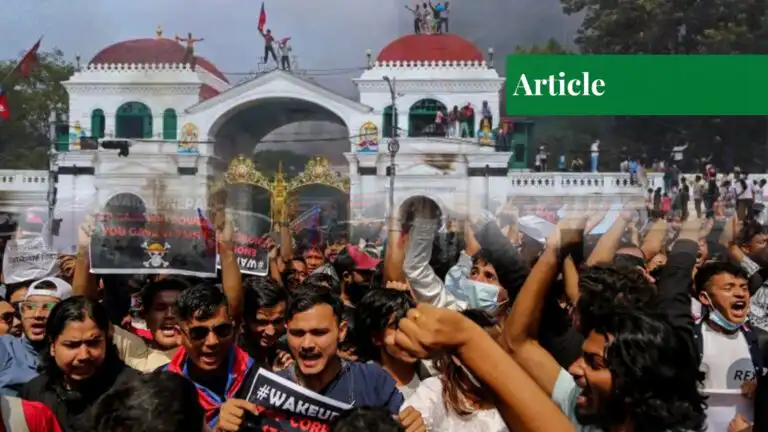

The 21st century is witnessing astonishing political developments in the international arena. Whether it is the case of great powers or third-world countries, domestic grievances and evolving public perceptions are creating serious hurdles for the political leaders. In particular, the South Asian region is facing significant challenges in terms of its political and economic conditions. Bangladesh in 2024 witnessed a youth revolution, which resulted in the ousting of Sheikh Hasina’s rule. Before this, massive local protests were recorded in Sri Lanka in 2022, which forced the Rajapaksa administration to resign from office. And as of the September 2025 protests in Nepal, the state is meeting the same fate. The current government of Prime Minister Oli has been forced to kneel down before the public.
The interesting fact here is a common thing noticed in all these protests—Gen Z. South Asia boasts approximately 25% of the world population, with 60-70% lying in the domain of youth. Such a large number of youth presents both opportunities and challenges side by side. The increasing population of Gen Z has resulted in their growing concerns regarding employment, economic opportunities, freedom of speech, etc. The combined effect of all these unresolved grievances, in the end, forced the youth to come to the streets for their rights.
Deep-Seated Causes of Nepal Protests 2025
Nepal has seen unrest before. But the 2025 anti-corruption protests show just how much everyday people are struggling. Many problems have been building up for years, making the country ripe for these kinds of movements. These are not new issues, just ones that have gotten worse.
Economic Disparities Across Nepal
Youth unemployment in Nepal reached as high as almost 10% as of 2025. Food prices rose by 15% in the last year, which makes life hard for poor families. That is, families that make every rupee go a long way. Individuals in the mid-hills and far west tend to suffer the most, with fewer opportunities to find good jobs or markets. Meanwhile, the children of politicians openly showcase their luxurious lives on social media, creating distress among the locals. This lack of money and sense of deprivation generated a lot of anger and sorrow.
Corruption and Political Instability
Trust in government is low, and Gen Z feels their leaders do not listen. Political fights mean little gets done, leaving big problems unsolved. For instance, reports from groups like the Nepal Policy Institute show that public faith in political parties dropped to a new low in late 2024. Corruption is a huge part of the anger. You hear stories about money meant for public works going missing. A big scandal around a new hydropower project in 2024 really showed people how deep these issues go. Nearly all the political parties of Nepal have been charged with accusations of corruption. For example, the head of Nepal’s Congress, Deuba, and his wife have been accused of illegal money laundering and counterfeit document issues. Similarly, the current PM of Nepal, K.P. Sharma Oli, also faces the accusation of illegally converting a tea estate into a commercial plot.
Social Vulnerabilities
Nepal is a land of many cultures, but not everyone feels treated fairly. Old issues of caste and ethnic background still cause division. Protest groups from the Terai plains push for more local control over land and resources. Indigenous groups in the hills demand protection for their traditional ways of life and languages. This push for identity and fairness adds a strong current to the protest wave, showing that social justice is a key part of the national discussion.
Triggers for 2025 Protests
While problems brew for a long time, usually one event lights the fuse. In 2025, certain actions by the government or other groups made people say, “Enough is enough.” A fresh ‘Public Security Bill’ that was enacted in early 2025 was the main cause. It was criticized as providing too much authority to the government to shut down gatherings and suppress free speech. It was interpreted by many as an attempt to curb the anti-state voices. Thus, student organizations and human rights groups rapidly mobilized under the banner of democracy. Reports of police breakdown during a peaceful student march in Kathmandu in February 2025 also created a deep sense of anger in the public.
Videos shared online showed excessive force used against young protesters. Likewise, a chain of social media posts in March 2025 went viral, and one could find a government representative uttering scornful remarks about the misfortune of flood victims in the far west. Such a feeling of carelessness on the part of a person in authority gave rise to a massive wave of rage among people.
Dire Consequences
It has been reported that at least 19 people—most of them young protesters—have lost their lives during clashes with security forces. Over 300 others, including some police officers, have also been injured. It’s pretty alarming. And on top of that, the economic fallout has been substantial; the Nepal Stock Exchange took a hit and dropped nearly 36 points. The damages from about 4,000 protests over the last 10 months have racked up costs exceeding Rs 500 million in terms of infrastructure and vehicles. This whole situation has led to the resignation of Prime Minister KP Sharma Oli.
Indian Media Fake Narrative
The Indian media has really ramped up a narrative around the protests happening in Nepal, suggesting that there’s some sort of Western plot behind it all. With the trade tensions between India and the U.S. heating up, especially with Trump’s tariffs hitting Modi’s government, several well-known Indian news outlets i.e. India Today, First Post, and platforms like Study IQ IAS, have started to hint that Washington is somehow using the youth movement in Nepal to throw a wrench in Kathmandu’s stability and chip away at New Delhi’s influence in the region. They portray the CIA as this puppet master, supposedly stirring up chaos through social media and pouring money into NGOs. Instead of viewing the unrest as a genuine grassroots movement fighting against corruption and censorship, it’s painted as a calculated U.S. strategy by the Indian media.
Conclusion
The South Asian region is witnessing these violent protests led by Gen Z one after the other. The regional countries, in particular the government and establishment of Nepal, must make sure that democratic principles are upheld. The social vulnerabilities have to be addressed before any other step. Gen Z must be given equal opportunities in every walk of life. The future of Nepal now completely depends upon the political parties to comply with the public demands.
If you want to submit your articles and/or research papers, please visit the Submissions page.
To stay updated with the latest jobs, CSS news, internships, scholarships, and current affairs articles, join our Community Forum!
The views and opinions expressed in this article/paper are the author’s own and do not necessarily reflect the editorial position of Paradigm Shift.

He is pursuing a BS in International Relations programme from International Islamic University, Islamabad and has a keen interest in research works, policy analysis, defence and strategic studies and conflict resolution.