

Introduction
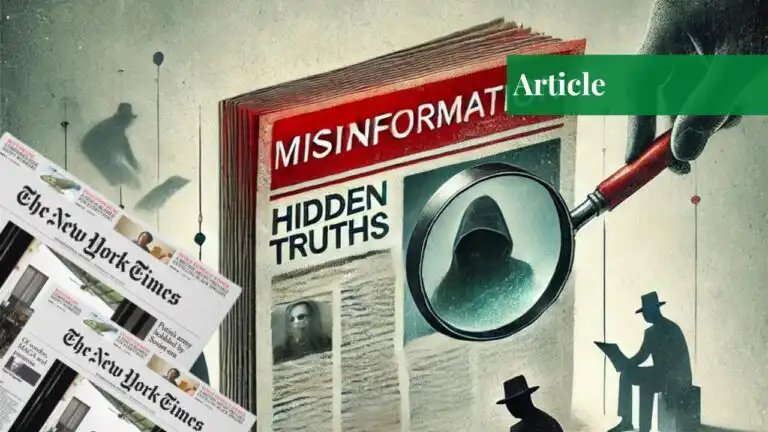
The New York Times (NYT) is one of the world’s most influential newspapers working right as one of the torchbearers of journalistic integrity. Since 1851, it has engaged in talks human beings consider significant, breaking stories that change the sphere of influence worldwide. But for decades, charges of misrepresentation, bias, and even fabricated stories have plagued the paper, occasionally raising questions about its commitment to the truth. This article analyzes the anatomy of these inaccuracies, the internal and external constraining forces contributing to them, and particular instances in which the New York Times has been called out for its lies and accused of getting the story wrong. Here we get into a deeper discussion of why and how such misrepresentations occur and their other impacts on the public trust of journalism.
Historical Precedents of Misreporting by the NYT
Walter Duranty and the Soviet Famine (1930s)
Walter Duranty was one of the most celebrated Moscow correspondents from the New York Times during a critical period in Soviet history. From 1932 to 1933, the Holodomor engulfed Ukraine and was attributed mostly to the policies formulated by the regime of Joseph Stalin. It is estimated that millions of Ukrainians were to die in the form of starvation, forced collectivization, and policies directed by the state that stripped peasants of food supplies.
Duranty’s reporting during this period has received wide censure for its unwillingness to unveil the truth. He depicted the famine as a minor inconvenience and discarded firsthand accounts of mass starvation. In one article, Duranty referred to reports of famine as “criminal propaganda” spread by the enemies of the Soviet Union.
It remains debatable why Duranty reported in this way. Some scholars pointed out that it was his close association with Soviet authorities that aided him access to resources in exchange for reports. Others feel that Duranty was deeply wedded ideologically to the Soviet experiment, thus allowing him to gloss over its failures. Despite all this, Duranty was awarded the Pulitzer Prize in 1932, a preposterous decision that has been met with a lot of public outcries ever since.
Duranty’s Pulitzer has been under contempt comprising several attempts at revocation. This problem illuminates how media misrepresentations have a tragic power to alter history, especially their role in building and creating regimes powerful enough to defy accountabilities for their actions.
Judith Miller and the Iraq War (2002–2003)
Judith Miller, a senior reporter for the New York Times, played a dominant role in creating public expectations leading to the Iraq War. She spun stories on Iraq, mostly portraying claims of weapons of mass destruction (WMDs), that later proved to be untrue. Her narratives were based on hearsay about unreliable sources such as Iraqi defectors and US officials who built a case for the invasion of Iraq by the United States in 2003.
One of Miller’s primary sources was Ahmad Chalabi, an Iraqi exile with an interest in taking down Saddam Hussein. Chalabi, assisted by his fellow party members, told her wonderful things about dwindling oil wells in Iraq. However, Miller never adopted the necessary skepticism to catch them trying to mislead her. In retrospect, she apparently relied heavily on these sources and, coupled with the New York Times not drilling down on the facts, they found themselves in a maze of untruthfulness.
In 2004, the NYT had to apologize to the public because of the bombardment of criticism it had received for its reporting of Iraq. In a statement admitting that some of its reporting had been based on faulty intelligence and anonymous sources, the editors noted it was ruefully sorry. For starters, while the obliviousness of the paper seems like an expression of contrition, it does not alleviate the consequences: the death toll was horrific, the fate of the region was posed to disarray, and public trust in government and media institutions was wasting away.
The Miller saga provides an anecdote of uncritical reliance on government narratives, especially in terms of war and peace. It underscores the need for journalists to always consider independent verification rather than access journalism.
Modern Example of Misrepresentation
Coverage of Palestine and Israel
The New York Times’ coverage of the Israeli-Palestinian conflict has remained a hotbed for controversy. This pattern can perpetrate itself in many different ways, such as the selection of words, the weighting of sources, and the framing of events.
For example, terms like “clashes” are frequently employed to describe confrontations between heavily armed Israeli forces and largely unarmed Palestinian protestors. The use of this kind of language implies a desirable singularity among the two groups as such minimizes the amount of imbalance in power and the structural nature of the occupation. Again, terms such as “security measures ” are terms used to describe Israeli policies against Palestinians that often would refer to this as collective punishment or apartheid.
Further criticism includes the selective inclusion of high-level officials and spokespersons of the Israeli government in a primary source capacity, with Palestinian voices muted or sidelined altogether. This very notion ends up providing a skewed perception to the public and goes a little far in wholesaling the already existing narratives with a sort of central focus on Israeli security over Palestinian human rights.
All these patterns are not simply accidents overseen by the editors; they speak to an underlying set of systemic issues that exist with regard to media coverage of and reporting on the conflict. Simply put, the construction of narratives within certain frameworks is really fueled by structural biases, ideological tendencies, and powerful lobbies that reinforce injustice and misrepresentation.
Why Does the New York Times Lie?
Institutional Pressures
Like other major media outlets, The New York Times is influenced by competition in a very tough media ecosystem. The emergence of digital media coupled with falling print-traffic revenue has amplified the pressure to secure readers and maintain relevance, stalk funding from subscriptions and advertisements. In such an environment, other sensational reports run the risk of overshadowing those requiring a little more background information.
For several reasons, that pressure may lead to near-total simplification of complex issues or prioritize stories that entertain the readership to remain at the expense of accuracy. The classic dichotomies of heroes and villains or winners versus losers are always stressed at the expense of more nuanced perspectives.
Access Journalism
Additionally influencing the NYT’s reporting is the area of access journalism. To maintain relationships with influential sources, whether government officials, corporate leaders, or other power brokers, journalists may sometimes downplay what they report on or even avoid certain questions. Access journalism thus creates an effectively dynamic cycle: reporters seek information from powerful figures, who in turn create a shaping force behind the reporting.
The reliance on access can twist reporting in favor of those in power because that is where the information lies. For instance, leading up to the war in Iraq, much of the NYT’s coverage relied on government sources pushing for military intervention. The lack of critical assessment, on the part of the New York Times, behind those claims essentially gave rise to misinformation and lies regarding WMD.
Echo Chambers and Cultural Bias
Like many large media organizations, the New York Times operates under an ideological and cultural frame of reference that informs its reporting. The makeup of its newsroom, including the backgrounds of editors and journalists, and the demographics of its readership contribute to a particular worldview. This can create unconscious bias, under which certain perspectives get amplified while others get downplayed.
Most of these biases and lies are readily visible, particularly in the international coverage of the New York Times. Critics have charged that the paper’s editorial version of global events often comes from a Western-centered point of view; their reports align with the Western audience but fail to represent the everyday realities on the ground. For instance, the NYT has been accused of framing stories on conflict in the Middle East through one single lens that correlates closely with US foreign policy interests and effectively sidelines voices that speak in conflict with such narratives.
Steps Toward Greater Accountability
Making Corrections More Transparent
The New York Times could heal the bond with readers by inventing a proactive disclosure of errors made by them in reporting serious or controversial matters followed by a concise explanation of how the error was rectified. They could also set up an easily accessible, obvious, and well-maintained correction log directly on its website. This would allow readers interested in keeping an eye on the New York Times to check on more than a particular article’s accuracy engagements. Such proactive transparency would signal that the New York Times is serious about its commitment to accountability and assure the readers that errors will not be swept under the rug or dismissed.
Diversity in the Newsroom
One very important thing that speaks to the credibility of a report is the diversity, and background of the newsrooms in order for varied perspectives to get a means of representation in reporting. A newsroom that is diverse demographically and ideologically is more likely to probe it for blind areas.
Diversity would thus help the New York Times balance its coverage, that is, more representation of differences in different fields, including race, gender, socio-economic background, and political ideology, will create a ground for dealing with cultural and ideological biases. Giving space to differing insights, NYT needs to additionally put forth an effort to offer reporting with more balanced and nuanced perspectives that truly reflect the nature of the issues driving the debates.
Public Ombudsman
A robust public ombudsman program can be a very effective way of proposing to the New York Times to be answerable to the readers. An independent ombudsman can play an oversight authority, giving the environment to investigate readers’ concerns, review the paper’s editorial decisions, and offer an impartial perspective concerning the accuracy and fairness of the reporting.
Conclusion
The New York Times has been both a light of perfect journalism and a lightning rod for criticism. Its vast influence, coupled with the key role it plays in shaping public opinion and policy, makes the genuine mistakes and misrepresentations of articles therein all the more consequential. Whether deliberate lies or accidental, they serve as jarring reminders of the inherent difficulties in modern journalism, wherein the demand for speed, sensationalism, and access sometimes works against veracity and neutrality. As a media institution that counts among the most significant in the world, it bears the weight of an enormous responsibility to live by the commitment to high values of journalistic integrity, accuracy, and fairness.
If you want to submit your articles and/or research papers, please check the Submissions page.
The views and opinions expressed in this article/paper are the author’s own and do not necessarily reflect the editorial position of Paradigm Shift.

Momina Areej is currently pursuing an MPhil in Clinical Pharmacy Practice. With a passion for writing, she covers diverse topics including world issues, literature reviews, and poetry, bringing insightful perspectives to each subject. Her writing blends critical analysis with creative expression, reflecting her broad interests and academic background.