
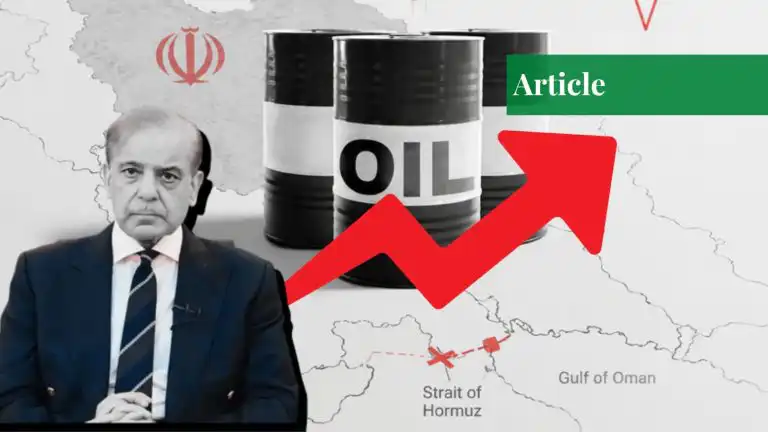
The Strait of Hormuz crisis is coming to an end, on paper at least. The United States and Iran have signed a memorandum of understanding to end the fighting and reopen the strait. Oil traders will exhale. Developing economies may not. A ceasefire does not erase the deeper lesson of the past few months: in today’s global economy, a maritime chokepoint can become a debt crisis, an inflation shock, and a political stability problem almost overnight.

The Strait of Hormuz is more than just a strait between Iran and Oman. It is one of the main arteries of the world economy. UN Trade and Development has characterized it as a path that transports roughly 25% of the seaborne oil trade across the world, as well as most of the LNG and fertilizer transport. When traffic slows through such a corridor, the effects are not limited to tankers. It runs through freight rates, insurance premiums, fertilizer prices, food costs, exchange rates, and public budgets.
The Hormuz crisis is therefore not just a security issue in the Middle East, but also an international political economy issue. The shock rippled through the global system in a now-familiar sequence. First, the rise in energy prices. Then there were higher shipping and risk costs. Then the strain on food and transport. Investors pulled back from fragile markets. Third, weaker currencies meant more expensive imports for countries already struggling with debt.
UNCTAD’s trade outlook for 2026 warned of a sharp slowdown in the growth of world merchandise trade, even as developing country currencies and borrowing conditions were already under pressure. Its separate debt assessment, A World of Debt 2025, said 3.4 billion people live in countries that spend more on interest payments than on either health or education. That is what the crisis is all about. Oil shocks do not get absorbed just by balance sheets in poorer economies. They become part of schools, hospital costs, food budgets, and household incomes.
This is where Joseph Stiglitz’s warning in Globalization and Its Discontents comes into sharp relevance again. Stiglitz did not reject the idea of globalization. His argument was more subtle. Globalization is unfair and politically volatile when powerful financial interests dictate the rules, and poorer countries are expected to bear the adjustment costs. In his later reflections, he again stated that the problem was not globalization itself but the way it was managed.
That imbalance is a textbook case in the Hormuz crisis. The richer states have strategic reserves, stronger currencies, deeper credit markets, and more fiscal space. Developing states are urged to tighten belts, protect price signals, avoid broad subsidies, and keep up with debt repayments. Globalization, in theory, promised shared efficiency. Its burdens, in practice, remain uneven.
A supply shock in a strategic waterway becomes an inflation shock for Pakistan, Bangladesh, Sri Lanka, Egypt, Kenya, or the Maldives. Higher risk premiums mean a budget cut. More expensive fuel means a weaker currency. More fuel bills become a political outrage. In these moments, the invisible hand looks a lot like a hierarchy.
The case of Pakistan is proving it, and of course, with a certain irony. It is not a party to the conflict in the Middle East but is extremely vulnerable to regional instability in terms of imported energy costs, remittance flows, shipping expenses, and foreign capital. Pakistan is also the prime mediator of the peace deal between the USA and Iran, where diplomacy has not provided any economic insulation. In Reuters’ reporting in June 2026, Pakistan’s budget was impacted both by the Iran war and the fiscal austerity required for IMF financing, with the formal economy and the middle class being the main victims. Geopolitical conflict thus becomes a national political economy: one can negotiate peace and still raise taxes, utility costs, and petrol prices for citizens.
In its June 2026 Global Economic Prospects report, the World Bank has also cautioned that Middle East tensions will be driving global growth to its lowest since the covid 19 pandemic, owing to higher energy prices, higher inflation, and higher borrowing costs. For countries with high debt-to-GDP ratios, it is no insignificant shift. It cuts the fiscal space exactly when it is required for the government to safeguard its citizens, stabilize prices, and carry out development expenditure.
The lesson is obvious. The “goodwill” of markets and crisis management by “great powers” is not an option for developing countries. They should have a collective economic security agenda. This would involve larger and better-managed strategic fuel reserves, quicker investments in domestic & renewable energy, regional payment systems, emergency swap lines, and coordinated bargaining at the IMF, World Bank, G77, and UNCTAD. And that will include making energy security integral to debt sustainability, and not a stand-alone technical concern.

The lesson of the policy for Pakistan is immediate. The nation needs to insulate itself against the volatility of imported fuels, but it also needs to change its ways of negotiating outside the country. Even as a mediator, a state that finds itself in every crisis without reserves, narrow exports, and heavy debt payment obligations can hardly afford to protect its citizens despite its mediation skills. Economic independence is not achieved by sloganeering. It comes from exports, equitable taxation, and energy diversification.
The case of the Strait of Hormuz has revealed that the problems of globalization are no longer just abstract. They are evident in the difference in the capability of states to withstand the same shock. The developed world self-insures, but Poorer economies adjust. Until Imbalance is addressed, every fuel crisis will turn into a debt crisis as well, and every faraway war will come to the doorstep of the developing world.
If you want to submit your articles and/or research papers, please visit the Submissions page.
To stay updated with the latest jobs, CSS news, internships, scholarships, and current affairs articles, join our Community Forum!
The views and opinions expressed in this article/paper are the author’s own and do not necessarily reflect the editorial position of Paradigm Shift.

Arooj Zafar is a student of International Relations at the National Defence University, Islamabad, with research interests in international political economy, foreign policy, international law, and regional security