Introduction
In early 2026, the Iran–Israel war began, which was one of the most destabilizing wars in West Asia in recent decades. In the wake of coordinated strikes that resulted in the deaths of Iranian Supreme Leader Ayatollah Ali Khamenei and senior commanders, the war rapidly turned into a regional crisis. Iran responded by firing missiles and drones at Israel and U.S.-backed military bases in the Gulf, and Hezbollah launched a second assault from Lebanon. Israel retaliated with ground operations and a massive increase in targeted bombing, with the bombing of a girls’ school in Minab being just one example of civilian deaths that resulted. The closure of the Strait of Hormuz further affected energy supplies around the world, causing shock waves that rolled across the international energy markets.
Pakistan Being a Mediator
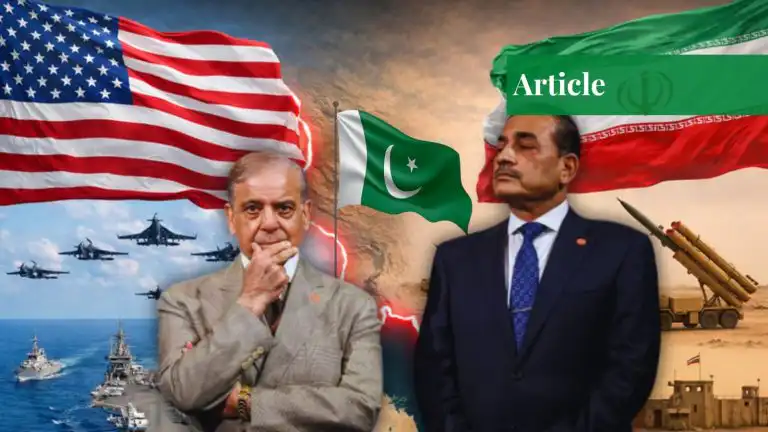
In this chaos, Pakistan came out as an unexpected but important peace broker. Islamabad was pivotal in bringing about ceasefires and negotiations owing to its unique geopolitical location, its relations with Iran and Gulf countries, and its historic linkages with Washington. Pakistan’s mediation was not only a humanitarian gesture, but it was also a strategic move to ensure economic and security interests are protected and to help maintain regional peace.
The unique geopolitical position of Pakistan enables it to mediate. Unlike the Gulf states, which have bases for the U.S. military, Pakistan has cooperative relations with both Iran and the U.S. without direct military involvement. It shares a 909-kilometer border with Iran, so stability in Tehran is of direct interest to it. Additionally, Pakistan has a history with the Muslim-majority countries and the Western countries, which makes it a trusted neutral mediator.
This enabled Islamabad to conduct backchannel negotiations and offer confidence-building initiatives when few other states could claim neutrality. Similarly, Pakistan’s efforts were backed by China and Qatar, which understood the possibilities of Pakistan to defuse a conflict that could have threatened global energy security and regional peace.
Ceasefire and Opening of the Strait of Hormuz
One of the most significant Pakistani successes was in successfully helping to arrange a two-week ceasefire between Iran and the United States on April 8, 2026. The truce was based on the opening of the Strait of Hormuz for shipping, which calmed world oil markets temporarily. It was Pakistan that played a crucial role in convincing Tehran to lift its blockade and in assuring Washington that Iran was ready to talk.
This truce proved Pakistan’s ability to play a credible mediator. Islamabad’s relationship with the Gulf states and its communication with Tehran made it a dependable broker with the capacity to bring about tangible results.
Peace Agreement June 2026
But Pakistan’s mediation efforts led to a preliminary peace agreement on 18th June 2026. An electronic memorandum of understanding signed in the deal cut down the violence and led to a wider framework agreement, which was signed in Switzerland. The truce did not end the tensions, but it was a good sign of de-escalation. Pakistan’s efforts to broker this truce highlighted its diplomatic significance. Islamabad showed that it was capable of shaping events in one of the most volatile regions in the world.
It proved that a country that is often seen as on the periphery of world events and affairs was a mediating power too. It was also a question of strategic survival for Pakistan. The closure of Hormuz looked set to upset Pakistan’s already fragile economy, since the port is responsible for energy imports. Unrest in Iran could have spilled over into Balochistan, where militancy across the border has been an issue for a while. Pakistan was trying to control the instability in the region to safeguard its own security and economic stability.
Meanwhile, Islamabad was faced with the challenge of maintaining its relationship with Saudi Arabia and Iran. Although Riyadh is important economically, Iran is a neighboring state whose security has a direct impact on the security of Pakistan’s border areas. The mediation helped Pakistan keep the balance between these conflicting interests and presented itself as a responsible player in the region.
Cautious but positive recognition was given to Pakistan’s mediation. China has expressed appreciation for Islamabad’s constructive efforts, highlighting the importance of diplomacy over confrontation. The key takeaway from this is the need for cooperation and coordination in the region, as Qatar and Pakistan were able to bring temporary ceasefires. The United States and Iran admitted that in a conflict fraught with polarization, Pakistan had played a key role in securing the framework deal.
This reception boosted Pakistan’s status in the international arena and gave it international legitimacy. Although Islamabad’s leverage is not as significant as the big powers’, its role in influencing peace talks has given rise to its profile and visibility in international diplomacy.
Limitations and Challenges
Though Pakistan’s mediation was successful, there were many difficulties. It was economically weak and was unable to continue with long diplomatic efforts. Security threats in the border area between Iran and Pakistan remained high, and there was a risk of spillover violence. Furthermore, the power of Pakistan was limited, as it could not give a final push and could only help in the process of negotiation.
These restrictions clearly illustrate the fragile nature of Pakistan’s mediation. It managed to broker ceasefires and preliminary agreements, but it remains to be seen whether those can withstand the long term if the U.S., Israel, and Iran want to find solutions.
Policies Needed
Several policy measures are critical for Pakistan to strengthen its position as a mediator. It must set up an independent diplomatic mission for conflict resolution in West Asia and build the capacity of institutions for mediation. Cooperation between other countries, such as Qatar, Turkey, and China, would strengthen the capacity of multilateral approaches to peace over unilateral approaches. A diversified energy mix is essential to reduce dependency on disruption in Hormuz, and fostering dialogue on maritime security, energy cooperation, and humanitarian relief can help establish trust with conflicting parties. Finally, Pakistan must use international forums like the Organization of Islamic Cooperation (OIC) to give its mediation efforts legitimacy and attain greater support.
The Iran-Israel war has vividly highlighted the fragility of the stability in West Asia. During rising tensions and a global energy crisis, Pakistan’s mediation efforts provided a way to defuse the situation. Islamabad’s efforts to arrange ceasefires and to put the talks on track showed its ability to play a bridge role between Tehran and Washington.
Pakistan’s mediation efforts were not motivated by altruism but by strategic survival; nonetheless, its contribution to peace is not to be overlooked. The next hurdle is to maintain the momentum and embed it as a viable mediator. If it works, Pakistan would be seen as a security-challenged country and instead become an initiative-taking diplomatic player, influencing the events of one of the most volatile regions of the world.
If you want to submit your articles and/or research papers, please visit the Submissions page.
To stay updated with the latest jobs, CSS news, internships, scholarships, and current affairs articles, join our Community Forum!
The views and opinions expressed in this article/paper are the author’s own and do not necessarily reflect the editorial position of Paradigm Shift.

Inshal Haider is pursuing her MPhil in Defense and Strategic Studies at Quaid-i-Azam University, Islamabad.