The Core Premise
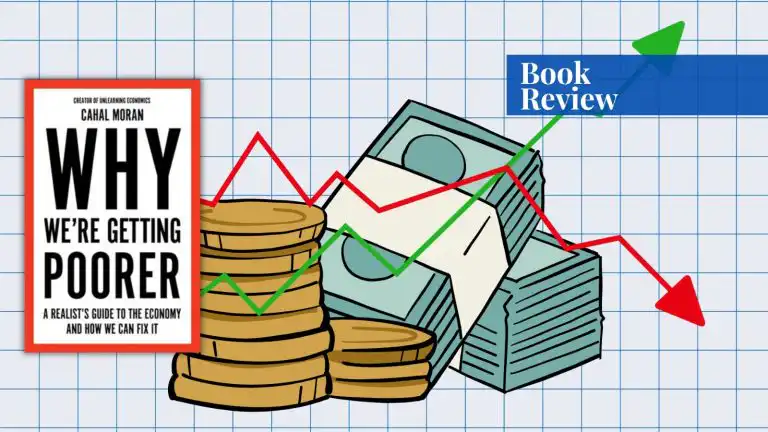
The book, Why We’re Getting Poorer: A Realist’s Guide to the Economy and How We Can Fix It, is written by Cahal Moran, a behavioural economist and Fellow at the London School of Economics. He is also the founder of the popular YouTube channel Unlearning Economics. This book was published in 2025, and it is a timely and accessible contribution to heterodox economic thought. The author opens with a candid autobiographical frame of his adult life that has been defined by a succession of economic crises, such as the 2007–9 Global Financial Crisis, austerity, Brexit, the Covid-19 pandemic, supply chain disruptions, and the cost of living crisis. The writings state that this relentless sequence of shocks does not happen because of unavoidable accidents, but rather because of the systematic design of any economy. The book covers all these themes and sketches the alternatives as well.
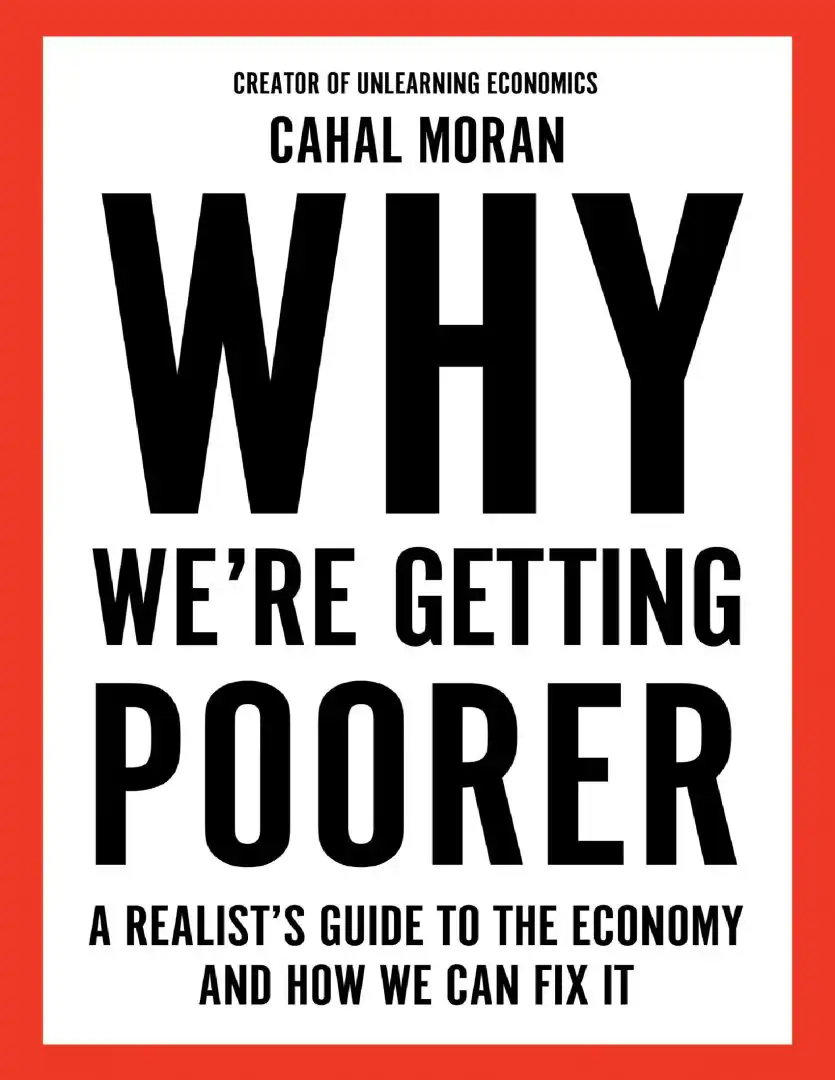
This book consists of three parts, including the “Uneven Economy,” which highlights who is important for the economy and who gets the reward and, similarly, how the billionaires are protected with the consequences faced by society at large. The second part of the book includes the “Dysfunctional Economy.” In this section, the book explores the four areas where economies face failure, such as housing, money creation, inflation, and global supply chains. Similarly, the last part of the book is “Redefining the Economic Landscape,” which is a conclusion that both political and economic reforms are necessary for the overall progress and governance of any economy.
Why We’re Getting Poorer highlighted the idea that the economy consists of a complex web of practices, laws, and institutions that are shaped by the choices required. These choices have consistently and disproportionately favoured the already wealthy and powerful. The book’s title requires an immediate qualification that the author is quite careful to make. He does not argue that people are getting poorer in the absolute sense, though he acknowledges that many still are. His claim is more precise and arguably more troubling. According to him, most people across the globe are considerably poorer than they could and should be, given the productive capacity in accordance with a modern economy. The gap between what is possible and what most people actually experience is, for Moran, not an accident of nature but a failure of design.
Unpacking the Paradox: Undervalued Labor vs. Billionaire Influence
Moran is at his most persuasive in Part I, where he uses the Covid-19 pandemic as an organising lens. The coronavirus lockdowns made starkly visible what wage structures habitually conceal, without which labour society cannot survive, including healthcare workers, farmers, logistics drivers, sanitation workers, and food retailers. They are consistently among the worst-paid members of the workforce, earning on average some 15 per cent less than other workers in the US alone.
A major part of the economy is mainly derived from bankers and investors, whereas their absence does not attract public attention. These investors decide labour wages based on their working capacity; normally, we may say based on productivity. The juxtaposition of Goldman Sachs receiving $125 billion in public bailout funds while its CEO publicly claimed his employees were among the most productive people on earth provides a particularly sharp illustration of this contradiction.
Furthermore, why are there so many billionaires? Moran stated that between 1990 and 2000, being a millionaire was worth talking about. However, from 2000 to 2022, the number of millionaires has grown rapidly with their wealth, from $41 trillion to $222 trillion, far faster than inflation. Being a millionaire no longer counts: billionaires are the ones who rule the economy and big corporations today. In 2024, 2,781 billionaires controlled a total wealth of $14.2 trillion. The growth of so much wealth in one private man’s favour is not only personally successful but also represents a fundamental change in money and power around the world.

Famous personalities/owners of big companies, for instance, Bernard Arnault, Jeff Bezos, and Elon Musk, are examples of people whose wealth gives them influence over industries, labour conditions, media, and political debate, and even over the rules that govern markets themselves. In other words, wealth is a form of control, not only a high bank balance. At the same time, control is maintained through structural mechanisms, instead of personal greed alone. But this is not the end. Weakening of anti-monopoly laws and use of intellectual property protection by dominant firms and capture of political lobbying help billionaires to maintain and expand their power. Extensive growth of wealth, an indication of an economy that is organised for the protection of wealth, causes high inequality, and it is a systematic issue instead of any incident.
Throughout Part I of Why We’re Getting Poorer, Cahal Moran uses the German economic model as a productive counter-example. Germany’s system of worker representation on corporate boards (Mitbestimmung) is a network of locally owned credit cooperatives, none of which required a bailout during the 2007–9 financial crisis, while its geographically dispersed industrial base serves as evidence that economies can be organised in ways that distribute their benefits more widely/evenly without undermining growth.
The chapter on meritocracy extends this argument, demonstrating by research from the United Kingdom, the US, and beyond that social mobility is far more constrained by class background, educational access, and entrenched prejudice than the dominant ideology of individual effort and reward. In the UK, a worker from a privileged background earns, on average, 25 per cent more than a comparable worker from a disadvantaged or marginalised class. Furthermore, it explains the reliability of the measurement standard adopted by the World Bank. The reduction in poverty in these statistics does not highlight the real improvements in living standards.
Institutional Failures: From Housing Crises to Inflation Myths
The second part of Why We’re Getting Poorer examines the part of the economy where institutions fail to uphold basic operational effectiveness. The housing chapter observes that a 2023 survey of 94 housing markets across the developed world found every single one to be some variety of “unaffordable”. It is a remarkable indictment of what is perhaps the most fundamental economic need beyond food. According to Moran, this is due to the fusion of housing and land subsequent to deregulation, commercial banks’ acquisition of the mortgage market, and the financing of property. His policies of social housing, Community Land Trusts, and land value taxes are logical but perhaps innovative. Most of the circulating money is not created by the government, but it is circulating through the banking system. This banking system consists of the credit creation mechanism, which is complex to understand for the public.
One of the book’s most interesting chapters is on the topic of inflation, which shows how official inflation statistics consistently understate the cost of living, especially faced by the lower segment of society. Their spending or expenses significantly differ from the national average. The book referenced a case of the British Freddo chocolate bar, a frog-shaped treat that for many years has been sold for 10 pence, which is regarded as a good test of reasonable pricing. Between 1994 and 2019, the price of Freddo increased by 150%, which is double the increase in official UK inflation (66%).
The author puts forward these examples to back a larger heterodox thesis: that greater rates of interest needed to fight inflation are a simplistic and retrogressive policy. It disproportionately affects mortgage holders, small business owners, and people in precarious jobs, while hardly hitting the asset-rich class and the elite. The analysis suggests more focused options, namely investments to increase production capacity, subsidies, and profit and price caps. Against this backdrop, the author has quoted Spain’s reaction to the energy inflation following the war in Ukraine as an example.
Critical Evaluation
The book’s claim that the economy is a political arrangement to be disputed rather than a natural system to be observed is its most important intellectual contribution. The author illustrates the ubiquity of decisions that orthodox economics frequently portrays as inevitable by presenting this argument on such a wide range of subjects, from corporate governance to home tenure to monetary sovereignty.
His examination of the global supply chain crisis, framed through the worsening working conditions of American truck drivers, provides a striking illustration of how the very workers who supply the flexibility necessary to keep intricate logistics systems operating have had their working conditions deteriorated to the point where the systems’ resilience is compromised. The book’s language is continuously captivating, with examples ranging from the German Bundesliga’s fan ownership model to LVMH’s extractive tactics throughout northern France. The analysis is quite rich in terms of historical contexts and uses relevant statistics on economic indicators.
However, the book is not free from limitations. The ambitious and simple writing outweighs the analytical rigour. For example, certain important issues such as global governance, the political economy of tax reform, and the structural imbalances and relevant reasons causing the 2008 global financial crisis need more conscious attention because they cover three key addressed aspects of inequality, dysfunction, and reform.
Pertinently, in Part III, the policy recommendations are plausible in terms of democratic spirit but naively optimistic and inadequately address the political economy of reform. Moran’s acceptance of slow development when facing opposition is the result of an afterthought instead of an integral part of the study. Similarly, the idea of regulating inflation through collective bargaining, exemplified in the book, is not unconventional or unusual in concept. However, the institutional preconditions as well as the peculiar historical experience of the UK’s economy for such a strategy with income programmes are not properly attempted in this regard.
The book also has a pronounced Anglo-American orientation. Although Moran draws on international examples of Spain, Finland, Germany, Brazil, and West Africa, they typically function as illustrations of problems experienced primarily in the UK and the US, or as models from which those countries might learn. Readers from different regions, for instance, Sub-Saharan Africa, South Asia, and Latin America, may notice that major structural forces influence their economies, like commodity dependency, dollar hegemony, and IMF conditionality. However, the transformation of wealth is acknowledged, but not placed at the centre of the analysis. These global domains remain secondary in the book, instead of a primary focus such as the internal dynamics and policy failures of Western, particularly Anglo-American, capitalism.
For readers already versed in heterodox economics, such as post-Keynesian, institutionalist, or political economy traditions, this book will cover familiar ground without much that is analytically novel. It is best suited to the educated non-specialist: policy professionals, students at the onset of their knowledge of political economy, or curious and engaged readers who have lived through the past fifteen years of economic turbulence and want a coherent framework for making sense of it.
To conclude, Why We’re Getting Poorer is an honest, well-intentioned, and often illuminating contribution to the growing body of accessible heterodox economic writing. Its greatest service is to make visible the political choices embedded in economic arrangements that mainstream discourse too often presents as neutral or inevitable. The argument that the economy is simultaneously uneven and systematically favouring the wealthy as well as dysfunctional, failing to deliver even on its own terms, is a useful and well-sustained organising framework.
Its weaknesses, however, include limited policy depth, an Anglo-American bias, and a tendency to survey rather than excavate complex terrain, reflecting the constraints of its genre rather than fundamental analytical failures. Why We’re Getting Poorer is ideally suited for young people seeking to understand the economic forces shaping their lives. Moreover, it is useful for educated readers who are confused by economic concepts and frustrated by prevailing economic outcomes. Additionally, the book is quite interesting for those readers who are willing to consider an alternative approach to understanding the present moment. Nevertheless, the book is written with genuine moral seriousness about whose interests the economy serves.
If you want to submit your articles and/or research papers, please visit the Submissions page.
To stay updated with the latest jobs, CSS news, internships, scholarships, and current affairs articles, join our Community Forum!
The views and opinions expressed in this article/paper are the author’s own and do not necessarily reflect the editorial position of Paradigm Shift.

Dr. Ahsan Abbas is Director at the Centre for Aerospace & Security Studies (CASS), Lahore, Pakistan. He can be reached at info@casslhr.com.