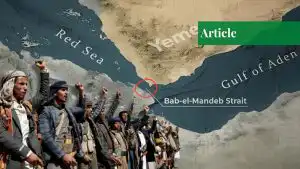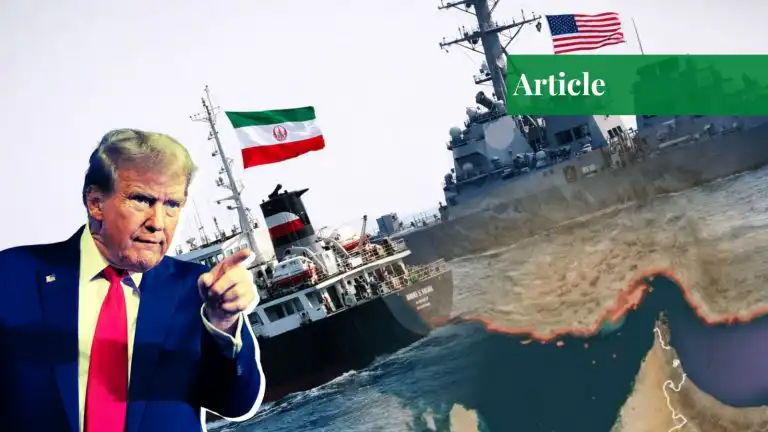
Senator Rick Scott, speaking without the usual diplomatic gauze, recently told a reporter that blocking the Strait of Hormuz was “fine from my standpoint,” adding that if no oil ever reached China again and its economy was destroyed, that would be “a really wonderful day for me.” Strip away the theatrical enchantment, and what remains is devoid of a fringe position; it is, contrarily, in raw terms, the operational logic of what the United States has been constructing across three interconnected theaters since January. The architecture is not new; the bluntness, however, is unprecedented.
I wrote an earlier version of this argument two months ago, when Nicolás Maduro had just been extracted from Caracas, and the threats against Iran’s leadership were still threats. The claim was that Washington was assembling a comprehensive energy coercion framework targeting China’s most acute structural vulnerability: its deep dependence on imported hydrocarbons flowing through maritime chokepoints that others, in a crisis, could choose to close. What has unfolded since does not disprove the thesis; if anything, it sharpens it. What we are witnessing is its harsher validation—unfolding faster than expected, more chaotic in form, and far more consequential than its original framing ever allowed for.
The Architecture, Now Operational
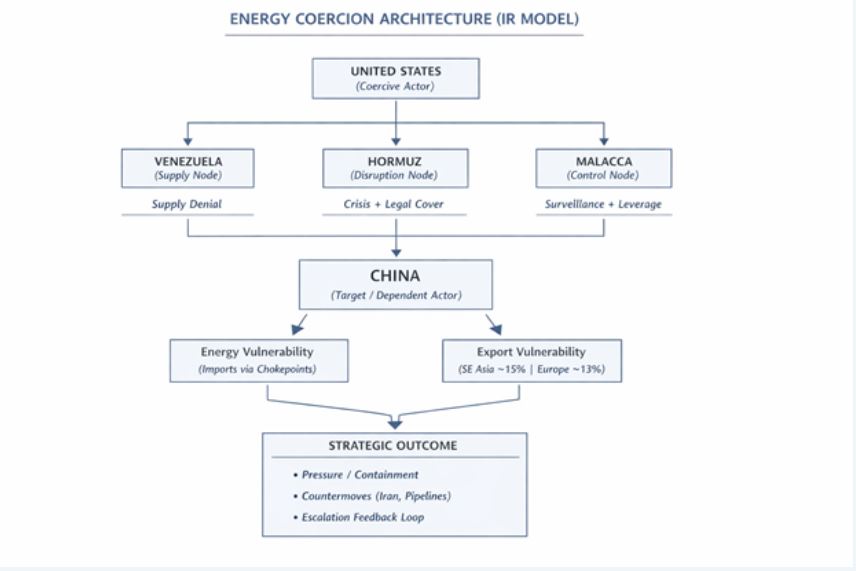
The original framework spanned three theaters. In the Western Hemisphere, the seizure of Maduro and the declared intent to manage Venezuelan oil production amounted to active denial of a critical Chinese energy partner—Beijing had invested roughly $3.1 billion in Venezuelan oil infrastructure between 2016 and 2023, and Reuters noted plainly that the operation was a signal to China to keep away from the Americas. In the Middle East, threats against Iranian leadership served a dual purpose: menacing a pivotal Chinese supplier while placing the Strait of Hormuz—through which roughly 42-45% of China’s crude imports flow—under a permanent cloud of strategic uncertainty. And in Southeast Asia, the steady expansion of maritime domain awareness networks around Malacca was designed to transform a neutral passage into a latent lever.
All three theaters are now active simultaneously. On February 28, the United States and Israel launched Operation Epic Fury, killing Supreme Leader Khamenei and triggering Iranian missile barrages across the Gulf. Iran responded by functionally closing the Strait of Hormuz—the largest disruption to world energy supply since the 1970s oil crisis, according to IEA head Fatih Birol.
On April 13, following the collapse of the Islamabad negotiations, CENTCOM announced a naval blockade of all maritime traffic entering and exiting Iranian ports, to be enforced “impartially against vessels of all nations.” And on the same day—the same 24-hour window—Secretary of War Pete Hegseth signed a major defense cooperation partnership with Indonesia at the Pentagon, focused specifically on maritime domain awareness, subsurface and autonomous systems, and special forces training along the Malacca corridor.
The simultaneity of the Hormuz blockade and the Malacca partnership on April 13 is not a coincidence. It is choreography.
Hormuz as Engineered Pretext
The argument that Washington was surprised by Iran’s closure of the Strait does not survive scrutiny. Iranian military doctrine, going back decades, has consistently named the Strait as its primary retaliatory instrument. Any serious Pentagon planner war-gaming a strike on Iranian leadership would have treated the closure as a near-certainty, not a contingency. What the closure provided was a jus ad bellum of sorts: legal and political cover for a naval blockade that would otherwise constitute an act of war against a non-belligerent. The formulation matters. By waiting for Iran to close the Strait and then declaring a blockade of Iranian ports under laws of armed conflict, Washington acquired the ability to tell Beijing, “We are blockading a belligerent; you simply have interests there”—a fig leaf that matters enormously in the theater of international legitimacy.
The blockade’s legal architecture is, however, more contested than Washington presents it. Andreas Krieg, a senior lecturer at King’s College London’s School of Security Studies, described the enforcement regime as “less like a clean historical blockade and more like a messy, high-risk interdiction regime,” requiring identification, tracking, diversion, and possible boarding of vessels in one of the world’s most crowded waterways. NATO allies Britain and France have both declined to participate, stressing the need to reopen the waterway rather than extend the confrontation. The coalition enforcing the blockade is, in practical terms, a coalition of one.
The Malacca Move
The Hegseth-Sjamsoeddin signing deserves more analytical attention than it has received. The MDCP’s three pillars—military modernization, training and professional military education, and exercises and operational cooperation—are standard capacity-building language. What is not standard is the specific emphasis on next-generation maritime, subsurface, and autonomous systems and joint special forces training. This is not a training relationship. It is an intelligence architecture.
Indonesian officers integrated with American surveillance systems and trained alongside US special forces means that, in a crisis, the operational picture of everything moving through Malacca and the adjacent Indonesian straits becomes a shared picture—one that leans, in practice if not in rhetoric, toward Washington.
The strategic significance of this is hard to overstate. Ship traffic through the Strait of Malacca hit an annual record of over 94,000 vessels in 2024. Hu Jintao, in 2003, coined the phrase “Malacca Dilemma” to describe the fundamental geometry of China’s energy dependence: most of its imported crude must pass through that narrow corridor between Sumatra, Malaysia, and Singapore, policed by powers whose interests may not align with Beijing’s in a crisis.
The dilemma has been documented extensively—Andrew Erickson and Gabriel Collins, writing in the Naval War College Review, demonstrated that China’s overland pipeline alternatives from Russia and Central Asia could only ever move energy at the margin, while Zha Daojiong’s work on Chinese energy security has long argued that the dilemma is structural rather than manageable: diversification strategies reduce exposure but cannot dissolve the geographic fact that China’s industrial coast faces the sea, not the steppe. The Indonesian MDCP is Washington’s answer to two decades of Chinese attempts to escape that trap. It does not close the Strait. It wires it.
Jakarta insists it is not choosing sides, and formally, that is true. The Defense Ministry walked back an overflight proposal the same day it was reported, stressing that no agreement was final or binding and that Indonesian sovereignty would be protected. But the partnership does not require a formal commitment to deliver strategic value. Chinese naval planners contemplating a Taiwan contingency now have to assume that Malacca traffic unfolds under a web of sensors and partnerships that lean toward Washington — and that assumption alone changes the risk calculus of any action that would invite interdiction.
China’s Counter-Moves and the Export Vulnerability
China’s response to the coercion architecture has not been passive absorption. US intelligence sources indicate Beijing is preparing to deliver new air defense systems and shoulder-fired MANPADs to Iran, routed through third countries to mask their origin. The Stimson Center’s Yun Sun observed that “no one should be surprised that China will rearm and rebuild Iran down the road.” Simultaneously, Iran has continued to route oil shipments selectively to China throughout the conflict, preserving the China-Tehran energy relationship while restricting flow to US allies—a stratagem that partially undermines the clean “blockade China through Iran” logic. Tehran is not closing the Strait against China. It is closing it against Washington’s partners.
The more important vulnerability, however, may not be China’s direct energy supply at all. Alicia García-Herrero, chief economist for Asia Pacific at Natixis, argued in a Bruegel essay that China’s deepest exposure is second-order: a prolonged Hormuz disruption devastates Southeast Asian and European economies—which absorb roughly 15% and 13% of Chinese exports, respectively—collapsing Chinese external demand even if Beijing’s own oil reserves hold. China currently holds around 95-115 days of strategic reserves. The direct energy shock is manageable in the short term. The collapse of export markets is not. “If we’re looking at a global recession,” García-Herrero noted, “China has more to lose than anybody else.”
The Limitations
The architecture has real bite. The simultaneity argument—Hormuz blockade and Malacca MDCP active on the same day, with Venezuelan oil in play—represents a genuinely panoramic coercive envelope. That is analytically significant and should not be dismissed.
But the self-defeating dynamics are equally real. First, the blockade’s coalition is paper-thin. Britain, France, and most NATO allies have refused to participate, which transforms an act of collective enforcement into a unilateral projection of force—precisely the posture that drives non-aligned states toward hedging rather than bandwagoning. Second, the Indonesian partnership is more fragile than it appears. Jakarta’s concession is capacity-building, not operational commitment. In a genuine US-China crisis, Indonesia’s calculus would be immediate and severe: hundreds of billions in Chinese trade, domestic political constraints, and a constitutional foreign policy doctrine incompatible with being seen as Washington’s instrument. The MDCP does not resolve that problem. It merely papers over it.
Third, and most consequentially, the strategy is generating exactly the adversarial adaptation it was designed to prevent. China is arming Iran, accelerating its overland pipeline investments, and holding the upcoming Trump-Xi summit as leverage. The pressure is real, but so is the mobilization it catalyzes. Energy coercion of this breadth does not produce capitulation in states with the strategic depth and political will of China. It produces a faster, angrier version of the rival you were trying to contain — one with a deeper institutional memory of the moment you tried to strangle it.
Senator Scott’s “wonderful day” is strategically illiterate. A Chinese economy under existential energy pressure does not gracefully concede. The grammar of strangulation may accurately describe what Washington is attempting. Whether the sentence it is trying to write ends with Beijing’s submission or with a world structured permanently around great power confrontation at sea is a question the current doctrine has not seriously tried to answer.
If you want to submit your articles and/or research papers, please visit the Submissions page.
To stay updated with the latest jobs, CSS news, internships, scholarships, and current affairs articles, join our Community Forum!
The views and opinions expressed in this article/paper are the author’s own and do not necessarily reflect the editorial position of Paradigm Shift.

Mohammad Zain is an International Relations student at NUML, Islamabad. With an associate degree in English Literature and Linguistics and a BS in International Relations, he brings a unique blend of analytical and literary skills to his writing.