
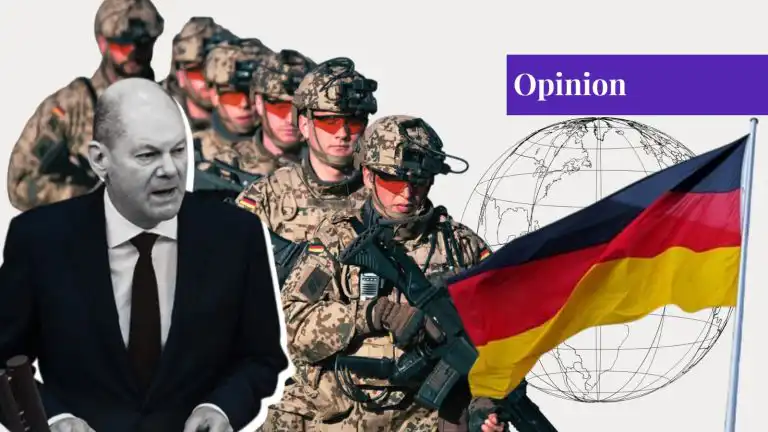
On February 27, 2022, three days into a war nobody in Berlin had planned for, Olaf Scholz walked into an emergency session of the Bundestag and used a word that would end up defining his chancellorship more than anything else he did in it. Zeitenwende, a turning point. He put a number on it too: more than €100 billion for the Bundeswehr, a promise to keep defense spending above 2 percent of GDP from then on, and the reversal of a policy Germany had held since the 1960s against sending its own weapons into a war zone. Germany, he said, meant to become “the guarantor of European security that our allies expect us to be.” The word got voted Germany’s word of the year. Not many chancellors write the headline for a speech they’re still living inside four and a half years later.
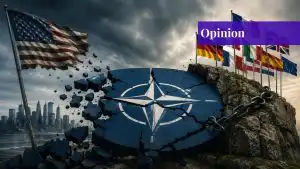
The postwar arrangement Scholz quietly retired that afternoon had a name too, coined by NATO’s first secretary general: keep the Russians out, the Americans in, and the Germans down. It worked for seventy years. Scholz didn’t say so out loud, but the third clause of that old formula was the one he’d just rewritten.
What he promised has mostly shown up. The constitutional debt brake no longer applies to defense spending. Another €500 billion is committed through 2035. A new conscription law is meant to take the standing army from 180,000 soldiers toward 260,000, with a 200,000-strong reserve behind it. None of that was guaranteed in 2022. A lot of governments announce turning points and then spend years failing to turn.
Where Germany hasn’t caught up is timing. NATO has said for a while now that Russia could be capable of testing the alliance by 2029, and the Bundeswehr has been quietly building around that number rather than hoping it’s wrong. Surgeon General Ralf Hoffmann has said the army is planning for roughly 1,000 wounded soldiers arriving every day in a serious war, a figure that would swamp its five military hospitals inside a week, so civilian hospitals are being written into the plan.
In March, the Bundeswehr ran its largest wartime medical exercise since 2022, practicing exactly that, moving the wounded from a simulated front line back into Berlin. Old barracks across the former West Germany, closed for decades, are being reopened to house the recruits the new law will produce. None of this is what a country does when it thinks it has years to spare.
It isn’t what the neighborhood looks like either. Early one morning this month, sirens went off across eight regions of Estonia because a drone had crossed the border from the southeast. A month earlier, a drone loaded with explosives turned up at Leipzig airport, in Germany itself, prompting the interior minister to say the country had reached “a new level of danger.” Latvia’s government resigned in the spring, in part over how it had handled a summer of similar incursions. None of these were attacks exactly. They were closer to knocking, repeatedly, on doors up and down the same street.
Then there’s what’s being said out loud. On September 13, Poland’s foreign minister told a conference in Kyiv that NATO’s roughly 2,500 aircraft in Europe gave the alliance a real edge and that if Russia attacked, “we would defeat Russia quite quickly.” Two days later, Kremlin aide Nikolai Patrushev answered that Poland would “cease to exist within two or three days” if Warsaw tried it. Around the same time, NATO’s Rutte was in Berlin repeating something he’s said for over a year: that if China moves on Taiwan, Beijing may ask Moscow to open a second front in Europe just to keep NATO’s attention split. He’s called this the most dangerous period Europe has faced since 1945.
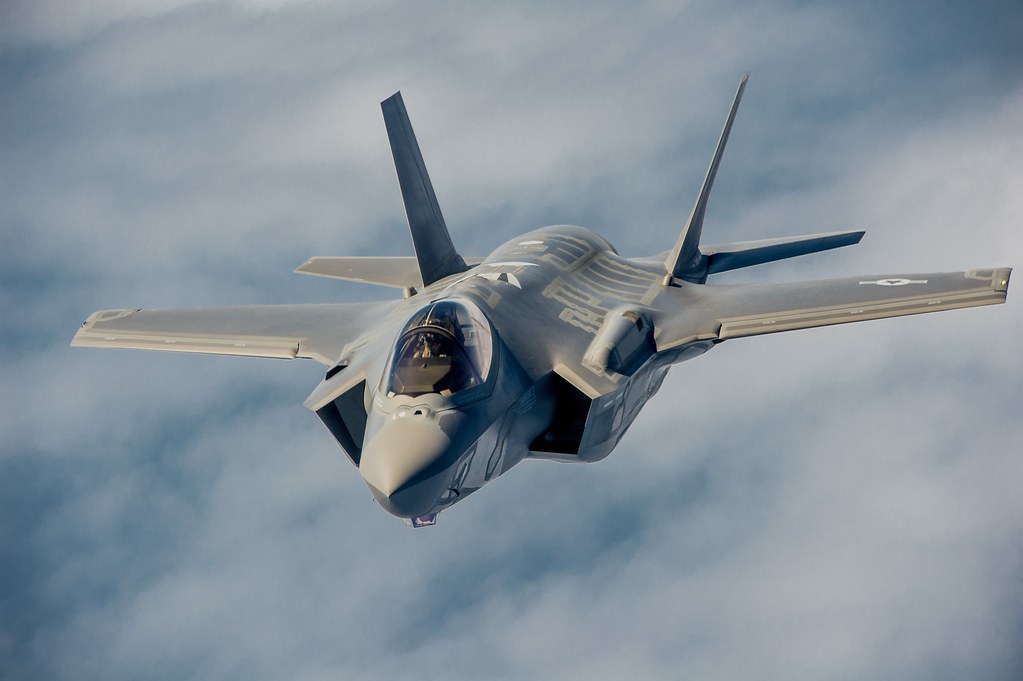
And now, in the middle of all that, Germany’s first F-35A rolled out of the paint shop in Fort Worth. It had already flown, ten days early, on September 8th, as if the ceremony were a formality the aircraft couldn’t be bothered to wait for. The jet will train in Arkansas before settling permanently at Büchel, the one German base still cleared to carry American nuclear weapons, a job the Luftwaffe’s aging Tornados have held since the 1980s and can’t hold much longer. Thirty-four more are coming behind it. This is what a Zeitenwende looks like once the speeches are over: a tail number, a paint job, and a runway in Texas.
Scholz named the turning point before almost anyone else in Europe would say it out loud. The one thing his speech from that afternoon in the Bundestag never got to answer is the only question that matters now: does Germany finish turning before 2029 gets here?
If you want to submit your articles and/or research papers, please visit the Submissions page.
To stay updated with the latest jobs, CSS news, internships, scholarships, and current affairs articles, join our Community Forum!
Find our FREE quizzes and MCQs here!
The views and opinions expressed in this article/paper are the author’s own and do not necessarily reflect the editorial position of Paradigm Shift.

Mohammad Zain is an International Relations student at NUML, Islamabad. With an associate degree in English Literature and Linguistics and a BS in International Relations, he brings a unique blend of analytical and literary skills to his writing.