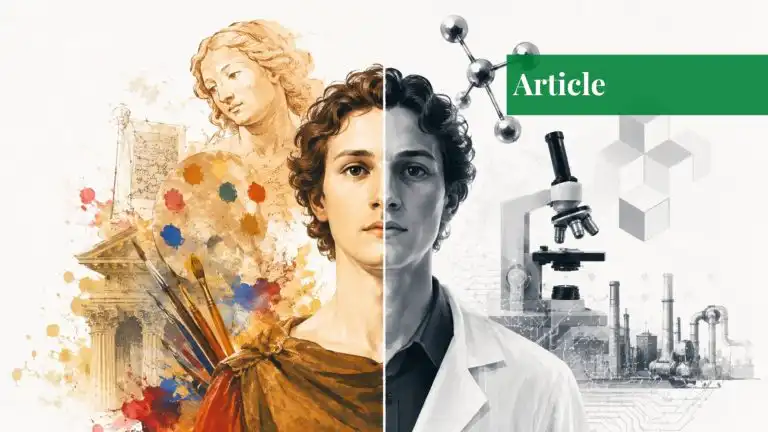
Have you read about the breadth of philosophers’ and scientists’ interests from the distant past and wondered how a person could produce such a vast and diverse body of work in a lifetime? I have. Ever since my school days, when I read about the contributions of scientists from the “Islamic Golden Age”, I was astonished to learn about the intellectual pursuits of figures like Ibn al-Haytham, Al-Khwarizmi, and Ibn e Sina. Later on, I encountered the figures from the European Renaissance, such as Leonardo Da Vinci, who was a sculptor, engineer, scientist, and mathematician. We can trace this phenomenon well into the 19th century; Thomas Young is even said to be the last man who knew everything, a physicist, physician, linguist, and physiologist.
My concern is not “How” that was possible, but what happened to the person who wanted to meaningfully comprehend and explore not just one field but many?
There is no single moment in history that marks the death or disappearance of the Renaissance man; no funeral was held, and no decree or announcement was made. It was a steady process, taking place alongside the major transformations in the ways of organizing knowledge and intellectual life in society. Major political transformations took place in great intellectual centers. The older centers of scholarship were affected by the wars and shifts in economic powers, resulting in dynamic changes in how intellectual life was sustained. Amid these changes, Europe began to build new intellectual infrastructure. The printing press increased the circulation of knowledge; universities and scientific societies organized the production; and Industrialization created the demand for new expertise and specialization. At the same time, imperial expansion enabled European institutions to accumulate knowledge from around the world and establish themselves as the centers of production and classification of knowledge.
With the expansion of scientific knowledge, the subdivision into narrow areas of specialization became increasingly necessary. It was no longer feasible for a physician to master every aspect of medicine; a chemist could spend a considerable amount of time learning about an increasingly specialized body of knowledge; an engineer had to acquire advanced technical knowledge. Specialized medical fields are one concrete example of this transformation. Therefore, specialization became not only about organizing knowledge but also a way of organizing work and professional life.
The world of specialized knowledge was organized through the modern university. With the division of knowledge into disciplines, organized through departments and increasingly specialized fields. The modern university provided the structure through which these fields were taught, researched, and reproduced. A person no longer simply studied ‘knowledge ’; entering the intellectual life meant entering the discipline, acquiring the credentials, publishing within its literature, and becoming part of the academic community with its own confines. A person trained in physics became a physicist, a person trained in history became a historian.
While it is safe to say that a modern specialist is a product of an intellectual system that has made enormous advances in human knowledge across the spectrum, and given the scale of accumulated knowledge in today’s world, one discipline may exceed the capacity of a lifetime.
Today’s intellectual system can produce extremely intelligent people whose intelligence operates within extraordinarily narrow boundaries. Their professional identity comes to dominate the individual identity, leaving them with little to no professional or institutional incentive for venturing outside their area of expertise. Take, for example, a highly trained STEM researcher; there is nothing wrong with having a little interest in literature, philosophy, and cinema. Even though their professional training does not require such engagement. Yet, it is possible to know an astonishing amount about a tiny corner of the world, be highly educated in a professional sense, and yet remain culturally and intellectually provincial.
This narrowing of intellectual life was not ineluctable, as the specialization did not require the abandonment of breadth. Even during the rapid expansion of knowledge, some people moved across intellectual domains. Neither am I arguing that those people were more knowledgeable in a particular subject than a specialist knows today. What changed is not merely the amount of knowledge available. It’s the expectations of what an educated person ought to know.
The modern specialist is expected to master a particular field and furnish the credentials to establish them as an accomplished and educated person. Anything beyond their field becomes a hobby and a matter of personal preference rather than an expected part of intellectual life. Their disciplinary boundaries become the boundaries of their curiosity.
To conclude, this was not meant to be a nostalgic plea for the return of the Renaissance man as an individual who would master all fields of knowledge. As noted earlier, it is impossible for a human being to do that, given the enormous advances in human knowledge. The disappearance of the Renaissance man should not be the disappearance of breadth. A physician engaging with sociology and history, or a physicist engaging with philosophy and art, or a sociologist reading biology and physics should be normalized, not because it would help one professionally, but because it makes them intellectually expansive. We cannot know everything, and we should not pretend that either, but the lesson of the Renaissance man is that one should remain curious beyond the boundaries of their discipline. While a specialist may be necessary for advancing knowledge, curious people are also necessary to make sense of what that knowledge means. Renaissance man may be dead, but we should not let our curiosity to learn more die.
If you want to submit your articles and/or research papers, please visit the Submissions page.
To stay updated with the latest jobs, CSS news, internships, scholarships, and current affairs articles, join our Community Forum!
The views and opinions expressed in this article/paper are the author’s own and do not necessarily reflect the editorial position of Paradigm Shift.
Muhammad Yameen is a sociology graduate from the School of Sociology, Quaid-i-Azam University, Islamabad. His academic interests centre on urban inequalities, class, gender, and anti-colonial movements.