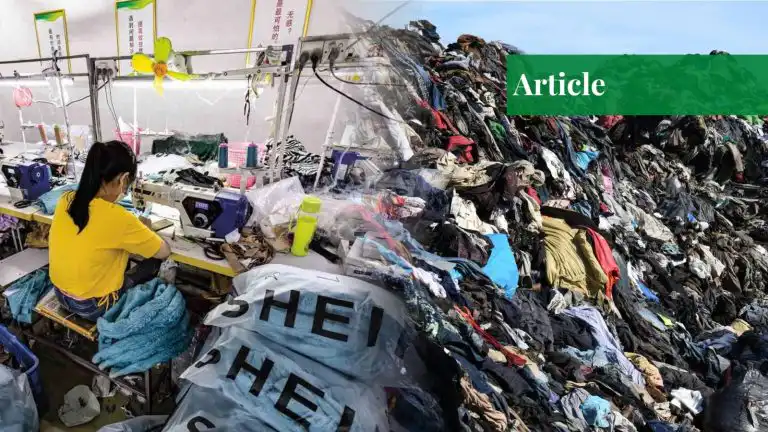
There is something strange about shopping on Shein.
You open the app looking for one shirt, and suddenly you are looking at hundreds of dresses, shoes, bags, and accessories. The prices are low enough to make you think, “Why not?” Before long, the small purchase becomes a basket full of things you never planned to buy.
That experience is not an accident.
Shein has emerged as one of the names in online style and fashion, especially amongst younger (Gen Z) shoppers. However, this model made Shein a quick success; despite Shein’s achievement, it became one of the most criticized businesses within the fashion industry.
What Makes Shein Different?
Shein is often described as a fast-fashion company, but ultra-fast fashion is probably a better description.
Shein works much closer to the customer, unlike traditional fashion companies that plan collections for months. Shein watches the algorithmic activity of what people search for, click on, and buy, then uses that information to decide what to produce.
Moreover, 12,000 clothing products from Shein, Zara, and H&M were compared, and it was found that Shein’s marketing strategy was significantly different from the other two companies. Its products were more heavily focused on current trends, and its approach to replenishment and pricing was different as well. A study of Shein’s supply chain found that its system relies on small initial orders, rapid feedback, and digital coordination with suppliers. This allows products to be tested before the company commits to producing them on a much larger scale.
That is the clever part. Shein does not have to guess what shoppers will like months from now. It can test an idea and let shoppers provide the answer.
Why Are the Prices So Low?
This is where Shein’s business model becomes difficult to separate from its controversies.
Just because products are lower in price is a great benefit for those, especially students, young workers, and families whose budgets matter and who are unable to afford expensive and trendy dresses but can still be part of trending fashion.
Clothing would not come to be superbly reasonably priced simply because a corporation works nicely. Someone still has to lay it out, make it, pass it from one location to another, promote it, and then handle it when the customer is carried out with it. All of that takes time, effort, and money. You cannot ignore the steps, even supposing a company runs matters easily.
Shein’s supply chain is built around thousands of small, flexible production orders and rapid switching between products. A 2025 manufacturing study described how fast-fashion platforms such as Shein coordinate large numbers of nearby garment factories to handle many small batches and quickly changing orders.
The system is impressive from a business perspective.
The uncomfortable question is what it encourages on the consumer side.
When a shirt costs only a few dollars, throwing it away can feel less serious than throwing away an expensive garment.
The Environmental Cost
This is one reason Shein has become a symbol of the environmental criticism surrounding fast fashion.
The problem is not simply whether one piece of clothing is made from polyester or whether one package travels by plane. It is the scale of the entire system.
The easier clothing becomes to buy, the more clothing people can end up buying.
The easier it is to buy clothing, the more clothing people will buy. I see that Shein reported that Shein’s transport-related emissions grew by 13.7% in 2024, reaching eight point five two million tonnes of CO₂ equivalent. I notice that Shein’s environmental record has drawn scrutiny because governments are beginning to treat fast fashion as more than a trend for consumers.
France introduced a tax on fast-fashion products in September 2026, aiming specifically at the environmental damage that cheap, high-volume clothing causes. This does not mean that Shein alone is responsible for all the problems of fashion.
But Shein has pushed the model to a scale and speed that make the problem harder to ignore.
Who Makes the Clothes?
The other major criticism concerns labor.
Shein relies on a network of suppliers, which makes it hard to keep track of working conditions across the whole supply chain. The company has been asked many times about long working hours, low pay, and poor factory conditions. In 2025, Shein admitted that its own supplier audits determined two instances of child labor in 2024 and additionally said the providers involved have been cut off and that it had made its auditing process stronger.
Shein also says it’s miles ahead in taking steps to improve situations. Its sustainability reporting describes lots of provider audits and efforts to monitor factories.
Both statistics can be true at the same time.
An organisation can conduct thousands of audits and nonetheless discover severe violations, and finding violations does not mean every factory in its supply chain is abusive.
The bigger question is whether extremely low prices and extremely fast production create constant pressure on suppliers and workers.
That is not a question. Shein can answer simply by adding more audits.
Shein Is Now More Than a Fashion Problem
What is particularly interesting about Shein’s story is that criticism has moved beyond environmental groups and labor activists.
Governments and regulators are increasingly inquisitive about the enterprise.
In February 2026, the European Commission opened formal court cases against Shein under the Digital Services Act. The investigation includes the platform’s potentially addictive design, transparency around recommendation systems, and the sale of illegal products.
European consumer authorities had already raised concerns in 2025 about practices including alleged fake discounts, pressure-selling techniques, and problems with information about returns and refunds.
That tells us something important. Shein is no longer simply a clothing company. It is also a digital platform that decides what millions of shoppers see, how products are recommended, and how quickly people move from browsing to buying.
Did Shein Create the Problem?
It would be easy to turn this into a story about one company doing everything wrong.
But that would miss the more interesting point. Shein did not invent our appetite for cheap clothes.
Consumers wanted affordable fashion. Social media made trends move faster. Smartphones made shopping easier. Online platforms made it possible to sell directly to people around the world.
Shein put all of those things together. In that sense, Shein is not just changing fashion. It is showing us what happens when technology is used to remove almost every barrier between wanting something and buying it.
The clothes can be cheap because the system is fast. The system can be fast because it is heavily data-driven, and the cycle keeps going because there is always another trend waiting on the screen.
What Happens Next?
Shein’s latest Hong Kong stock-market debut has arrived at a difficult moment. The corporation raised approximately $1.74 billion; however, its valuation was some distance below the more or less $100 billion stage it reached in 2022. Investors at the moment are looking at how the organization responds to tariffs, law, competition, and slowing growth.
Shein is likewise seeking to amplify past promotions of its personal clothing. Its developing market business and latest moves toward acquiring hooked-up brands suggest that the organization desires to become something larger than an ultra-rapid-style store.
Whether that works stays to be seen.
But perhaps the most useful question is not whether Shein is good or bad.
It is this:
How cheap can fashion become before someone else has to pay the difference?
The customer sees a $5 shirt.
The full price may include the worker who made it, the resources used to produce it, the emissions created while moving it around the world, and the waste left behind when it is no longer wanted.
Shein did not invent that hidden price.
It simply made it much harder for us not to notice.
Find our FREE quizzes and MCQs here!
If you want to submit your articles and/or research papers, please visit the Submissions page.
To stay updated with the latest jobs, CSS news, internships, scholarships, and current affairs articles, join our Community Forum!
The views and opinions expressed in this article/paper are the author’s own and do not necessarily reflect the editorial position of Paradigm Shift.
Hooria Akbar is an independent researcher and content writer with a strong interest in contemporary issues across AI, technology, society, and emerging trends. She writes research-informed articles, thought pieces, and blogs on a wide range of topics, aiming to present complex ideas clearly and engagingly for diverse audiences.